



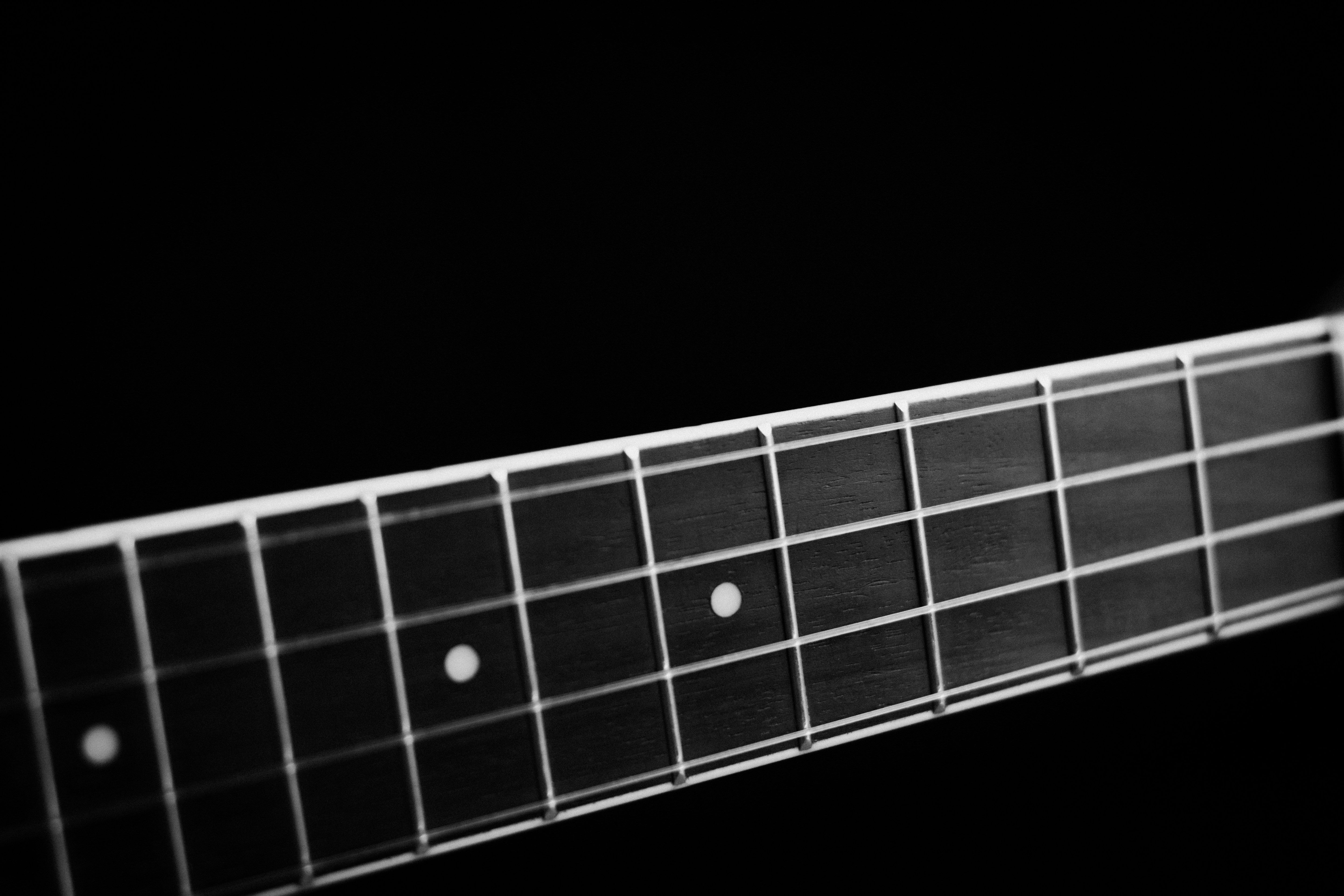
Your tuner is lying to you, politely
Try this on whatever's closest to hand. Tune the guitar until an open E major rings dead-on against a good tuner — every string, green light, the works. Now play an open C major without touching a peg. Listen to the G. It sits flat against the chord. Now an open A, then a D. Some chords sparkle, some sound faintly sour, and you didn't change a thing.
Nothing is broken. The setup isn't off. You are hearing the instrument do exactly what it was designed to do, which is be slightly out of tune in every key at once.
This is the part the forums never quite say out loud. "In tune" is not a state your guitar can occupy. It's a target it negotiates toward and misses on purpose. The only honest question is which compromise you've chosen — and most players have never been told they were choosing one.
Twelve ways to be slightly wrong
Equal temperament divides the octave into twelve identical steps, each one the twelfth root of two. That single design choice has a consequence nobody advertises: the octave is the only interval on your fretboard that is mathematically pure. Everything else is a rounding error you've agreed to live with.
The numbers aren't an opinion, they're arithmetic. A pure major third is the ratio 5:4, which works out to 386.3 cents. The equal-tempered major third is 400 cents flat. So every major third you play — every one — is about 14 cents sharp of pure, forever, by design. The minor third runs the other way, roughly 16 cents flat of its pure 6:5 ratio. The fifth gets off easy at about 2 cents flat, which is why power chords sound clean and big open chords sometimes don't.
That's the whole trick. Equal temperament spreads the error evenly so that no key is unusable and no key is perfect. It's a truce, not a triumph. You traded purity in any single key for being equally, tolerably wrong in all of them.
We used to be able to fix this
Here's the history that reframes the whole conversation, including the squiggly-fret guitars people post as if they're from the future.
Fretted instruments did not always have their temperament welded in place. Lutes, viols and vihuelas were fretted with loops of gut tied around the neck, and those frets moved. A player could nudge them to favor the key of the piece, and the scholarship says many of the best ones did exactly that. Mark Lindley's Lutes, Viols and Temperaments (Cambridge University Press, 1984) and David Dolata's Meantone Temperaments on Lutes and Viols (Indiana University Press, 2016) lay out the organological evidence that Renaissance and Baroque players routinely tuned in some flavor of meantone rather than equal temperament. When Vincenzo Galilei argued for equal temperament in 1584, he bothered to insult the players who used tastini — little extra frets — to chase meantone semitones. You don't insult a practice nobody follows.
I have to be careful here, because honesty is the point. The everyday reason for movable frets was often more mundane than temperament theory. As one maker's survey of the period sources points out, gut strings are inconsistent down their length, and a shiftable fret let you compensate for a bad string as much as a temperament. And there's a hard mechanical limit: a single straight fret crosses all the strings, so sliding it fixes one string's note and bends five others. You could choose a temperament. You could not perfect every string independently.
Fixed metal frets, when they arrived, traded that adjustability for stability and speed of manufacture. The guitar got reliable and repeatable. It also got locked into one temperament and lost the ability to be re-tempered by hand. The modern fretboard isn't the natural state of things. It's a standardization decision that hardened into "the way guitars are."
It beats. You just blamed the wrong thing
So why can you hear a 14-cent error if it's so small? Because of how the ear handles two notes at once.
Played one after another, 14 cents is near the edge of what a listener flags as a wrong pitch. A peer-reviewed synthesis by Frieder Stolzenburg (2015) puts the just-noticeable pitch difference at roughly 1% across the range that matters musically, crediting the classic psychoacoustic measurements of Zwicker and of Roederer. One percent is about 17 cents. So as a melody step, a tempered third skates just under the threshold of "that's wrong."
But a chord doesn't play its notes one after another. It stacks them. When the sharp third sounds against the root, the two tones beat — a slow throb of rising and falling loudness as their overtones drift in and out of phase. That beating is audible far below the threshold for spotting a lone pitch, and it's exactly the restless shimmer you hear in a tempered major chord. You always heard it. You just called the guitar "a little off" instead of "tempered."
Set it right and it'll be in tune (it won't)
The myth, stated as fairly as I can: if the intonation is set correctly, the guitar plays in tune. Its premium cousin: this compensated nut / these curved frets make it perfectly in tune.
Both sentences quietly assume "in tune" is a destination. It isn't. A perfect setup removes the errors the instrument adds. It cannot remove the error the temperament bakes in, because that error is the temperament. No saddle, nut, or fret on a twelve-note-per-octave guitar will ever flatten that 14-cent third back to pure, because flattening it would un-tune every other chord that uses the same note.
The string is stiffer than your opinion
Now the errors a good setup can fix — the ones the instrument piles on top of the temperament. There are three, and they're all mechanical.
First, inharmonicity. A textbook string is infinitely flexible and its overtones line up as exact multiples of the fundamental. A real string has bending stiffness, so its overtones run progressively sharp of a true harmonic series, and the instrument reads a slightly sharp pitch. Arthur Paté, in his doctoral thesis on solid-body electric guitar lutherie, gives the inharmonicity coefficient as β = EIπ²/(TL²), and because the bending stiffness term scales with the fourth power of the string's radius, the thickest plain string is the worst offender by a wide margin. His worked example puts the plain third string — the G — at the highest coefficient on the instrument.
This is the real verdict on the most slandered string in music. The plain G isn't a defect or a cost-cutting choice. It's simply the thickest string with no winding, which makes it the stiffest, which makes it the most inharmonic. A 2015 doctoral thesis on guitar acoustics (Perry) makes the flip side explicit: a wound string carries its mass in a winding while keeping a thin, flexible core, so it stays far closer to harmonic. Swap to a wound G and the problem largely evaporates — not because the new string is "better," but because you removed the stiffness. The G string did nothing wrong. Physics did.
Second, fretting sharpens. Pressing a string down to the fret stretches it, and stretching raises tension, and higher tension raises pitch. The effect is worst near the nut, where the geometry is harshest, which is why your first-position chords are the ones that fight you. Earvana, one of the compensation companies, names the two components plainly in its own technical copy : the stretch from the string reaching the fret, and the extra stretch from your finger pressing down behind it.
Third, the nut. The open string is your reference, but the act of fretting near it sharpens those first few notes disproportionately. That's the entire reason compensated nuts exist. A compensated saddle, meanwhile, lengthens the string's speaking length just enough to pull the sharpened fretted notes back down. None of this is exotic. It's what "intonating a guitar" has always meant.
Read the small print — it's more honest than the headline
Which brings us to the systems sold to "fix" intonation. There are three serious ones, and the striking thing is that their own engineering pages are more honest than their marketing.
Start with the most candid one. The Earvana compensated nut, on the market since 1998, extends the string's break point at the nut to flatten the notes from there to the twelfth fret, while the saddle moves to sharpen the back half — squeezing the instrument's added error out of both ends. But the creator's own technical page concedes the point in plain language: the nut is built around equal temperament, which he says you simply have to accept because the guitar is a fixed-pitch instrument, and the result is a guitar that works accurately as an equal-tempered instrument — not a pure-intonation one. He even spells out the ceiling himself. Approximating pure chords in every chord shape, he writes, would take something like three dozen frets per octave; equal temperament is the bargain that buys it back down to twelve.
The Buzz Feiten Tuning System, patented by guitarist Buzz Feiten in 1992 and once factory-fitted by Washburn and Suhr, pairs a "shelf nut" — moved closer to the first fret by a patented amount to kill the first-three-fret sharpness — with a set of proprietary bridge offsets. The offsets are secret, so I won't put numbers to them. The published mechanism, though, targets exactly the fretting-and-nut errors above. It's a tempered tuning formula, in their own words, not an escape from temperament.
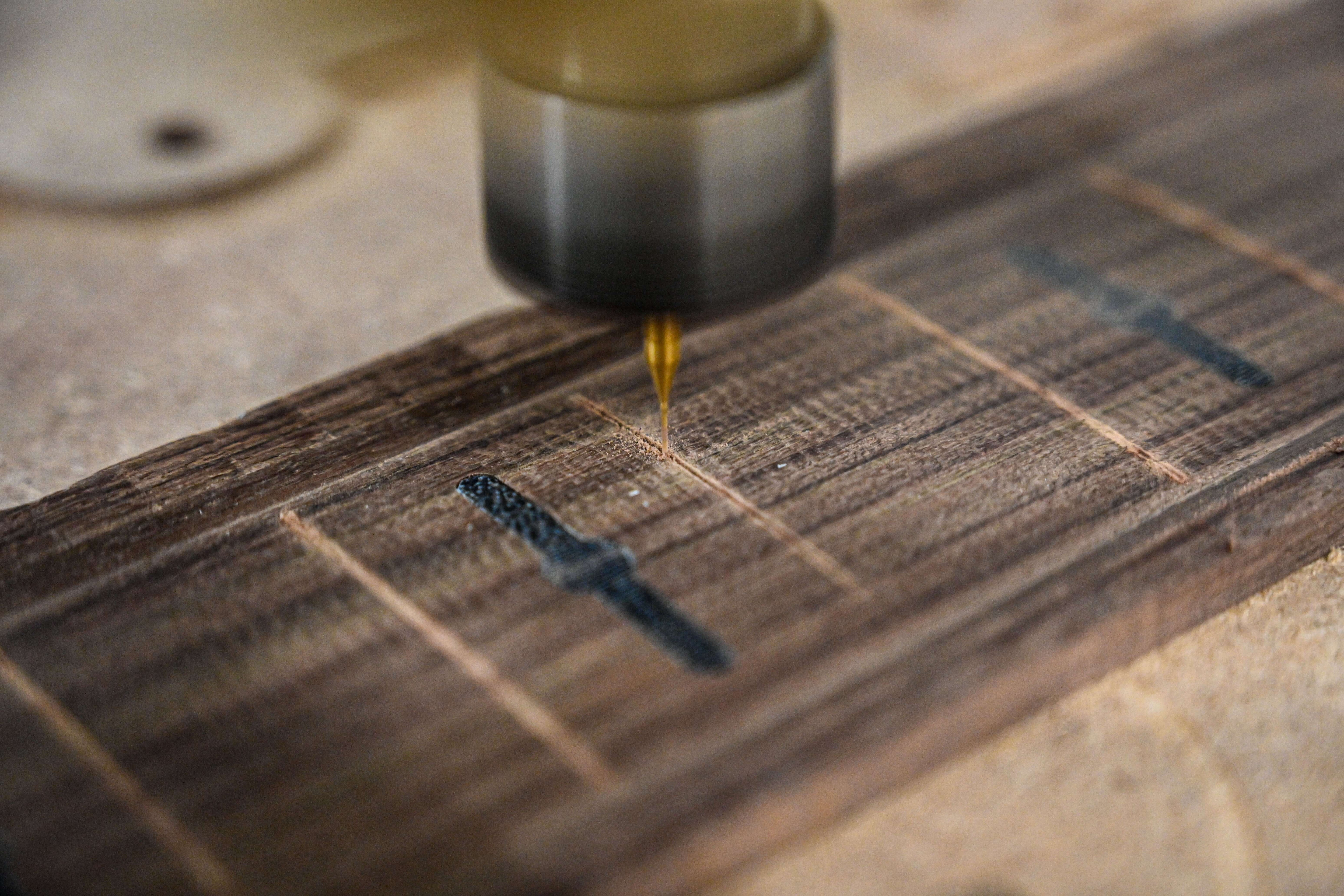
Then the spectacular one. True Temperament's curved "Curved Frets," developed by Anders Thidell with luthier Paul Guy from 2005, do per-string what a straight fret never could — they wander across the neck so each string's note is corrected individually. That's a genuine advance, and it's the modern answer to the lute's old straight-fret limitation. But the system implements a fixed scheme called the Thidell Formula One, and their own FAQ is blunt about what it is: "all tuning offsets start from zero cent in equal temperament," and they're small enough not to clash with ordinary instruments. The squiggly frets aren't pure intonation either. They're a refined, fixed temperament with the instrument's mechanical errors engineered out.
Every one of them, in its own technical voice, says the same thing: we fix the instrument, not the math. The word "perfect" lives on the headline. It does not survive the FAQ.
Three guitars that weren't broken
A near-new instrument comes in because the owner is convinced the factory shipped a lemon — open chords sound "wrong" no matter how carefully he tunes. The frets are level, the nut is fine, the intonation is dead on at the twelfth. The guitar is working perfectly. What he's hearing is a tempered third beating against a root, and no adjustment in the building will remove it, because removing it would break a different chord.
A player brings in a guitar that "won't stay in tune," strobes perfectly on the bench, and goes sharp the moment he plays it. He has a heavy hand. Finger pressure, fretting angle, and an unconscious push behind the fret move his pitch more than any saddle adjustment ever will. The variable that's out of tune is the player, and there's no nut on earth that compensates for grip.
A guitar comes through that simply refuses to intonate at the saddle — close at one fret, off at the next. The strings are months old. Corrosion and fret divots have wrecked their mass distribution, and an uneven string has uneven inharmonicity that no fixed saddle position can track. Fresh strings, problem gone. Half of all "intonation problems" are a string change wearing a disguise.
Why the green light wins
The myth is sticky for a reason that has nothing to do with physics. A clip-on tuner shows a green light when one note matches one reference inside equal temperament. The light says "in tune," so the player believes the instrument has reached a state called in-tune — and then is baffled when chords don't agree. The tool measures the one thing it can and the brain generalizes it to a promise the tool never made.
Expectation does the rest. A player who paid for a compensated nut hears cleaner chords partly because the nut works and partly because he is now listening for clean chords. Perception leans toward what you expect to hear. The engineering is real; so is the halo around it, and the two are very hard to separate by ear alone.
The study nobody's run
What's genuinely unsettled is the human side. The temperament math is exact and the inharmonicity is measurable, but how much a given listener tolerates a tempered third in a real chord voicing — versus in an isolated dyad, on a guitar specifically, across players and genres — is not something I can point to a clean controlled study for. The number that gets quoted is the just-noticeable difference for single tones, which isn't the same question as "does this chord sound sour to this listener." The study I'd want isolates real guitar chord voicings, controls for the player's hand, and measures detection and preference directly. As far as I can find, it doesn't exist in that form.
There's a tidier-sounding claim I'll flag rather than make: that Bach's Well-Tempered Clavier proves equal temperament was standard by the 1720s. Musicologists still argue about it, and "well-tempered" most likely meant a well temperament — every key usable, each with its own color — not equal temperament. I'm not going to settle a live dispute to win a guitar argument.
Where the other side is right
The compensation systems are not snake oil, and I won't pretend they are. They measurably reduce the errors the instrument adds. A correctly fitted compensated nut really does clean up first-position open chords. True Temperament's curved frets really do correct each string in a way a straight fret physically cannot. For a player who lives in open chords, or who records where every beat between overtones gets captured and magnified, the improvement is audible and worth paying for. A properly cut nut, accurate per-string saddle compensation, fresh strings, and correct relief make a real, repeatable difference — that's most of what a good setup is, and it's most of what I do at the bench.
All of that is true. And all of it fixes the instrument. None of it fixes the math. The systems take you from "the temperament plus the guitar's mechanical errors" down to "just the temperament," which is the best a fixed-fret instrument can do — and which is still, by design, slightly out of tune in every key.
What to actually do
Tune for the music. If you play in open position, tune so the chords you actually use sound right and let the ones you don't drift. If you play across the neck, split the difference at the bridge and stop chasing a green light that was only ever measuring one note. Put fresh strings on before you blame the saddle. Use a wound G if the plain one's inharmonicity bothers you, because that's physics you can buy your way out of.
And if you want the compensated nut or the curved frets, buy them for what they are: real engineering that removes the errors your guitar adds, sold under one word it can't quite deliver. They give you a better compromise. They don't give you perfection, because perfection on twelve fixed frets was never on the table. In-tune isn't a setting. It's a verb.

シェア:
IRYW : Electric Guitars Are Acoustic Instruments