




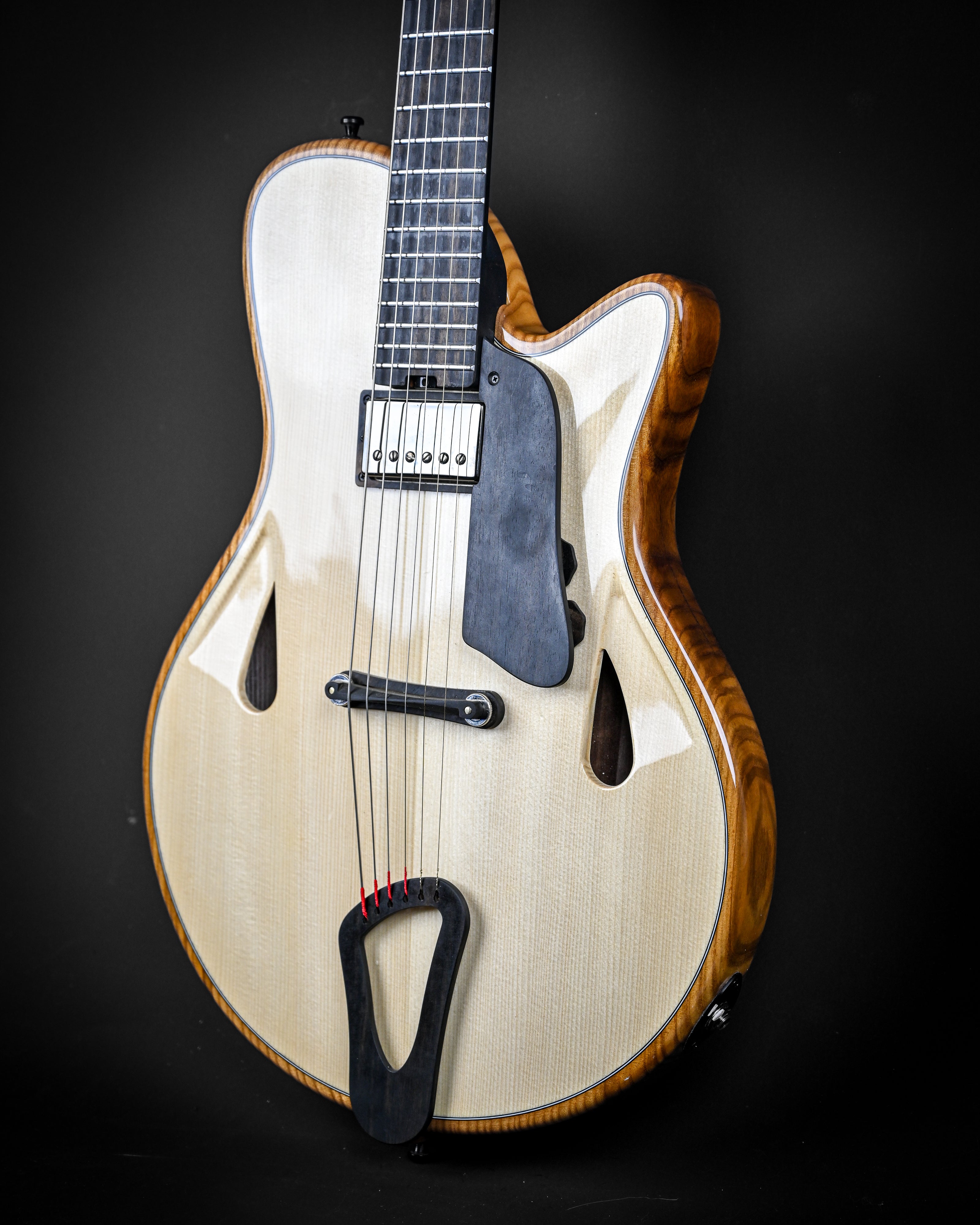

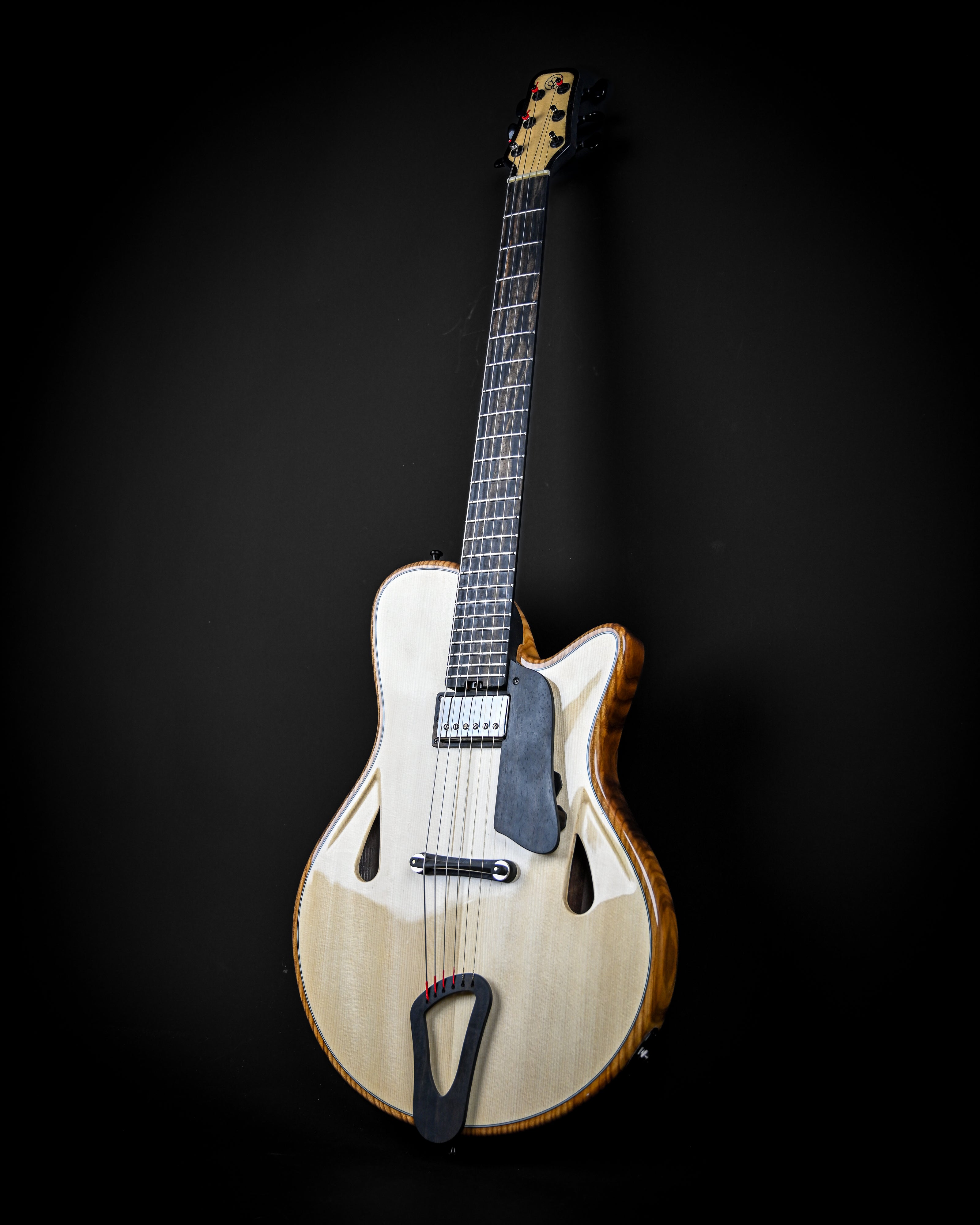
Aeri is technically an archtop. It looks like one, it behaves like one acoustically, and it carries the lineage of one. But it is not a reissue of an archtop tradition, and it was not designed to be one.
The instrument sits at the intersection of three established voices — the resonance and projection of an archtop, the percussive attack and rhythmic drive of a gypsy jazz guitar, and the focused electric clarity of a thinline. It is not the sum of those three. It is a fourth thing, built with the lessons of all of them.
That positioning shapes specific design choices — and one of them deserves to be addressed directly.
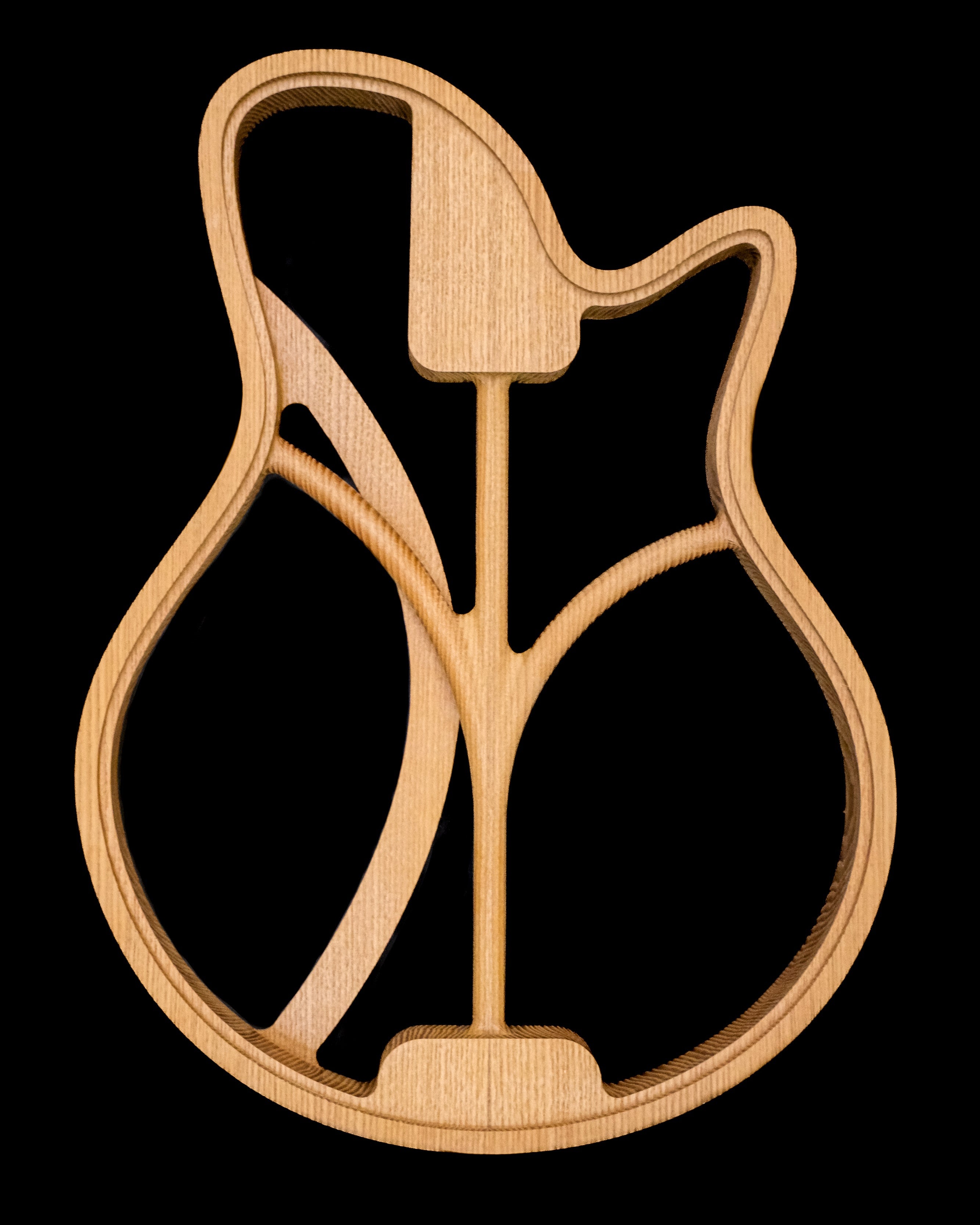
The core of the Aeri is a sculpted internal chassis, machined as a single continuous structure from neck block to tail block. It replaces the traditional combination of kerfed linings, glued blocks and tonebars with one unified load-bearing spine — carved to deliver stiffness exactly where the instrument needs it, and removed everywhere it doesn't.
The result is an archtop that holds its geometry under string tension over decades, resists seasonal movement, and routes energy through the top with a clarity that bonded internal components cannot match. Every Aeri shares the same internal structure, machined to the same tolerances, instrument after instrument.
Both Aeri and Aeri HL are built around this chassis.
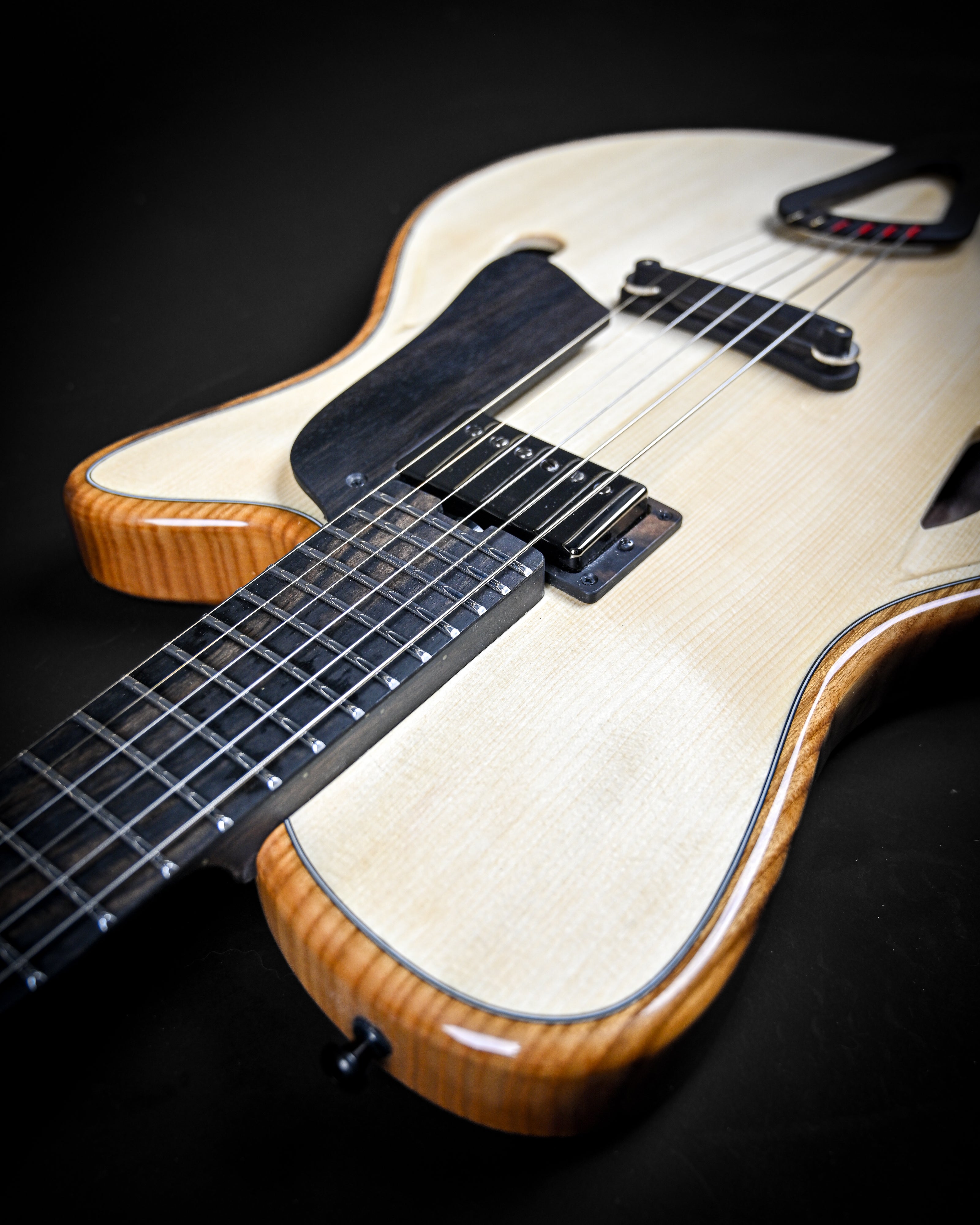
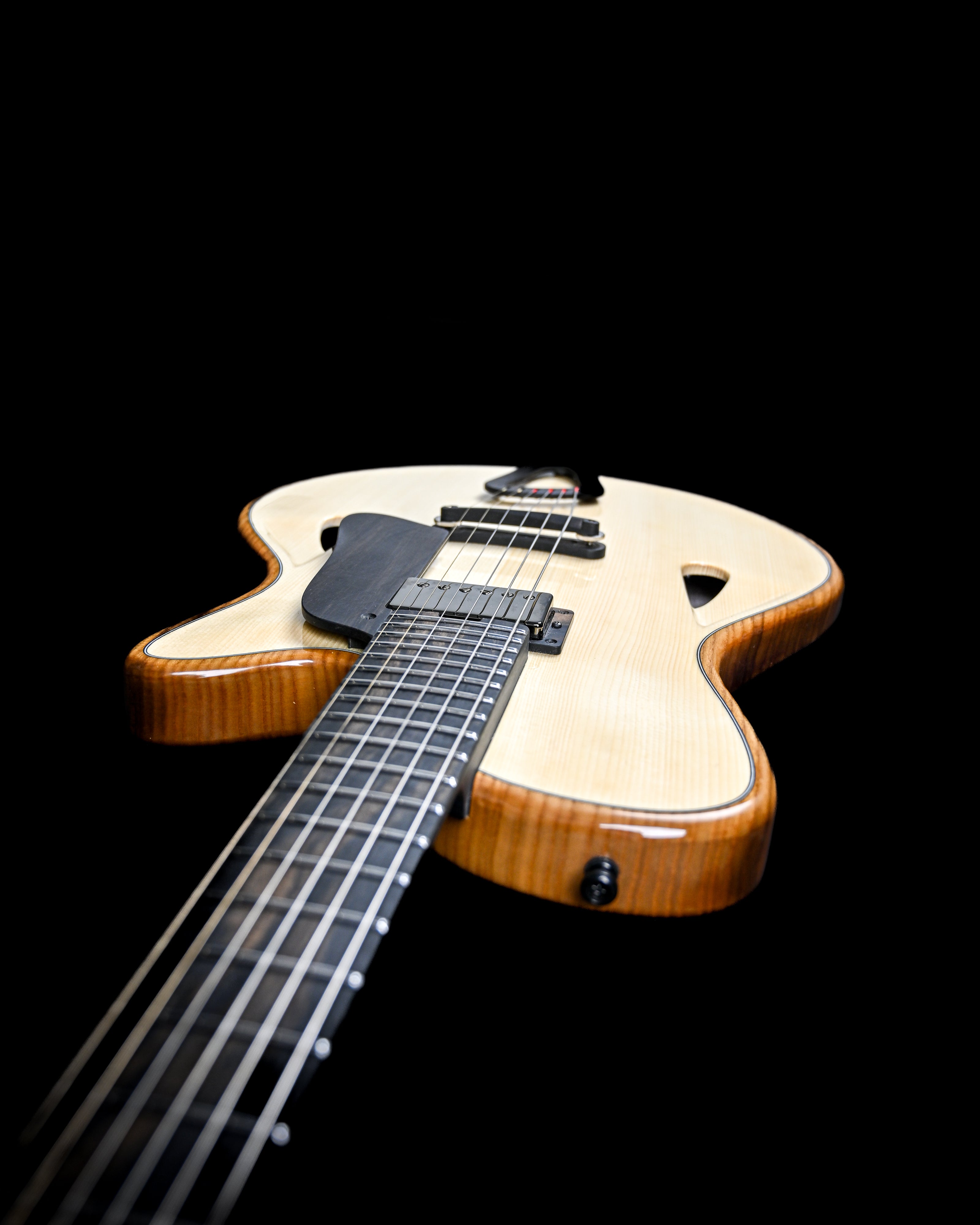
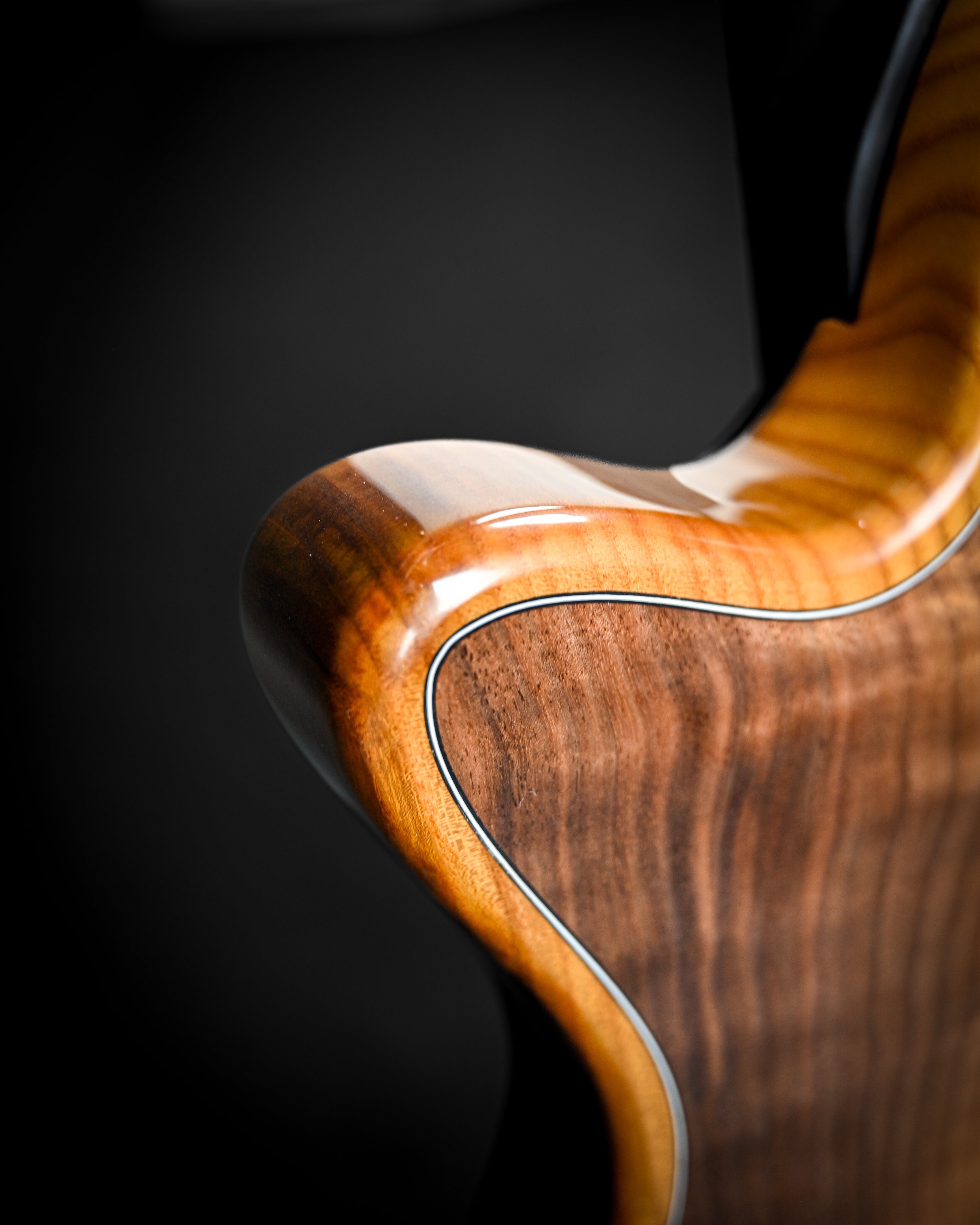
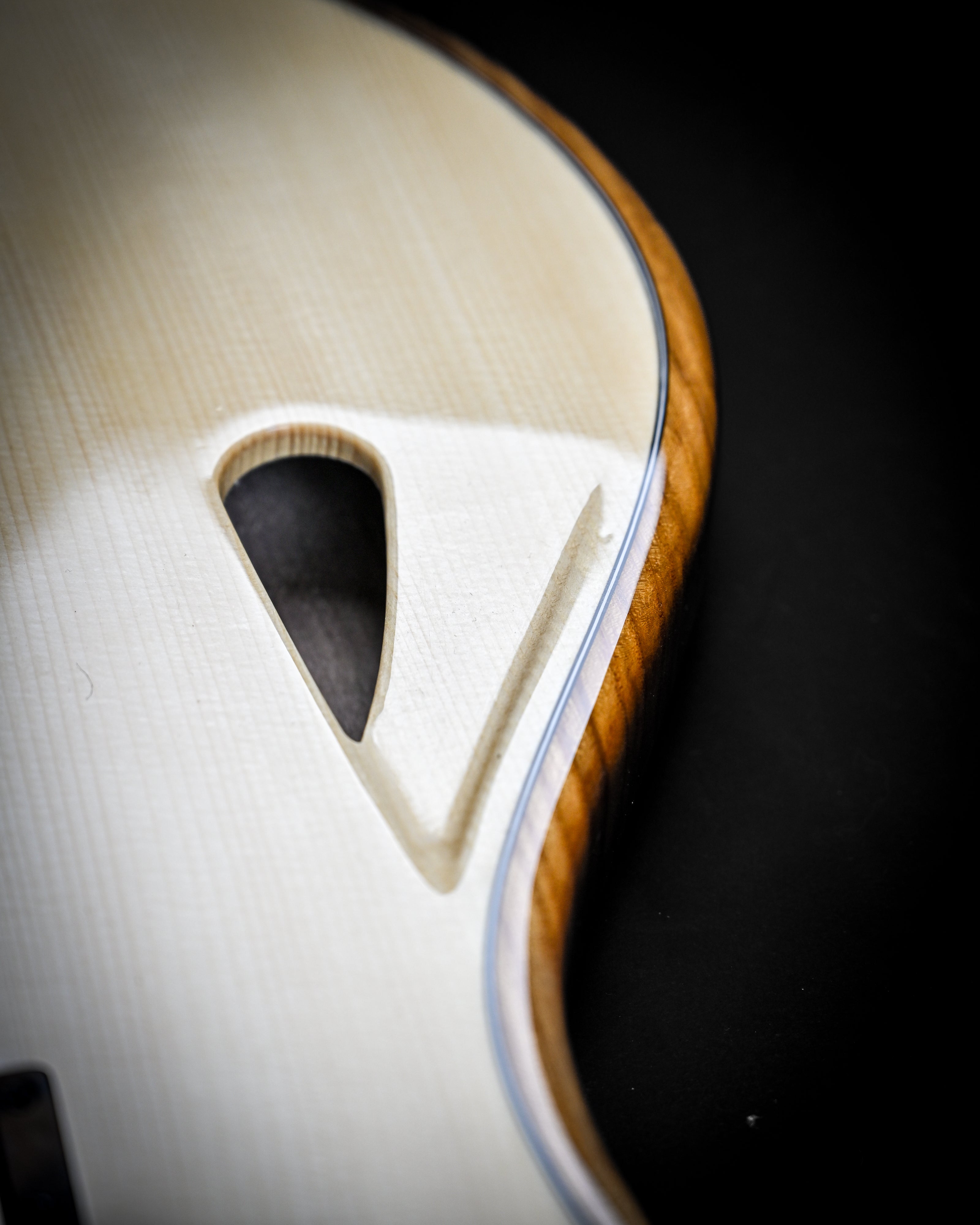
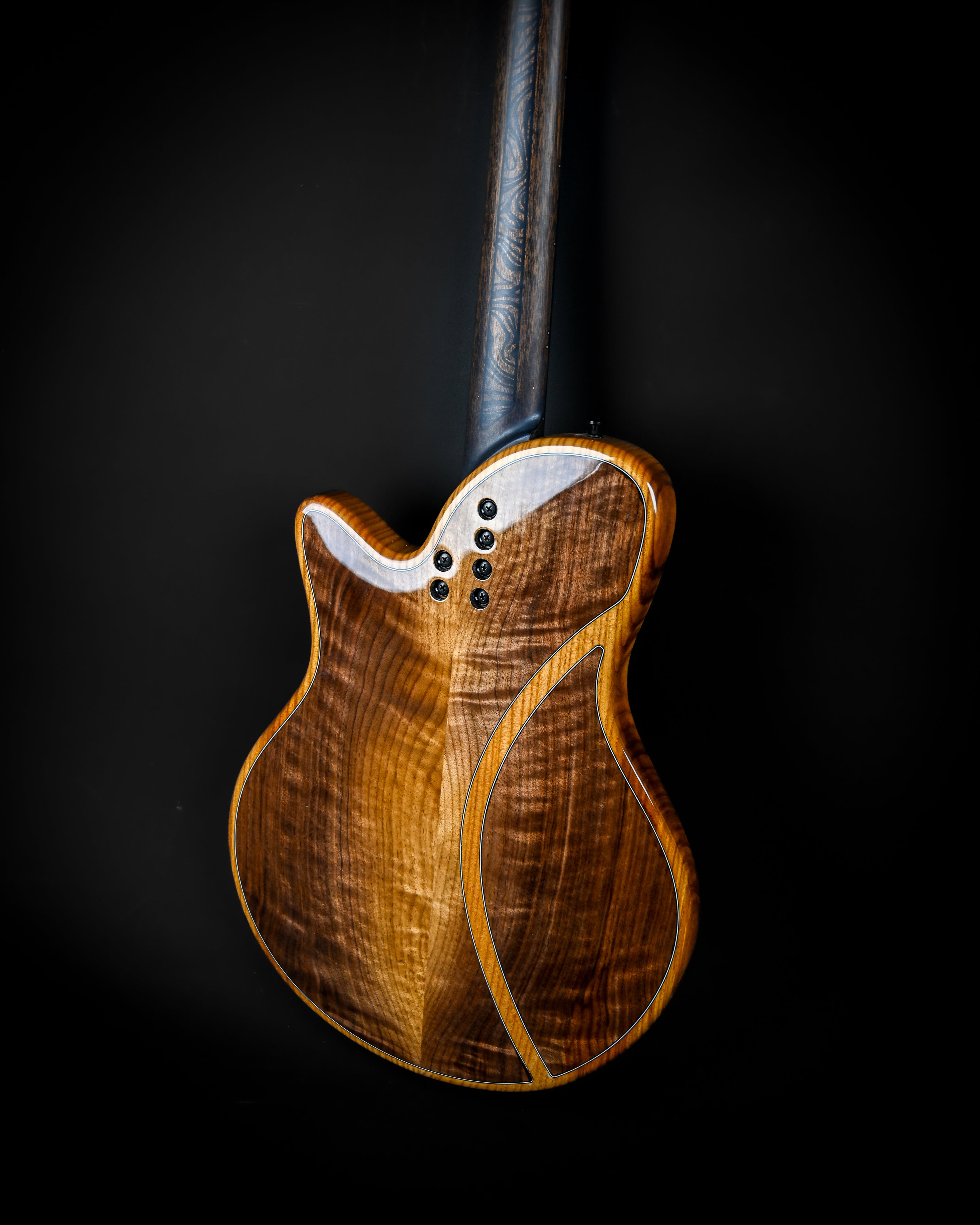
The top, back and bellycut are inlayed flush into the body sides — no binding channels, no protruding edges. The transition between top, side and back is a single continuous, rounded surface.
Two consequences: a cleaner visual line, with the figure of the top reading uninterrupted to the edge of the instrument, and a far more comfortable instrument against the body and forearm. Traditional archtop binding is replaced by precision joinery and a fully rounded perimeter.

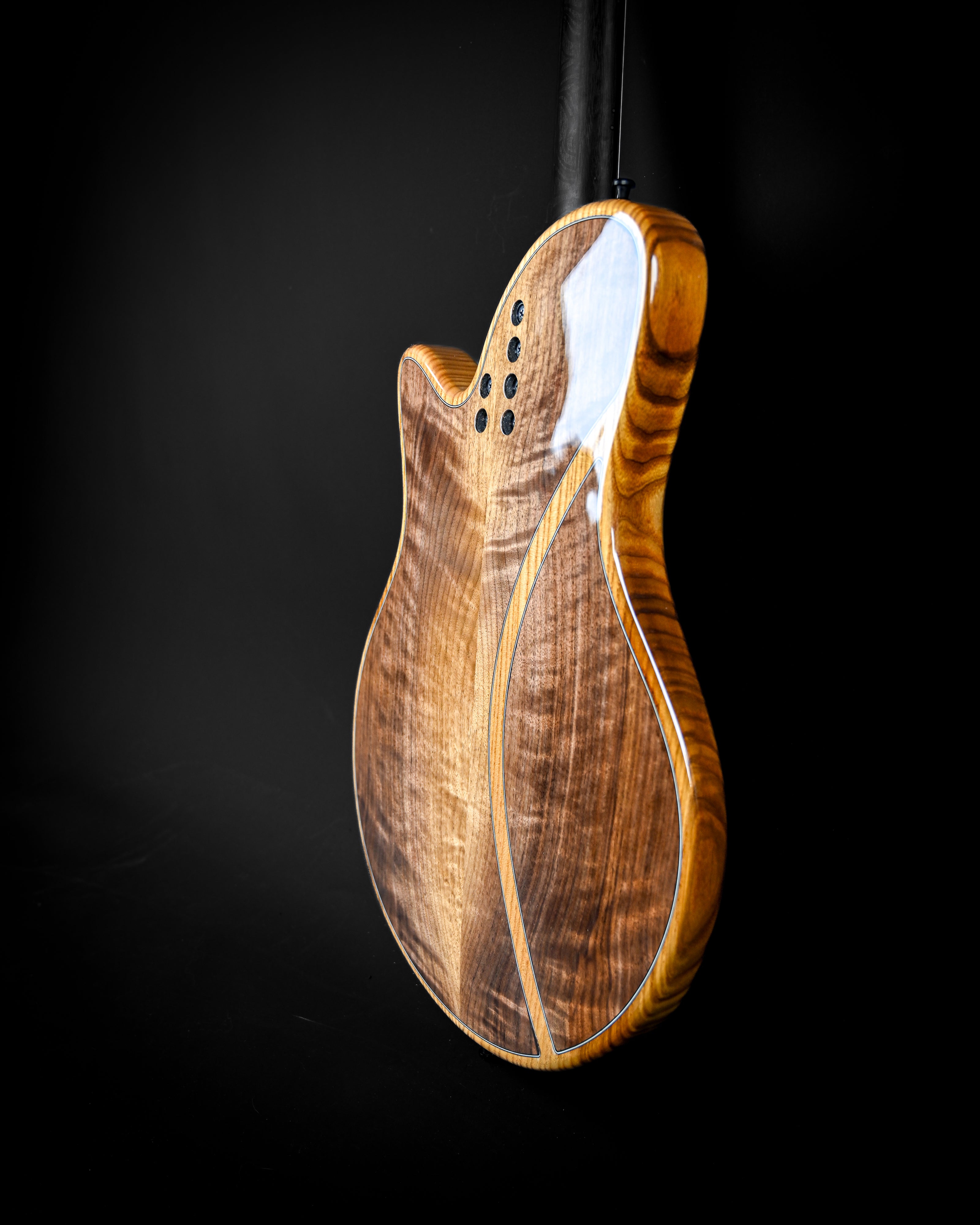
The Aeri introduces a belly cut to the archtop format — a contoured relief on the back where the instrument meets the player's torso. Combined with the rounded perimeter and a forearm bevel on the upper bout, it transforms the playing position of an instrument that has historically offered none.
An archtop you can play sitting, standing, or for an entire session without the body fighting you.
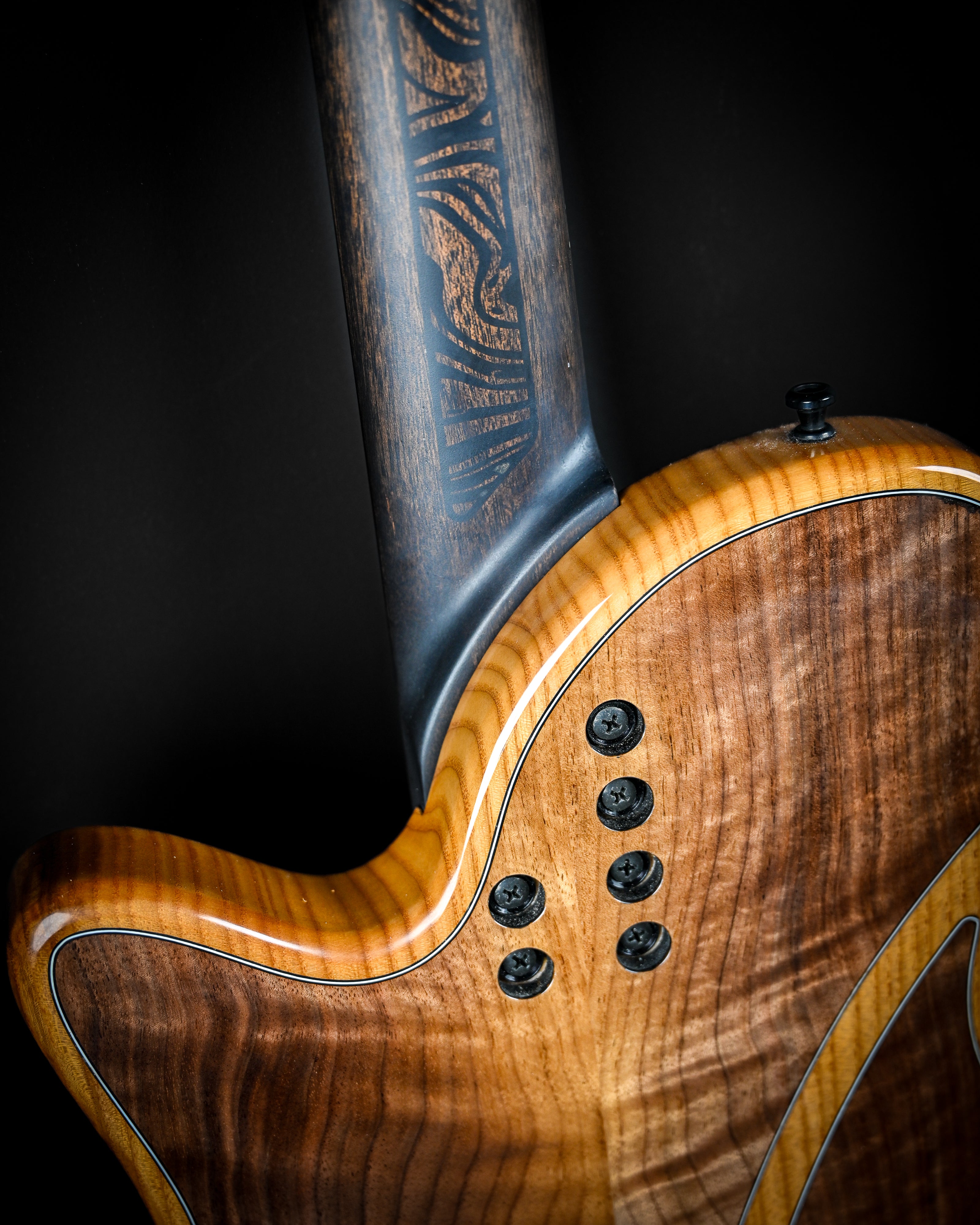
Aeri retains Belforti's signature no-heel architecture: a bolt-on neck joint engineered to disappear under the hand, with full unobstructed access to the upper frets. The bolt-on configuration means the neck is fully serviceable — removable, reshimmable, replaceable — without the irreversible procedures a set or glued neck would require on an instrument of this caliber.
A modern archtop should be a working instrument, not a fragile object. Aeri is built to be played hard and serviced cleanly.
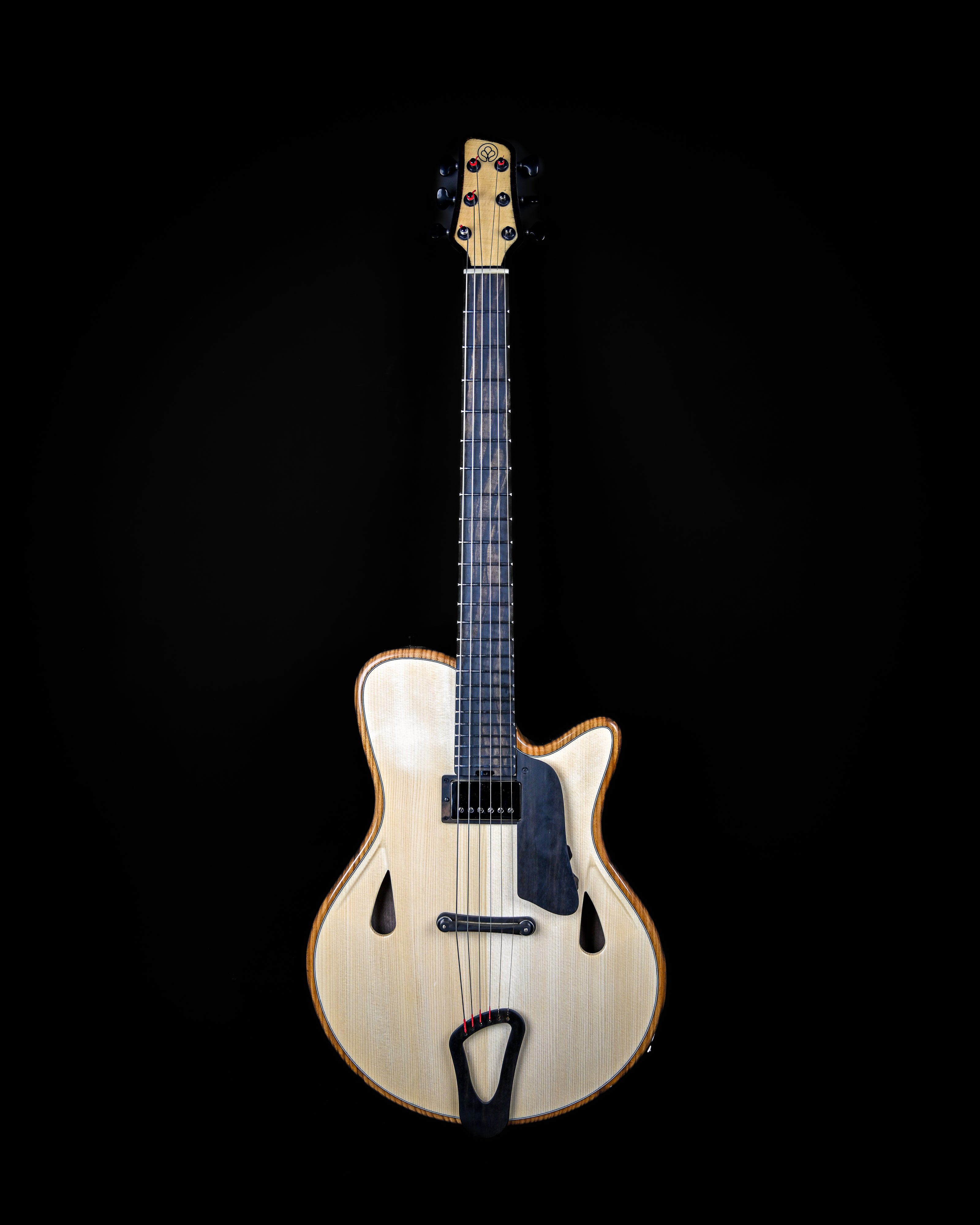
Aeri
The traditional archtop expression of the Aeri concept. Full headstock, straight frets, conventional scale length. Twenty-four stainless steel frets, dual carbon fiber neck reinforcement, headstock-access truss rod.
For the player who wants the silhouette, balance and visual identity of an archtop — built on a modern chassis, with modern ergonomics, and serviceable for a working musician's lifetime.
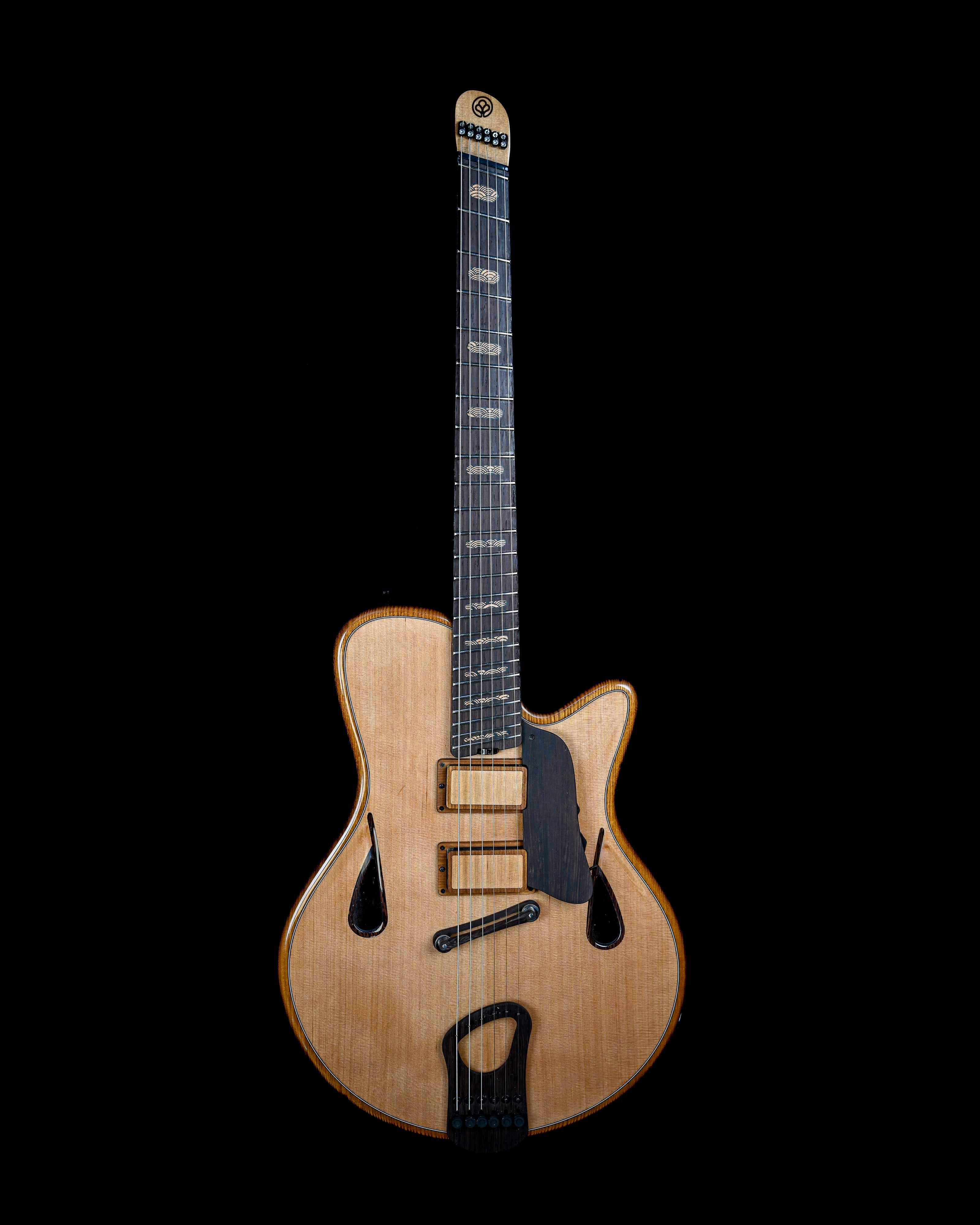
Aeri HL
The headless, multi-scale variant. Fanned frets across a custom scale range, headless tuning hardware at the bridge, and an ergonomic neck profile shaped for extended playing in any position.
The headless format removes the mass and the leverage of a traditional headstock — the instrument balances differently against the body, sits lighter on a strap, and tunes from the bridge end. Multi-scale fretting matches scale length to string range, tightening the low end and easing tension on the treble strings.
For the player who treats the archtop as a forward-looking instrument, not a heritage object.
Both configurations share the same chassis, the same inlayed top and back, the same belly cut and rounded perimeter, the same no-heel bolt-on architecture, and the same 24 stainless steel frets.
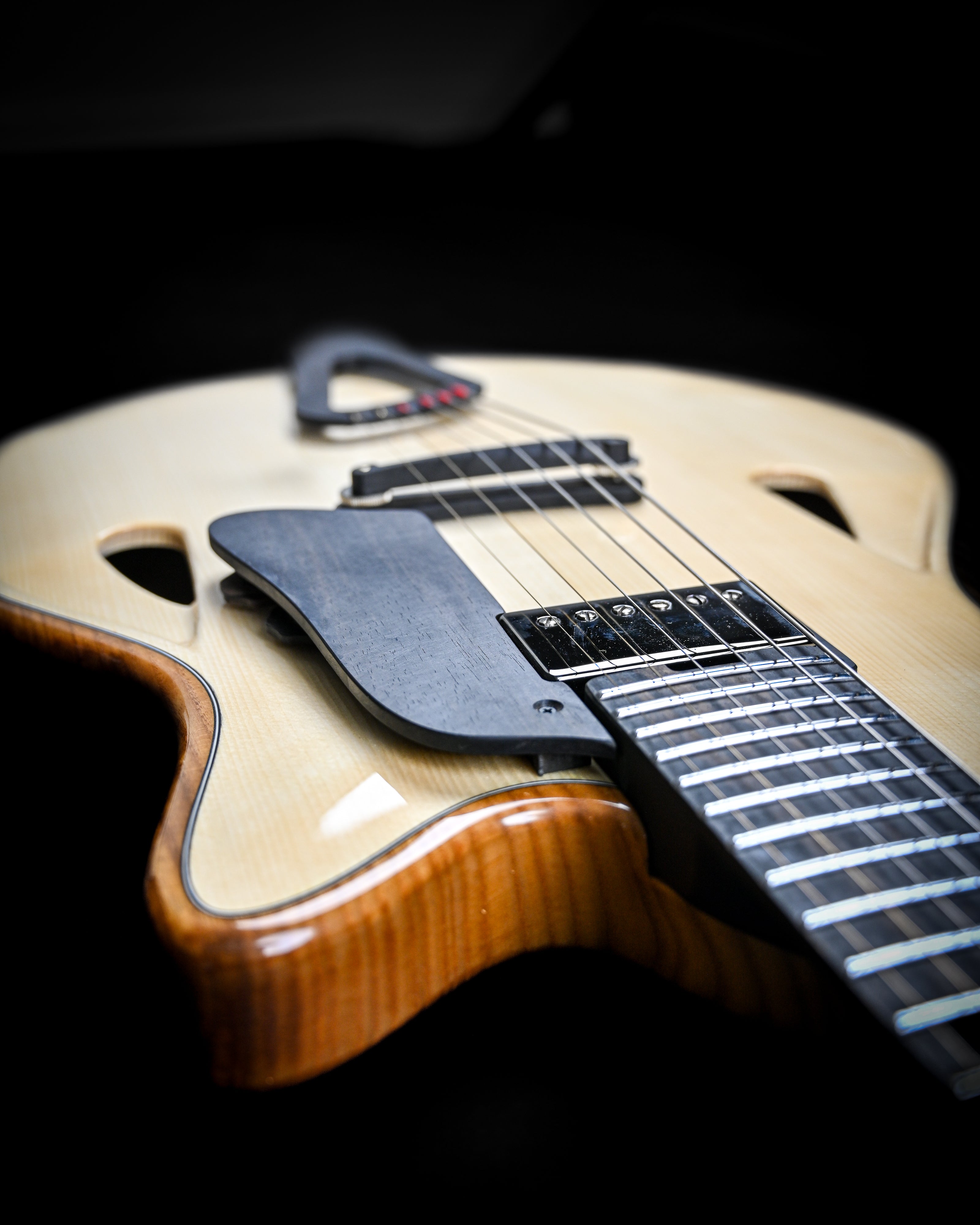
The Aeri is built to be looked at as carefully as it is played. Beyond the chassis and the architecture, the instrument carries a set of deliberate design details — drawn from traditional archtop hardware but redesigned, rebuilt, and made entirely in-house. Every visible component is ebony. Every component does its job better than the part it replaces.
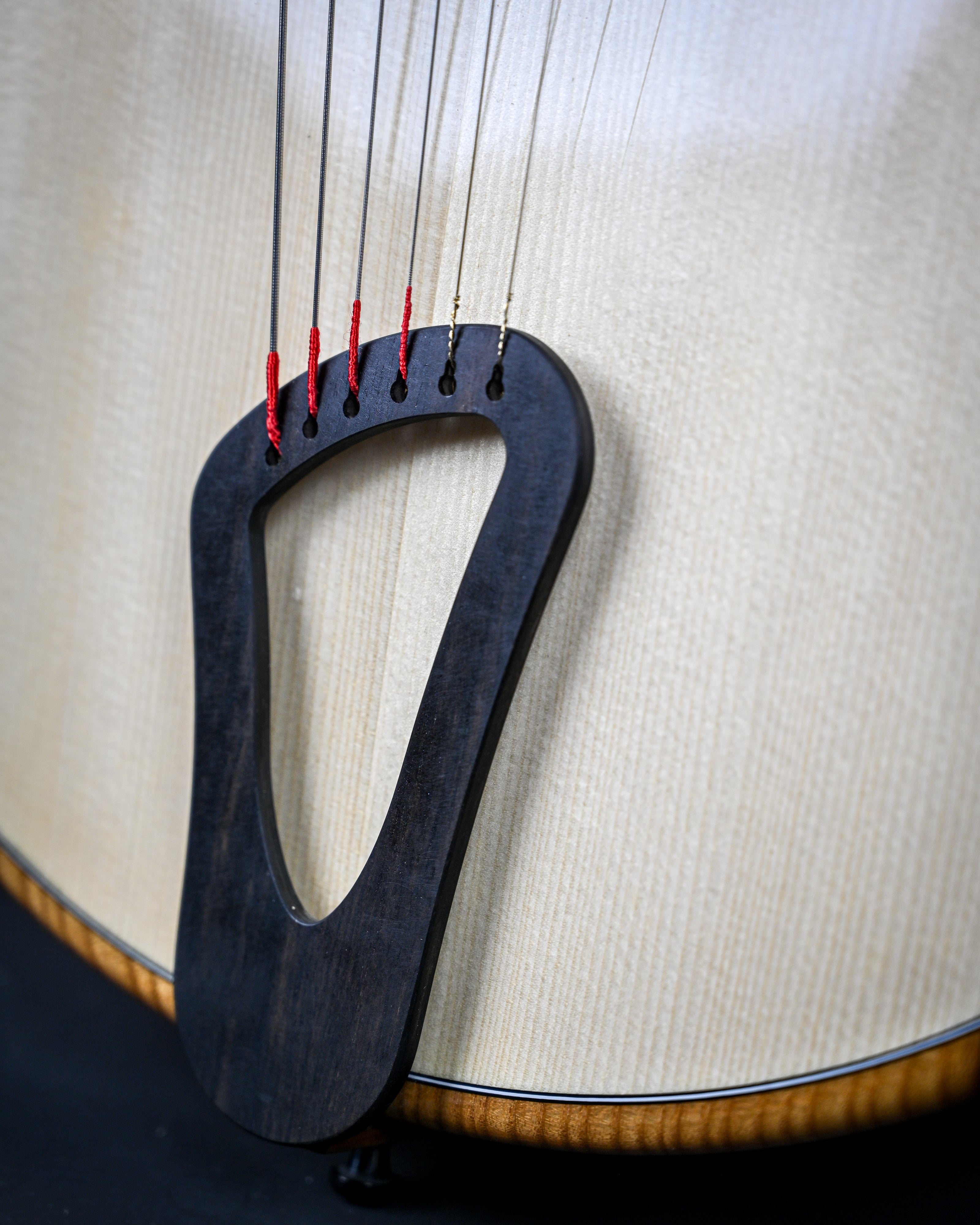
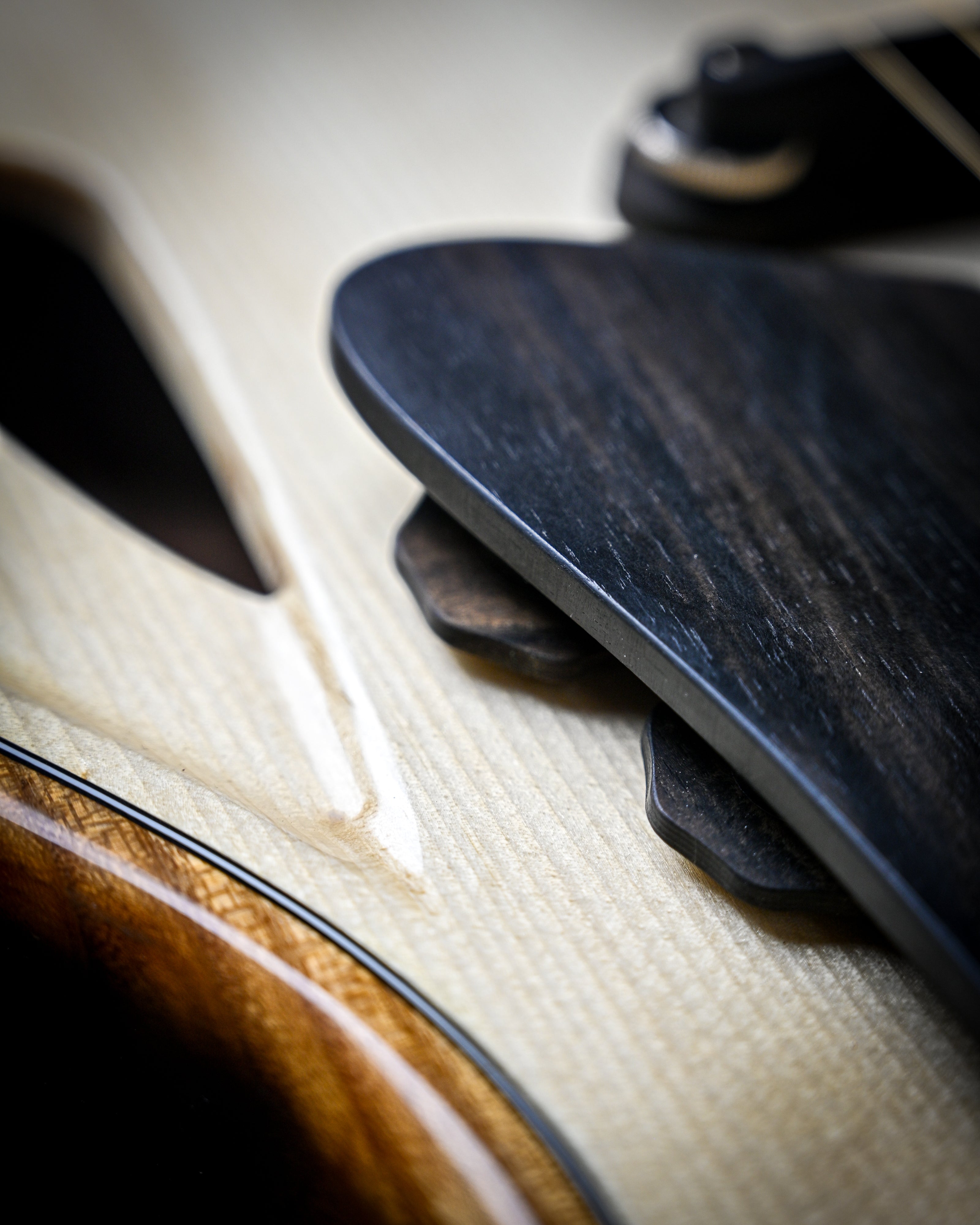
Ebony / Carbon Floating Tailpiece
A floating tailpiece anchors the strings to the lower bout while letting the top vibrate freely — the traditional archtop approach to mounting hardware without dampening the soundboard. Aeri's tailpiece is shaped from a single piece of ebony, finished to the same standard as the fretboard, and engineered to clear the top with a clean shadow line. The mass is calibrated for sustain and string return; the geometry is calibrated for visual balance with the bridge and pickguard. No metal, no plating, no compromise on resonance.
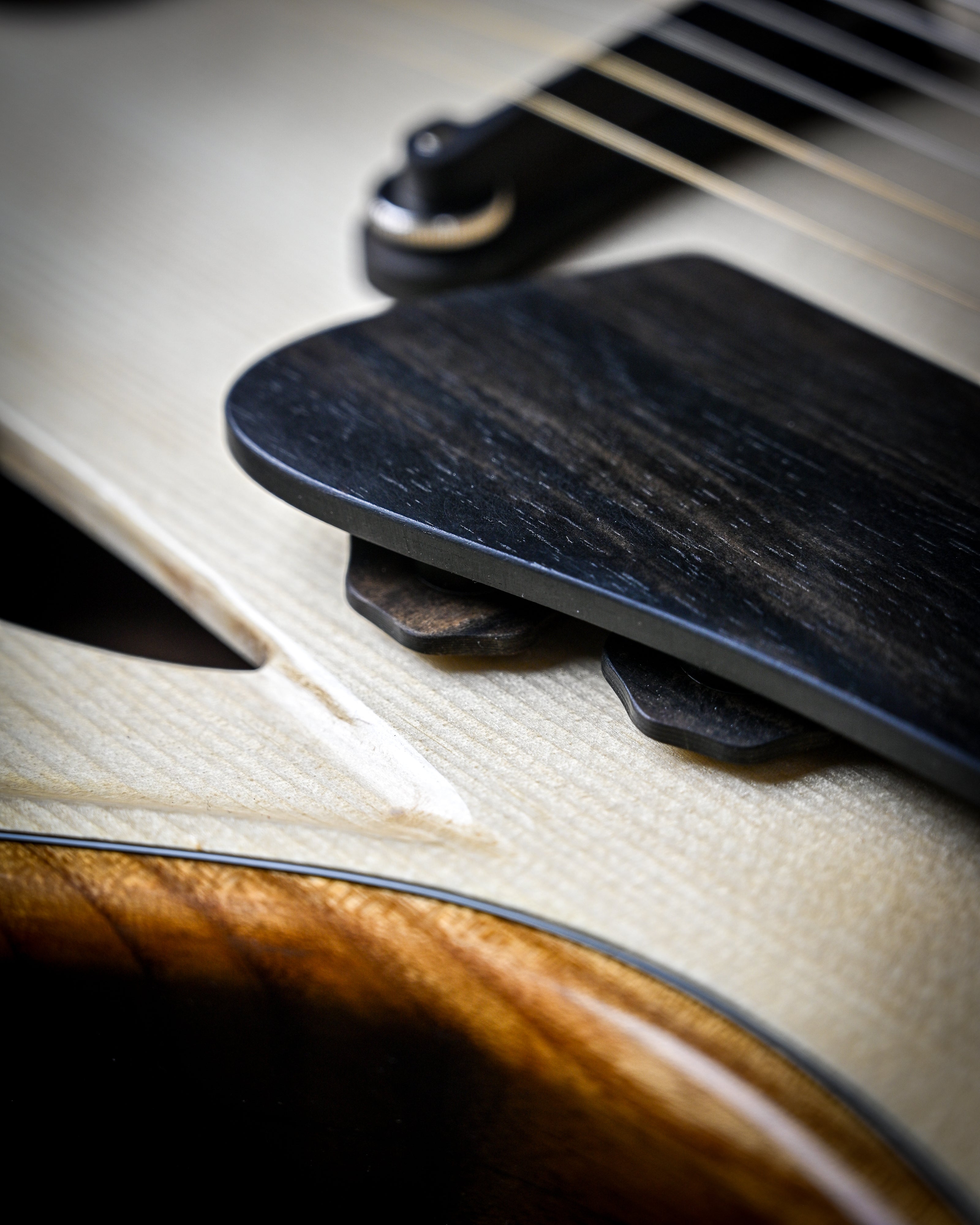
Ebony Thumbwheels with Notched Sides
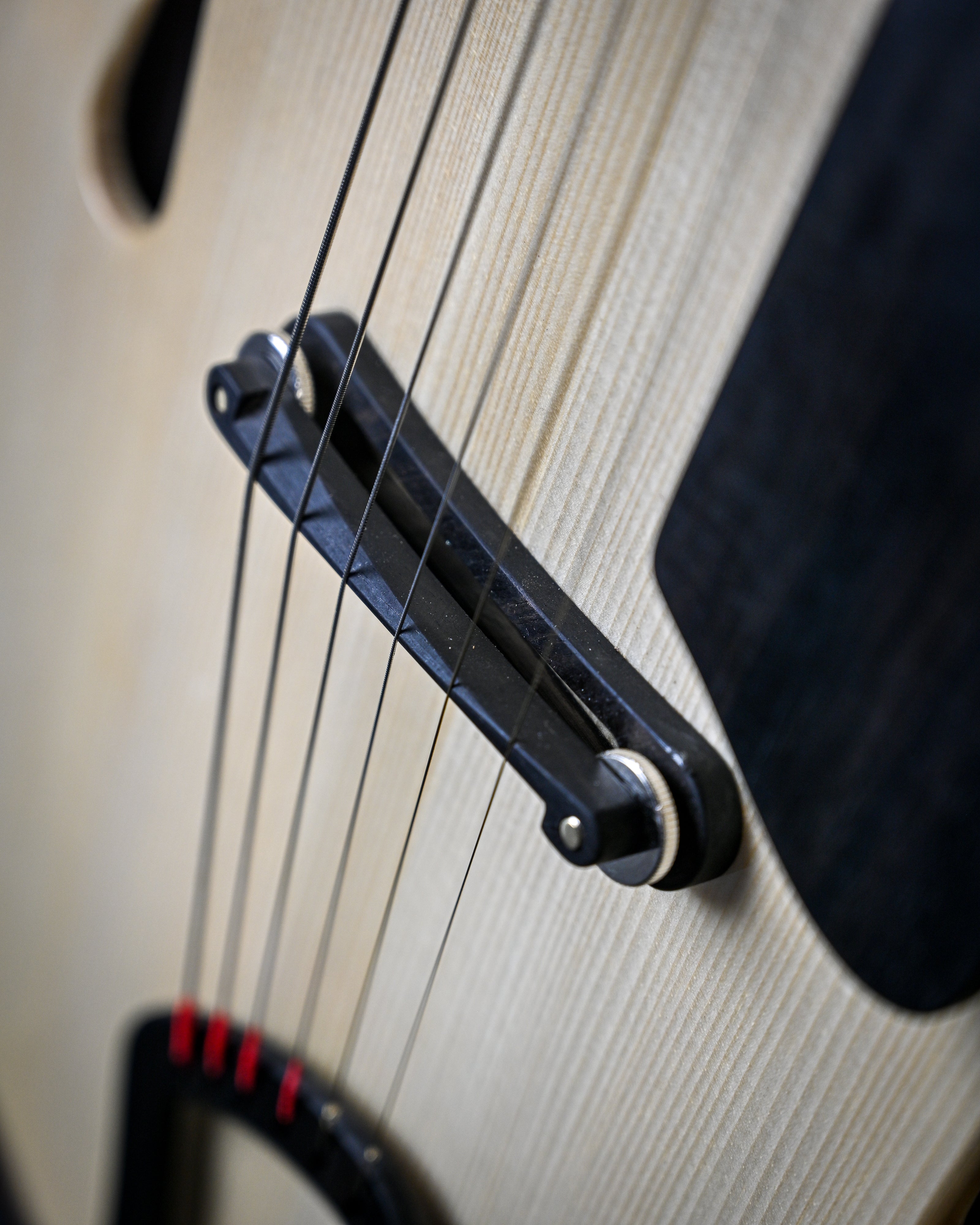
The bridge thumbwheels are turned from ebony and notched on their outer faces — a small detail, but one that transforms the experience of setting action. The notches give the fingertips real purchase, allowing precise, controlled height adjustments without slipping or over-tightening. Most archtop thumbwheels are smooth metal cylinders that resist careful adjustment under tension. Aeri's are designed to be turned by hand, by the player, in tune, on stage if necessary.
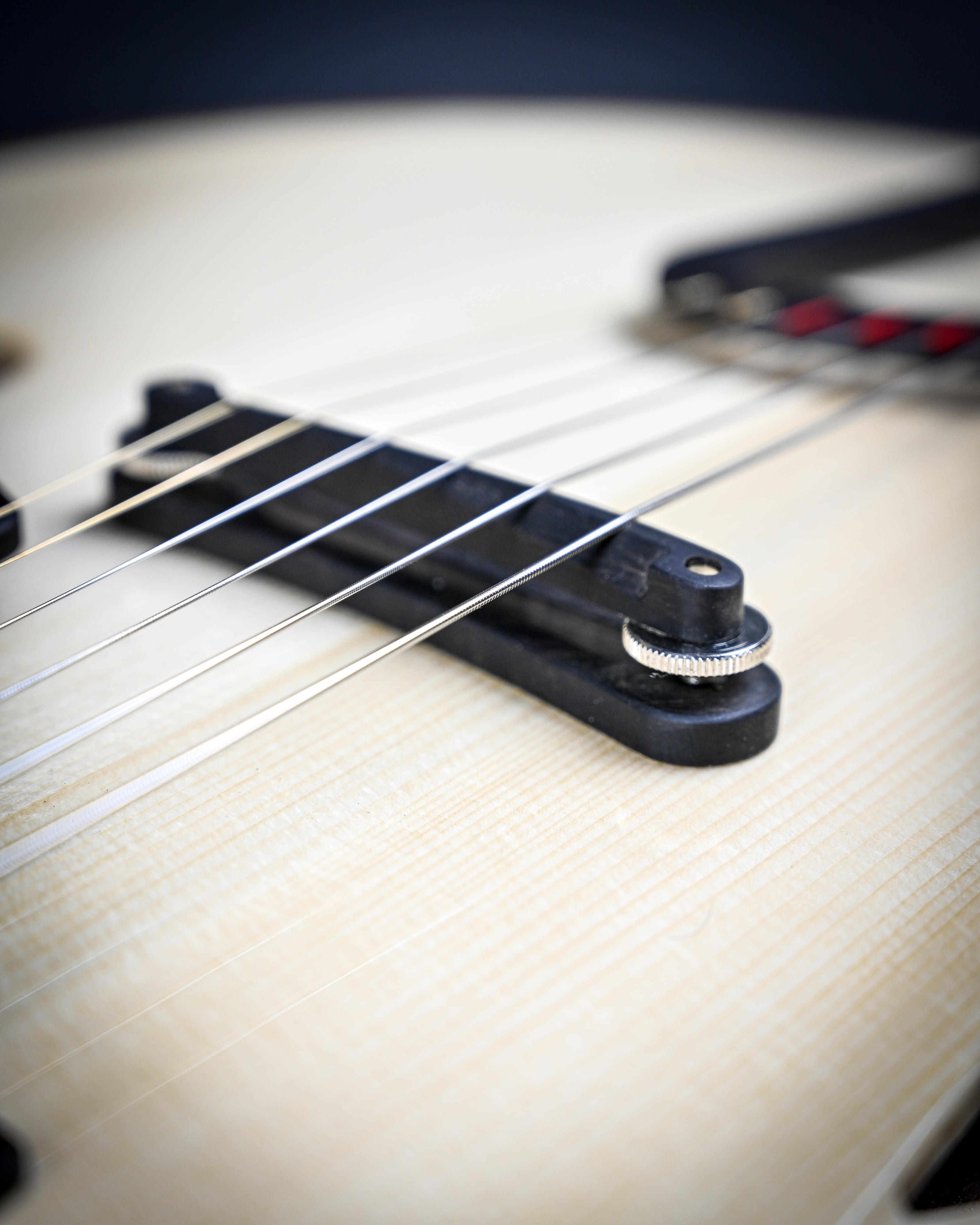
Dual Intonation Ebony Bridge
A floating ebony bridge, machined with a dual intonation profile — engineered to work cleanly with both flatwound and roundwound strings. Most floating archtop bridges are intonated for a single string type, forcing the player to commit to flats or rounds for the life of the instrument or accept compromised intonation when switching. Aeri's bridge solves the problem at the geometry level: two intonation paths cut into a single bridge, allowing the player to move between string types without rebuilding the saddle. Ebony throughout — for the resonance, for the visual coherence with the rest of the hardware, and for the longevity.
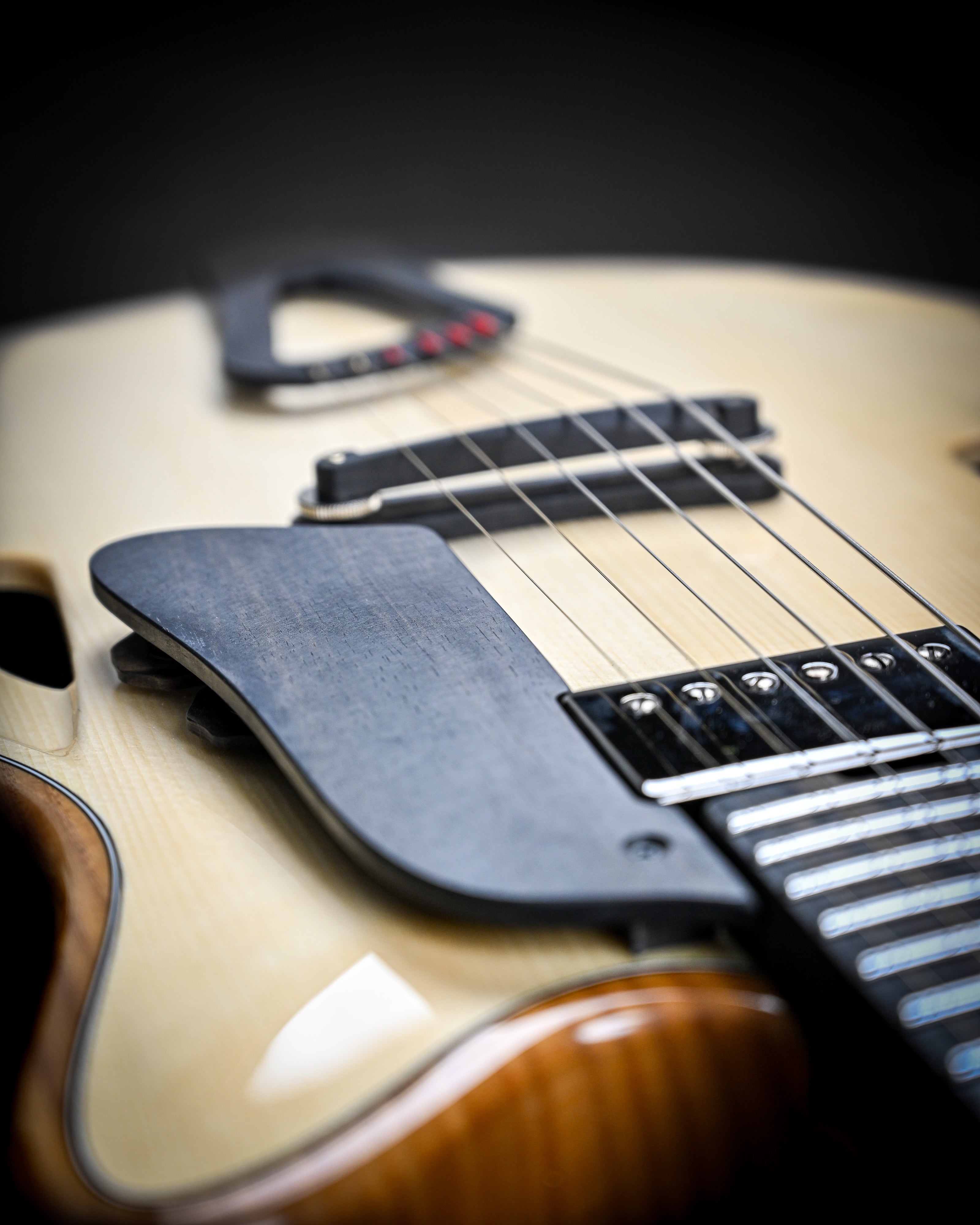
Ebony Pickguard
The pickguard is shaped from solid ebony, mounted floating off the top in the traditional archtop manner. No plastic, no laminated layers, no printed grain. The pickguard reads as a continuous design element with the tailpiece, the bridge, and the thumbwheels — a single material, four components, one visual language. It is also the easiest detail on the instrument to dismiss as decorative, and the easiest to recognize as not.
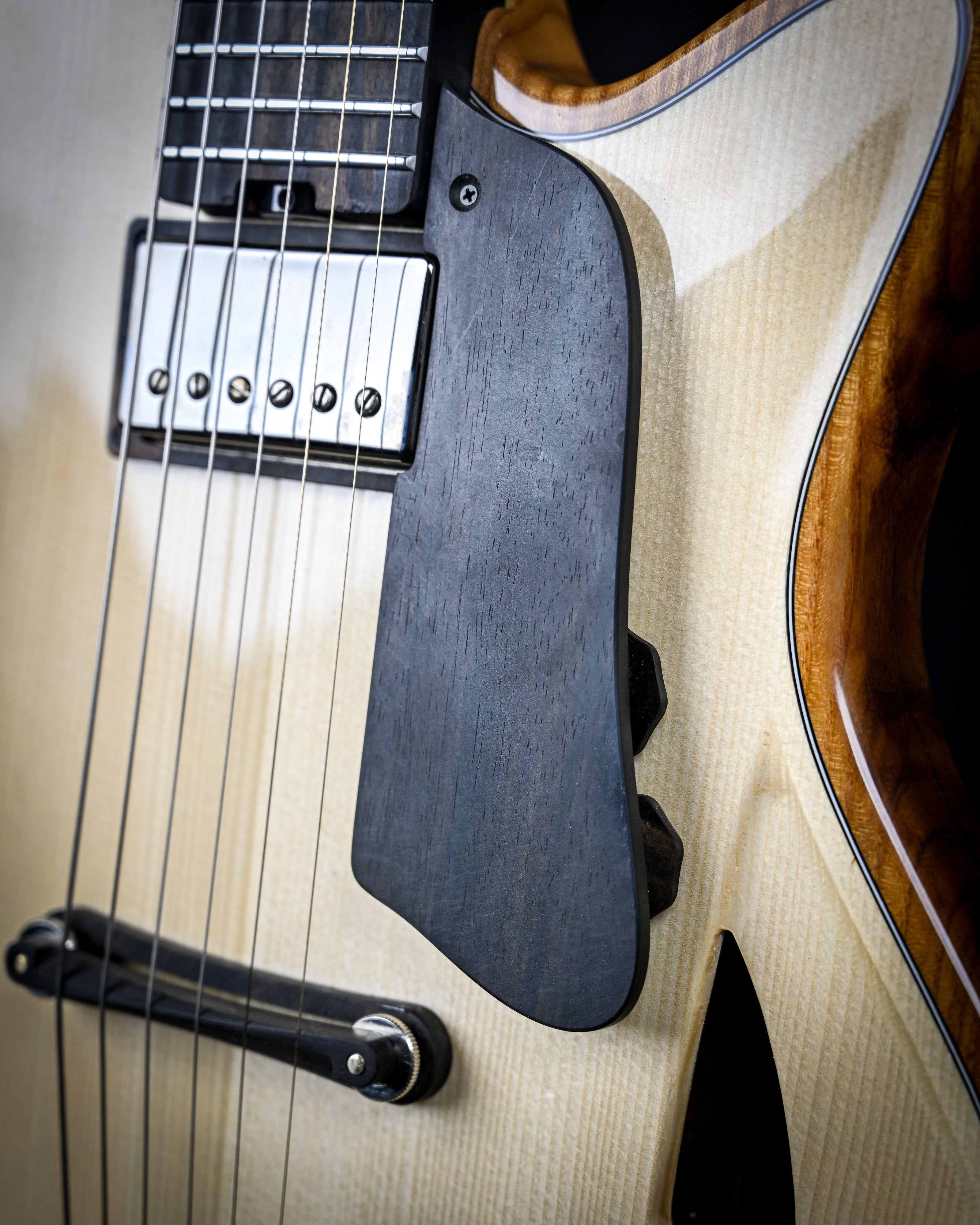
Both Aeri and Aeri HL are offered in single or dual pickup configurations.
Single pickup — a focused, vocal voice, with a clean upper bout and minimum visual interruption of the top.
Dual pickup — full tonal range, neck-and-bridge versatility, traditional archtop options expanded into modern territory.
Pickup choice is open. Belforti specifies and sources to the player's preference — humbuckers, mini-humbuckers, P-90s, floating or top-mounted. We will discuss the right voice for the instrument as part of the build conversation.
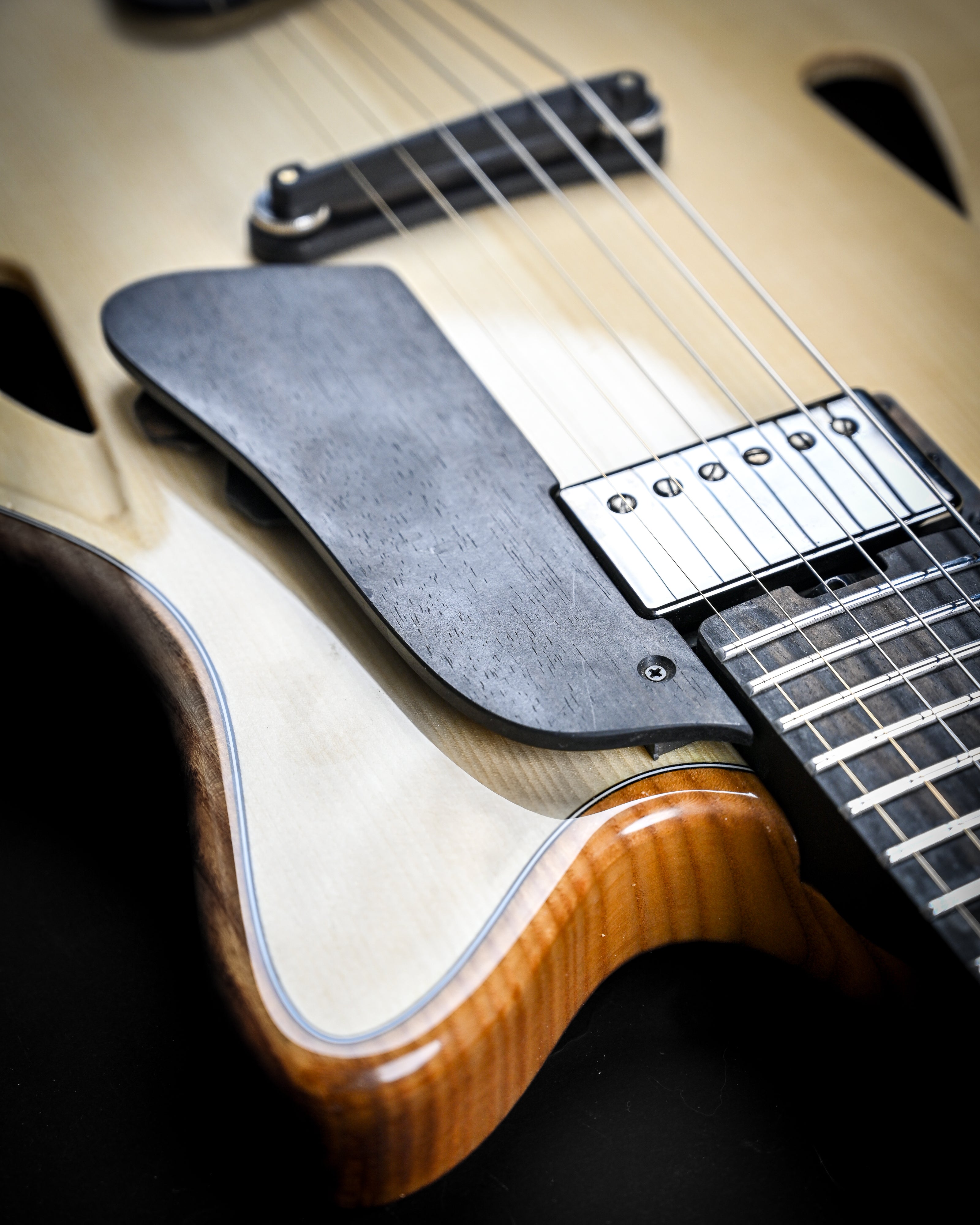
On the Neck Pickup Position
Aeri carries 24 frets. On a traditional archtop with 19 or 20 frets to the body, the neck pickup sits at a fixed harmonic location — typically over the 24th-fret node — and produces the warm, dark, vocal voice that the format is known for. On Aeri, the extended fretboard moves the neck pickup further toward the bridge, into a different harmonic position.
This is intentional. The neck pickup on Aeri is voiced for clarity and articulation rather than the smoky, dark register of a vintage archtop. The instrument is not trying to reproduce a 1950s ES-175 voice. It is offering a voice of its own — bright at the top end, present in the midrange, with the resonance of a chambered archtop body behind it.
For a player looking specifically for a traditional archtop neck-pickup tone, Aeri is not that instrument. For a player looking for what an archtop could be when designed for a contemporary musical context, it is exactly that.
The voicing is the point. The instrument was designed around it, not in spite of it.
Still a Belforti
For all that the Aeri redefines on the archtop format, it remains unmistakably a Belforti. Every instrument that leaves the workshop carries the same foundation — the construction standards, the playing standards, and the service standards that define what we build, regardless of model.
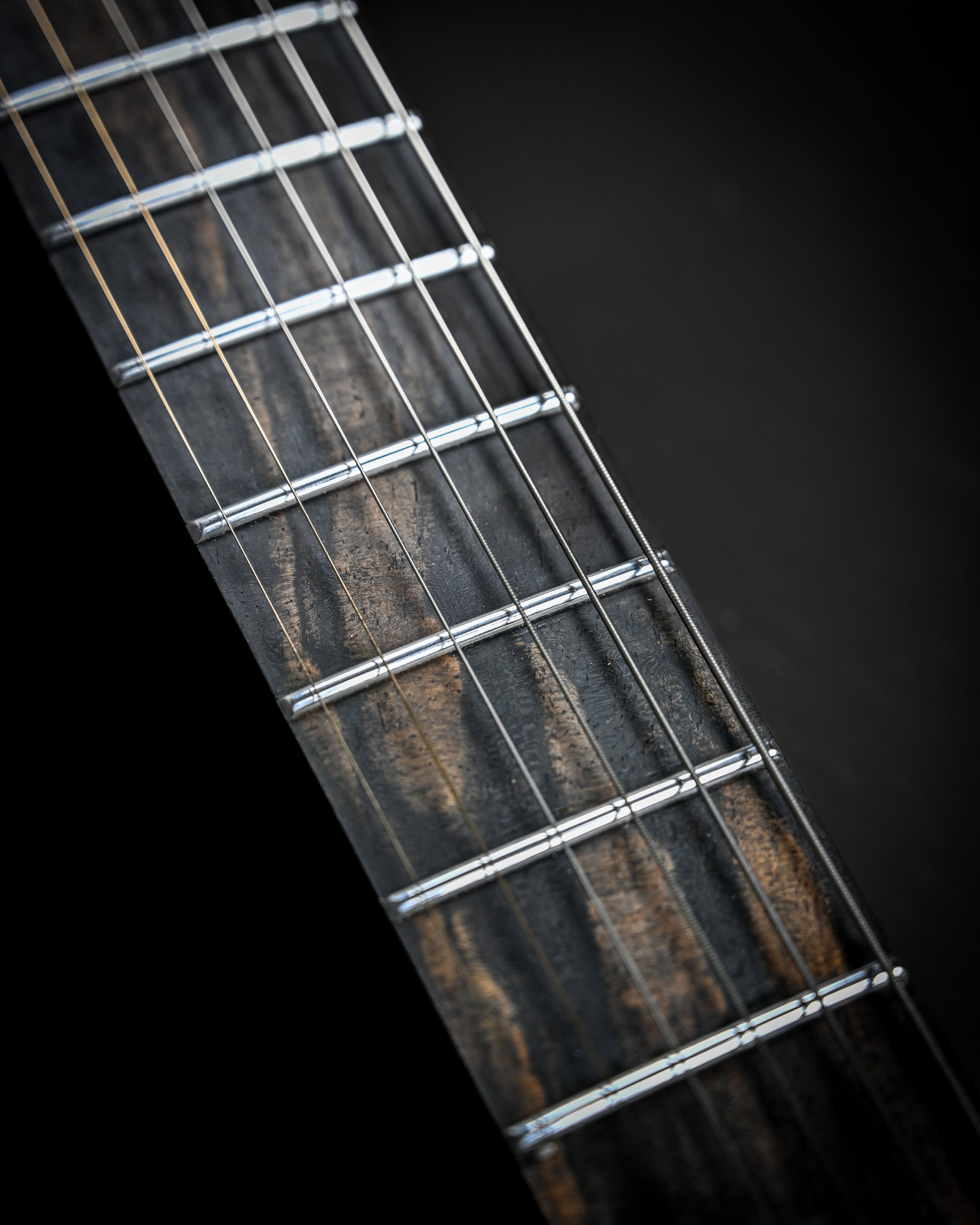
PLEK Treatment
Every Belforti guitar undergoes meticulous PLEK treatment, a high-precision process that levels frets to perfection, enhances playability, and ensures optimal action. This cutting-edge technology guarantees that your instrument is set up with the finest precision for unmatched comfort and playability right out of the case.
Titanium Reinforced Necks
Each neck is internally reinforced with dual titanium rods, preserving rigidity and stability across time, travel, and climate.
Combined with carefully selected tonewoods, it maintains resonance while preventing warping or dead spots.
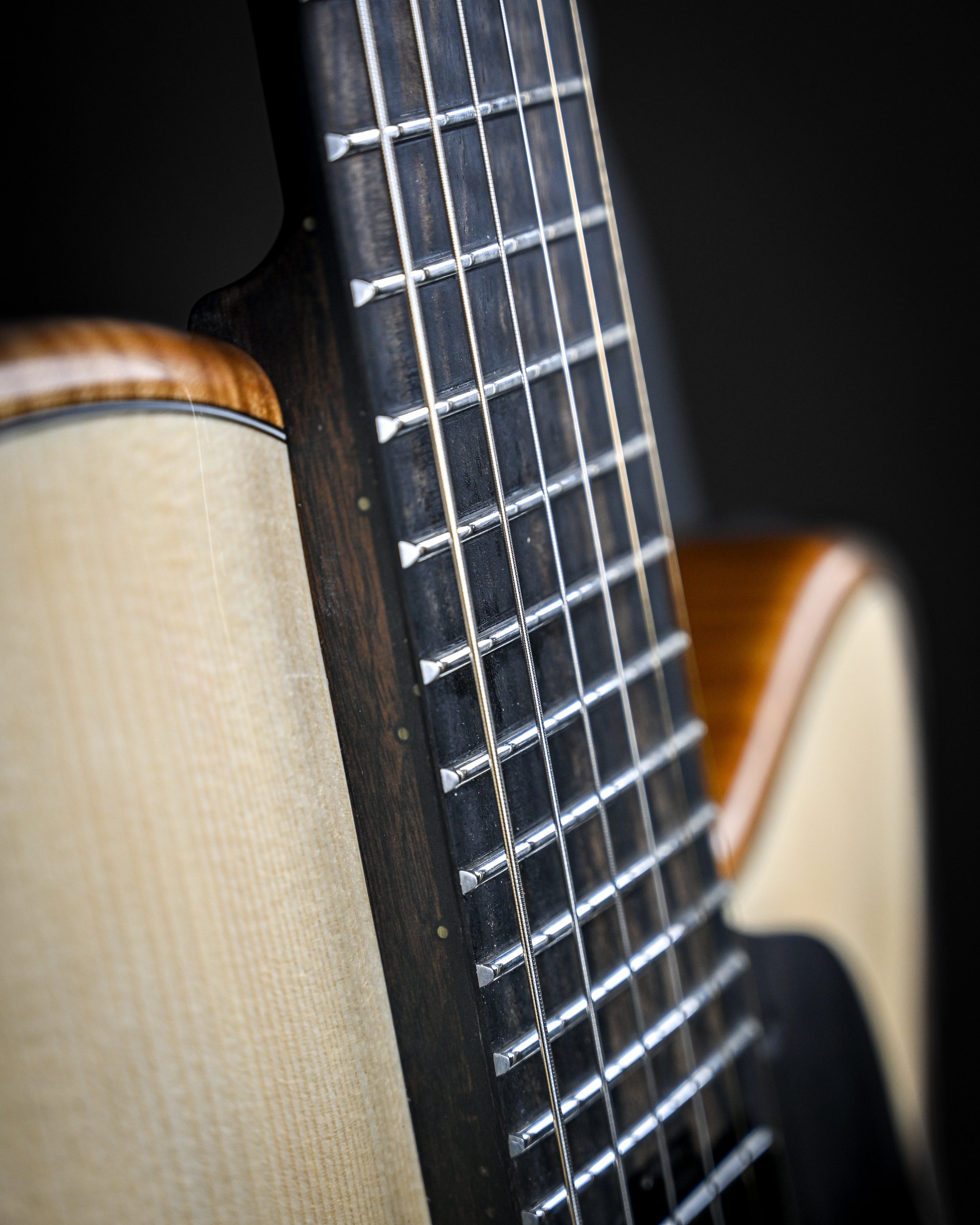
Invisible Fret Tangs
The fret ends are perfectly integrated into the fingerboard, eliminating protruding tangs and the need for binding.
This technique ensures a perfectly smooth edge, exceptional durability through humidity changes, and a refined aesthetic that feels as good as it looks.
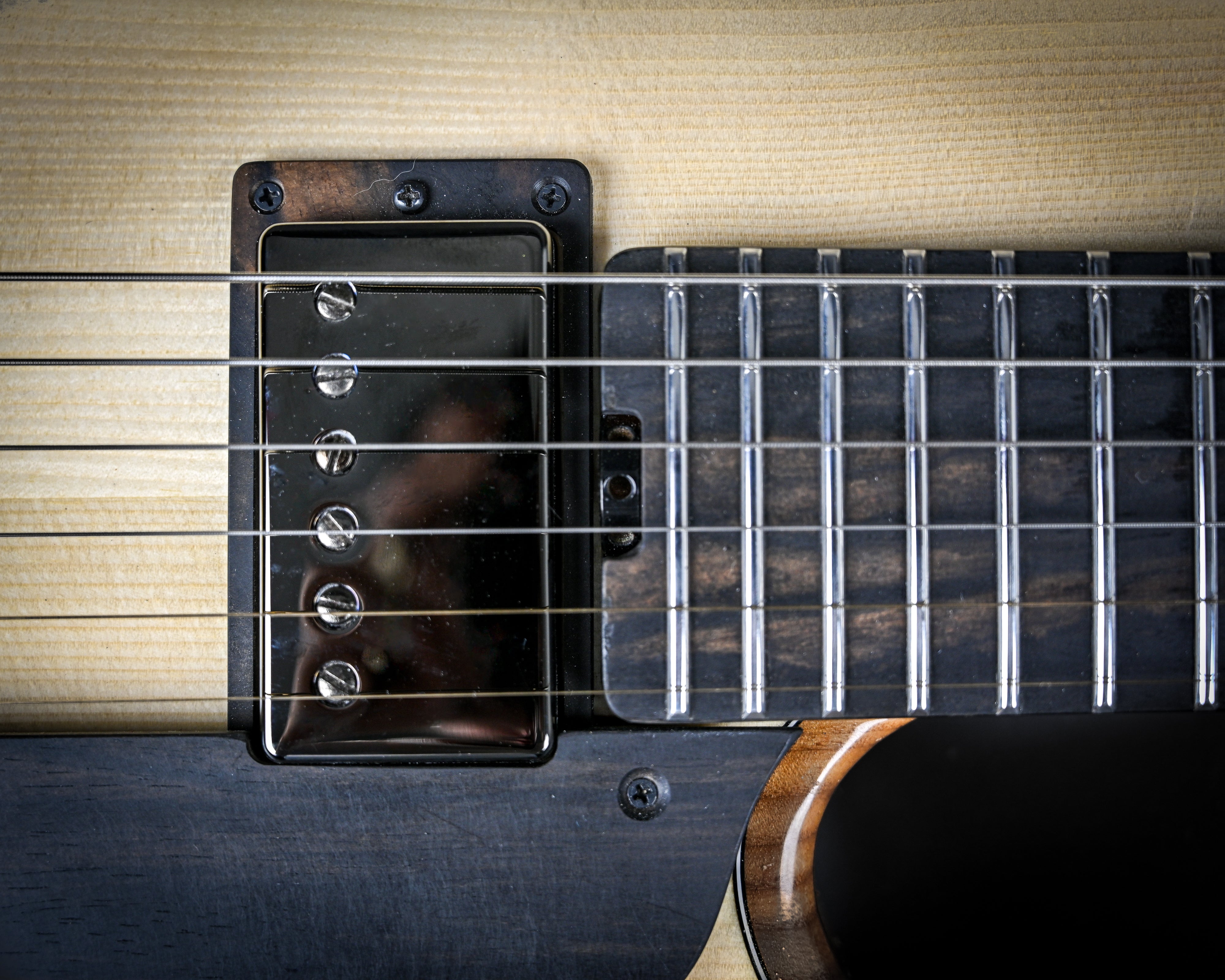
Easy Truss Rod Access
For easy and precise neck relief tuning, Belforti instruments use a spokewheel truss rod system accessible directly at the heel — no need to remove strings or hardware.
It’s a professional feature born from workshop practicality, built into every instrument
Technical Specs
6 Strings
Nut Width : 44mm
Width at Last Fret : 60mm
Fretboard Radius (3 Options)
Vintage 9"-12" / Balanced 10"-14" / Modern 12"-16"
Neck Profiles (5 Options)
Small / Medium / Large / 3D Nest™ / 3D Flow™
Scale Length (3 Options)
Aeri : 25" / Aeri HL : 26" to 25"
Number of Frets : 24
String Spacing at Bridge : 10.5mm Equal Spacing
Lower Bout : 370mm
Shoulders : 270mm
Total Length : 100cm
Thickness : 50mm
7 Strings
Nut Width : 48mm
Width at Last Fret : 70mm
Fretboard Radius (3 Options)
Vintage 9"-12" / Balanced 10"-14" / Modern 12"-16"
Neck Profiles (5 Options)
Small / Medium / Large / 3D Nest™ / 3D Flow™
Scale Length (3 Options)
Aeri : 25" / Aeri HL : 26" to 25"
Number of Frets : 24
String Spacing at Bridge : 10.5mm Equal Spacing
Lower Bout : 370mm
Shoulders : 270mm
Total Length : 100cm
Thickness : 50mm
8 Strings
Nut Width : 54mm
Width at Last Fret : 80mm
Fretboard Radius (3 Options)
Vintage 9"-12" / Balanced 10"-14" / Modern 12"-16"
Neck Profiles (5 Options)
Small / Medium / Large / 3D Nest™ / 3D Flow™
Scale Length (3 Options)
Aeri : 25" / Aeri HL : 26" to 25"
Number of Frets : 24
String Spacing at Bridge : 10.5mm Equal Spacing
Lower Bout : 370mm
Shoulders : 270mm
Total Length : 100cm
Thickness : 50mm
Built to Order
Aeri is a standalone model, built to order outside our series structure. Each instrument is configured in direct conversation between the player and the workshop — top wood, finish, pickups, hardware, neck profile, and the choice between Aeri and Aeri HL.
Contact the Montrouge showroom or workshop to begin a build.