



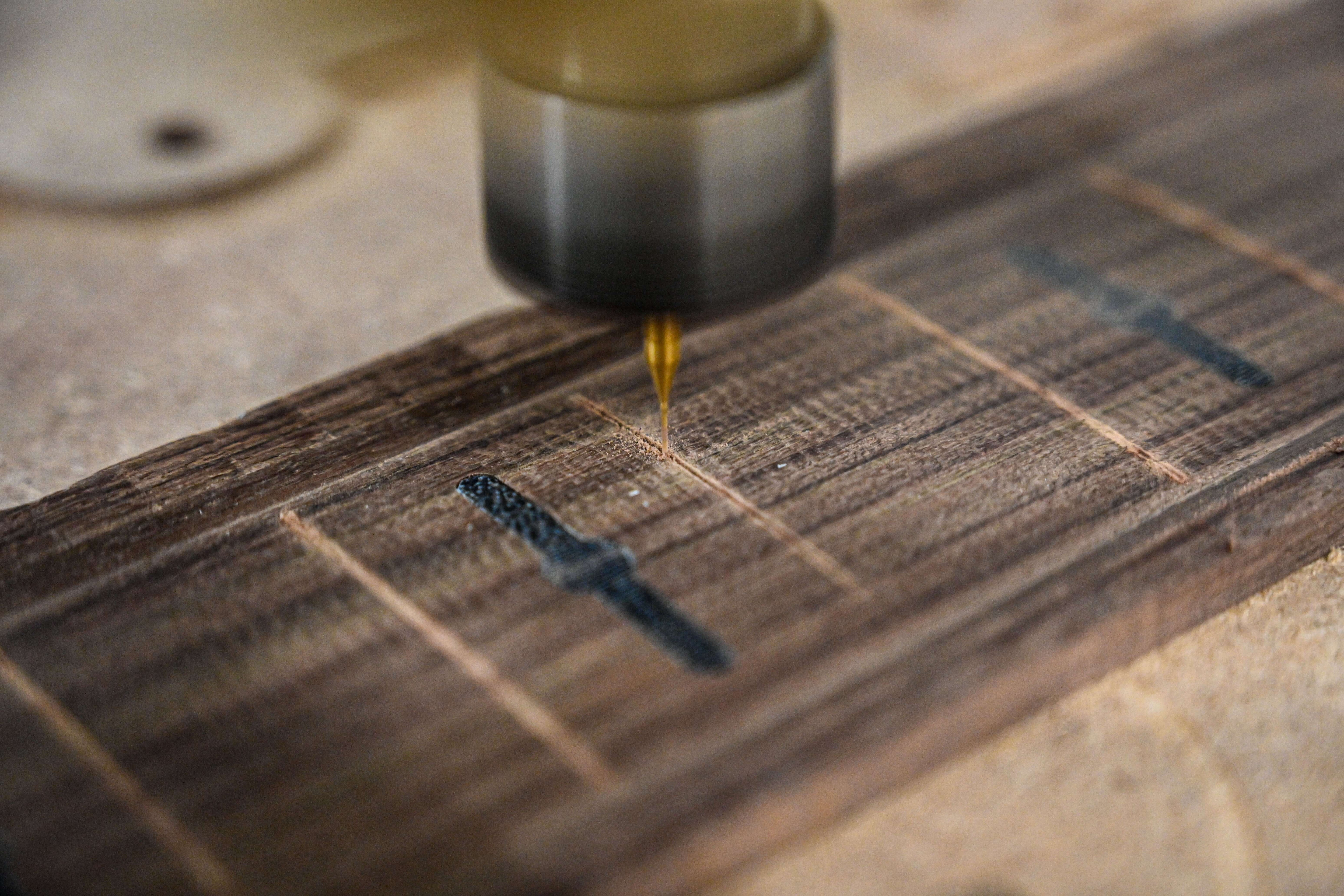
A fret slot is a saw cut about six tenths of a millimetre wide. There is nothing in it. And almost everything you feel when you play above the open string is decided by how it was cut.
That gap — between how trivial a slot looks and how much it governs — is exactly where bad information breeds. Most of what gets written about fret slots, including the version of this article it replaces, mixes three very different kinds of claim and serves them as one. So this piece keeps them apart on purpose. Some of what follows is fixed by mathematics and has a single correct answer. Some is fixed by tooling and the wire you're using, and is correct only relative to that wire. And some is shop preference wearing the costume of settled fact. Knowing which is which is the whole job.
What the slot is actually for
A fret slot is a channel that holds the tang — the thin foot under the fret's rounded crown. The tang has small barbs, or studs, along its sides. They bite into the slot walls, and that friction, often backed by a bead of glue, is what keeps the fret in.
Worth stating plainly, because the next part trips people up: the fret does not rest on the bottom of the slot. It seats when the underside of the crown meets the surface of the fingerboard. The slot floor can sit a comfortable distance below the tang and nothing is wrong. Air under a tang does no harm.
A slot has three independent properties, and each controls a different thing. Where it sits along the neck sets intonation. How wide it is sets how the fret grips. How deep it is sets whether the fret seats at all. Treat these as one quality called "precision" and you'll repeat the usual mistakes. Treat them as three and the subject gets simple.
Position: this part is arithmetic
Fret position is the only part of slotting with a single right answer, and it isn't a matter of craft or taste. It's equal temperament, and equal temperament is a formula.
The distance from the nut to the nth fret is the scale length L, minus L divided by the twelfth root of two raised to the nth power:
d(n) = L · (1 − 2^(−n/12))
The old shop shorthand was the "rule of 18": divide the remaining scale length by 18 to find the next fret. It's close, but it leaves the upper register slightly flat, because the exact constant is 17.817, not 18. Modern templates and calculators use the real number. You can check any layout in one move: the twelfth fret must land at exactly half the scale length. On a 25.5-inch scale that's 12.75 inches, dead on. If it isn't, the math is wrong, and no amount of clean cutting will rescue the intonation.
This is why position error is the one slot error a player actually hears. A fret a couple of tenths of a millimetre off its calculated spot pushes that note sharp or flat for the life of the instrument. The same error in width or depth changes nothing about pitch. So when intonation gets blamed on "slot precision," the precision that matters is longitudinal placement — and that comes from the template or the CNC program, not from how the cut itself was made.
It's also where the geometry turns genuinely demanding on a multiscale instrument. On a fanned-fret neck — our Aeri HL, for instance, where the bass and treble sides run different scale lengths — every slot sits at its own angle, calculated per string. The standard Aeri keeps straight frets and a single scale; the HL does not. That kind of layout is where a machine or a dedicated template stops being a convenience and becomes the only sane way to hit the numbers.
Width: a fit problem, never a tone problem
Slot width is set by the wire, not by preference. Most fret wire is made with a tang about 0.020 inches wide — roughly half a millimetre — and the makers spec a 0.023-inch slot to receive it. That's Jescar's published recommendation for their standard profiles, and it's why StewMac's fret saws are ground to a 0.023-inch kerf: the saw is sized to the wire. The three-thousandths of an inch of clearance is the room the barbs need to dig in.
Go wider than the wire wants and the fret sits loose. It'll lift, buzz, or lean on glue to do a job the slot should have done. Go narrower and you crush the tang or split the board, and the fret rides high because it can't get down. Note the asymmetry: a touch wide is recoverable with adhesive; too narrow can cost you a board.
The number everyone quotes — 0.023 inches — is only "standard" relative to standard wire. Jescar say it themselves: other tang sizes need other slots. A vintage refret with thinner tangs, or a wide-tang specialty wire, throws the figure out, and measuring the actual tang beats trusting a default. There's also a deliberate use of the width-to-tang relationship: fret a neck with tangs slightly proud of the slot and the wedging action induces a touch of back-bow. Done on purpose that's compression fretting; done by accident it's a warped neck. Either way it has nothing to do with how the guitar sounds. Width is grip. Tone lives elsewhere.
Depth: clear the tang, miss the truss rod
Depth has two limits and a lot of harmless room between them. The slot has to be deep enough — at its shallowest point — for the tang to drop fully in so the crown can seat on the surface. Cut too shallow and the tang bottoms out first, leaving the fret proud and rocking. Standard practice is a hair deeper than the tang and nothing fancier than that.
The catch is that tang depth isn't one number. It runs from around a millimetre on small wire to nearly two on tall bass wire, so "correct depth" is whatever clears the specific wire in hand, plus a little. The lower limit is structural: don't cut into the truss rod channel, and on a thin board don't break through the back. That's the real reason to respect depth — not seating, which a generous slot handles easily, but not turning a fingerboard into scrap. It's also why pre-slotted boards from suppliers come cut straight across and deliberately deep: deep is safe, and the builder can always stop a fret short of the floor.
The radiused-slot question
Here is the claim that does the most work in most fret-slot articles, including the one this replaces: that radiused fret slots — slots whose floor follows the curve of the board rather than running flat across it — are the superior choice, giving more even seating and a stronger install. It deserves a careful answer, because it's half right, and the half that's wrong is doing a lot of selling.
Start with the geometry, which is real. Most builders cut slots into a flat blank at a constant depth, then sand the radius into the top. Sanding a radius removes wood from the edges of the board, not the centre. So once the radius is in, those constant-depth slots end up deepest in the middle and shallowest at the edges. Choose a tighter radius or a thinner board and that difference grows. A truly radiused slot — deepened at the edges, cut after radiusing with a follower, or done in one pass on a CNC — keeps the depth even across the width.
Now the part the "superior" framing skips. The fret doesn't seat on the slot floor; it seats on its crown against the surface. So the only thing the depth variation can hurt is whether the shallow points — the edges — still clear the tang. If they do, a flat-bottomed slot seats a fret exactly as well as a radiused one. The extra depth in the centre is just air, and air under a tang does nothing for grip, seating, or stability. Cut your flat slots deep enough at the edges, and the case for radiusing them on a normally proportioned board mostly evaporates.
Where it stops being academic is at the margins: very thin boards where you can't spend the extra centre depth, tight radii where the variation is large, and any job where breaking through the back is a live risk. There, following the radius is sound engineering, not fuss. Everywhere else it's a refinement, and a builder who skips it is not cutting a worse slot.
So, the three labels, kept honest. The geometry — flat slots vary in depth on a radiused board — is measurable and true. That this makes them inferior in normal use is not established; the seating physics says otherwise. That radiused slots are universally "superior" is marketing. And my own position, offered as a bench opinion and not a fact: radius the slots when the board is thin or the radius is tight, and don't lose sleep over it otherwise. Plenty of fretwork I'd put my name to sits in flat-bottomed slots.
Two claims worth retiring
Two more lines travel with the radiused-slot pitch, and both should go.
The first is that radiused slots reduce fret sprout. They don't, and they can't. Sprout is the fingerboard losing moisture in dry conditions and shrinking across its width, while the steel frets — which don't shrink — stay put, so the ends sit proud and catch your hand. It's a humidity-and-wood-movement problem from start to finish. The geometry of the slot floor has no bearing on it. The actual remedies are controlling humidity and dressing the fret ends. That's the whole list.
The second is that slots, in general, determine intonation. Only their position does, and that's the arithmetic from earlier. Width and depth are seating and retention. Folding them into an intonation claim is how a fit specification gets quietly promoted to acoustic physics.
Hand versus CNC, fairly
The usual framing says CNC slotting "dramatically reduces human error," which makes it sound as though a motor is inherently more honest than a person. That's not where the accuracy lives. Position accuracy comes from the template or the program. A builder cutting against a good template with a depth-stopped saw lands fret positions inside a tolerance no player will ever hear; a CNC running a bad file will cut a bad neck very repeatably.
What CNC genuinely buys you is sameness across many boards, speed, and clean execution of awkward geometry — compound radii, multiscale fans, the hardest and most brittle woods. What hand methods buy you is control and feel, and an easier time on one-offs, bound boards, and finished boards where a machine is the wrong instrument. At 20 to 30 instruments a year, our reason to reach for one method over the other is the work in front of us, not throughput. Neither is "more precise" in a way that reaches the ear.
The wood has opinions too
The board material changes how a slot behaves, though these are tendencies, not laws — every species varies plank to plank. Ebony is hard and brittle and likes to chip at the mouth of the slot, so it rewards sharp tooling and a scored or taped line. Rosewoods and pau ferro run oilier and are generally more forgiving. Maple is soft enough to compress and is almost always finished, which turns a slotting question into a finishing one. Dense modern composites cut consistently and wear tooling fast. Harder, denser boards dull blades and cutters sooner — a maintenance fact more than a design one, but it's the reason a tired blade leaves a ragged slot.
What actually separates good slotting from bad
Not the radius of the slot floor. Good slotting is position dead on the math, checked against the half-scale octave; width matched to the actual tang in your hand rather than a default; depth set to that wire with margin and never into the truss channel; and walls clean enough for the barbs to bite. On bound or finished boards there's one more: chamfer the top edges of each slot with a triangle file before the frets ever come out, so the day someone refrets the instrument the board doesn't chip on the way.
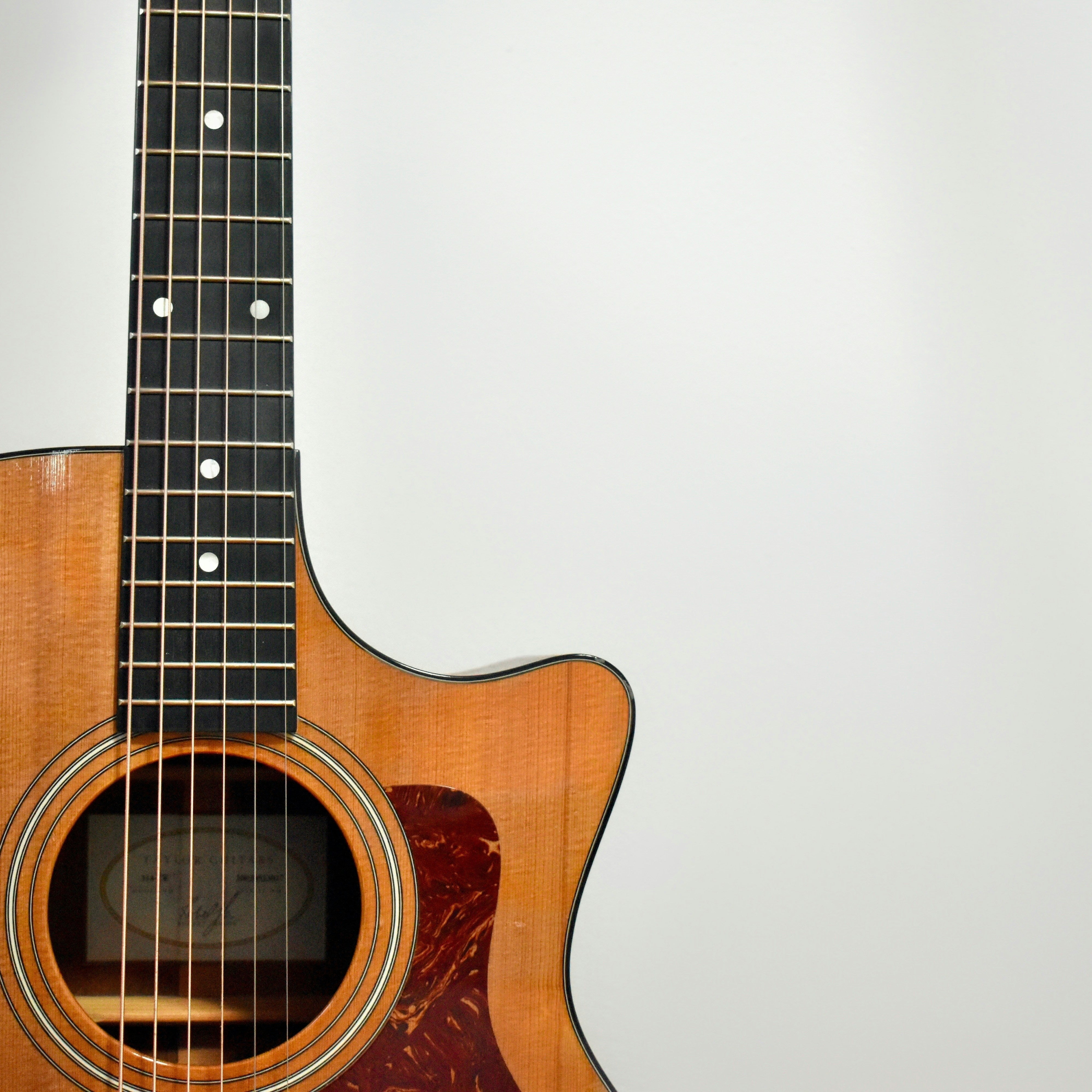
That last point is where slot quality is finally graded — not on the build bench but on the repair bench, years later. A guitar comes in for a refret and the old slots tell you everything: whether the width suited the wire, whether the depth was sane, whether anyone gave a thought to the person who'd open it up next. We see plenty of them as a Taylor repair centre. The clean ones were cut by someone who understood that the slot isn't the point. The fret is. The slot just has to be right enough to disappear.
Share:
Gloss, Matte, or Satin?
The Truth About Guitar & Bass Strings