



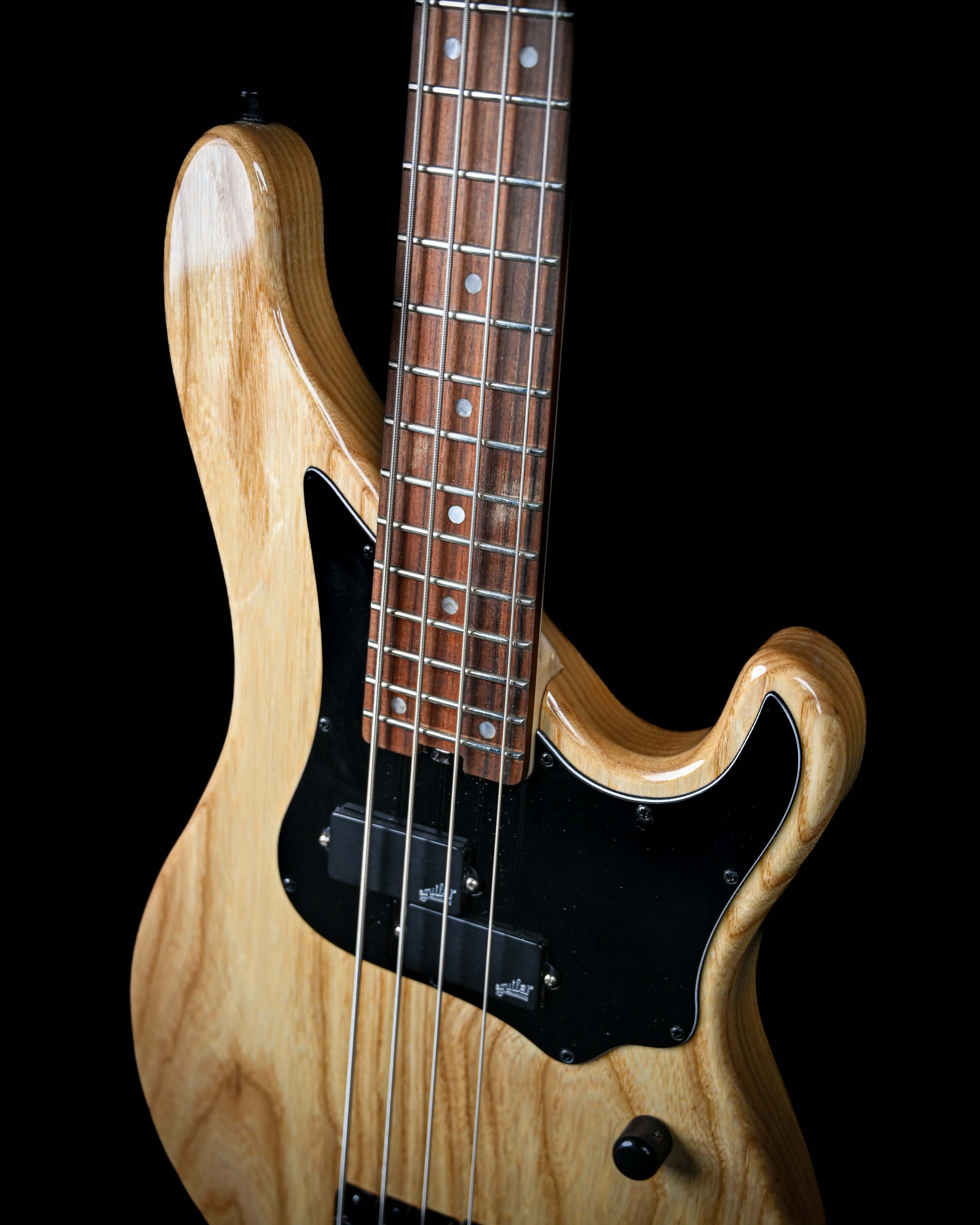
The note that won't bloom
You know the one. Somewhere on the fingerboard there's a note that comes out stunted — it speaks, then quits early, while the frets on either side of it ring out fine. Players call it a dead spot, and the usual suspects get rounded up on sight: tired strings, a lazy pickup, the wrong wood under the lacquer. All three have alibis.
A dead spot is a mechanical event, not a tonal one, and it has been measured carefully enough that we don't have to guess. The cleanest work on it comes from Helmut Fleischer, who spent years putting electric basses and guitars under a laser vibrometer at the Universität der Bundeswehr in Munich. His instruments tell a consistent story, and it is not the one in the forum threads.
Start with why an electric sustains at all. It doesn't radiate sound — the body isn't pushing air the way an acoustic top does. The note you hear is the string's own motion, read by the pickup and sent down the cable. Because the instrument never has to give that energy away to be loud, the string holds onto it for a long time, and that is the entire reason a solid-body rings longer than a flat-top. The supports stay put, so the string keeps moving.
A dead spot is what happens when one support stops staying put.
Your neck is not as rigid as it looks
Pick up a solid-body and it feels like a plank. It isn't. Fleischer's measurements show the body and neck flexing in clear, repeatable patterns — bending, usually with some twist mixed in — at specific frequencies. The motion that matters for dead spots is the one perpendicular to the fingerboard: the neck nodding toward and away from the strings.
Here is the part that surprises people. On a well-built solid-body, the bridge is the stiff, quiet end, and the neck is the lively one. So when the string dumps energy into the instrument, it does it mostly through the nut and the fretted note up at the neck — not through the bridge, the way an acoustic does. The neck's willingness to move is the leak.
For the string to actually feed that leak, two things have to line up at once. The note you are playing has to sit close to one of the neck's resonant frequencies, and the point where the string is anchored has to sit near a part of the neck that is free to move at that frequency — an antinode, not a node. A string fixed at a dead-still point cannot drive the resonance no matter how perfectly the pitch matches. Miss either condition and the note rings; hit both and the string starts pouring energy into the neck, and that energy is gone from the note.
A map of where the energy leaks
You can measure exactly how leaky each spot is. The parameter is mechanical conductance — the part of the neck's response that represents energy actually flowing out of the string and into the wood. Fleischer measured it along the whole fingerboard, fret by fret, and the result is a kind of landscape: ranges of "mountains" where the neck readily accepts energy, and "valleys" where it refuses. The conductance falls to nothing at a node and peaks at an antinode, exactly as the mechanics predict.
Then comes the elegant part. Lay the actual notes of the instrument over that landscape — every string at every fret, plotted by pitch — and you can read the dead spots straight off the map. Where a played note's fundamental lands on a mountain, the string loses energy fast and you get a dead spot. Where it lands in a valley, you get a "live spot" that rings forever. Every neck has its own version of this map, and it is as individual as a fingerprint.
This is the first thing the lore gets backwards: a dead spot is not a flaw in a note. It is a coincidence between a note and a neck.
The fundamental dies first, and it takes the note with it
Why does a dead note sound choked rather than just quiet? Because of which part of the note gets killed.
A plucked string isn't one tone; it's a stack of harmonics — fundamental, second, third, and up. Left to its own internal friction, the fundamental rings longest and sets how long the note "lasts." The neck resonance is fussier than that: it drains energy from whichever harmonic happens to match it and ignores the rest. When it lands on the fundamental, the fundamental collapses, and the second harmonic — which naturally decays about twice as fast — is suddenly the longest-lived thing left. The note's effective sustain halves. When the resonance is strong enough to take out the first two harmonics, the third takes over, and the note dies roughly three times as fast as its neighbours.
Fleischer's numbers make this concrete on one bass. On the D string, the notes up high behaved themselves — long, even decay from the nut and from the twelfth fret onward. The fourth fret did not. There the note, an F# around 92 Hz, sustained less than a third as long as the comparable live spot, because the neck was draining its lower harmonics roughly ten times faster than the string's own internal friction would. The energy was not vanishing into the air or the pickup. It was going into the neck, on schedule, at a frequency the neck happened to like.
About that famous C-sharp
Now the concession, and I have to be careful here, because being careful is the whole reason this series is worth reading.
Ask around and every bass player "knows" the dead spot lives at C# or D, up the G string, on a Fender. It gets repeated like a constant of nature. It isn't one. Fleischer's worst-measured dead spot wasn't there at all — it was that F# on the D string, on one particular instrument. The C# heuristic is real in the sense that a lot of similar basses cluster their trouble in a similar region, and as a rule of thumb it is often close. But it is a rule of thumb, not a law, and it belongs to the instrument in your hands, not to the model name on the headstock.
It moves with more than the build, too. The same neck Fleischer measured showed its lowest resonance at 72 Hz sitting in a guitar stand and at 40 Hz once a player held it — nearly an octave apart, from nothing but a pair of hands and a shoulder. How you hold the instrument changes its boundary conditions, and the boundary conditions change where the dead spots fall. A chart that promises the dead spot is "always at the sixth fret" is selling a certainty the physics doesn't support. The phenomenon is universal. The address is not.
Guitars are not exempt
If you build six-strings and you've read this far feeling smug, stop. Fleischer is explicit that the same thing happens on solid-body guitars — the modes just sit higher. For a Stratocaster-type guitar they land at roughly 1.4 times the bass's frequencies, which drops the neck resonance that plagues a bass's G string squarely onto the guitar's D string. That is where a Strat-style neck is most inclined to swallow a note. The wood didn't change the rule. The size did.
What moves the needle, and what's just merch
So what fixes a dead spot? Honestly: nothing erases it, and anyone promising otherwise is selling you something. But you can move it, and moving it is usually enough.
The lever, every time, is the neck's resonance — its frequency, and where its antinodes sit. On the simple beam model Fleischer uses, those out-of-plane resonances rise with stiffness, fall with length, and — usefully — don't depend on the neck's width at all. So the only moves that matter are the ones that change how the neck bends.
Add mass at an antinode and you pull that resonance down to a lower pitch. That is the physics behind a brass nut or a clamp on the headstock — the headstock is an antinode, so weight there shifts the mode. It works in the narrow sense that it relocates the dead spot to a different note, and whether that is an improvement depends entirely on whether the new note is one you use. I have not seen a clean controlled measurement of any of the commercial clamp products, so treat the marketing as unproven: the mechanism is sound, the magic is not, and it relocates rather than deletes.
Stiffen the neck instead — graphite reinforcement, a heavier profile, denser stock — and you push the resonances up rather than down. Same result: the coincidence moves. You can chase it off every note you actually play, which is the real goal, but you cannot make the resonance stop existing. There is always a mode somewhere.
And here is what does not reliably move it, whatever the catalogue says: the species of tonewood, the agonising over fingerboard material, the bolt-on-versus-set-neck argument. Some of those debates matter for other reasons. None of them is the lever for dead spots. The lever is stiffness, mass, and how the instrument is held — and a dead spot is decided in the geometry of the neck, long before anyone chooses a fretboard wood.
Blame the right thing
A dead spot is the neck stealing energy from the string at a frequency where the two coincide. It is not your strings, not your pickup, and not the wood's "tone." It is a mechanical resonance with an address — one you can measure, map, and move off the notes that matter, though never erase. Build the neck so the map works in your favour, or buy a clamp afterward and shuffle the problem around. One of those is engineering. The other is hope with hardware attached.


Share:
IRYW : Why Bolt On Necks Are Superior
IRYW : Acoustics are Easier to Build than Electrics
1 comment
You are so spot-on! I used a c clamp in 1972 to move the dead spot on my Rick. Thank you for doing the experimental work. I always called it sympathetic cancellation. My good friend, Dan Schwartz, RIP, and I would discuss this at length.