



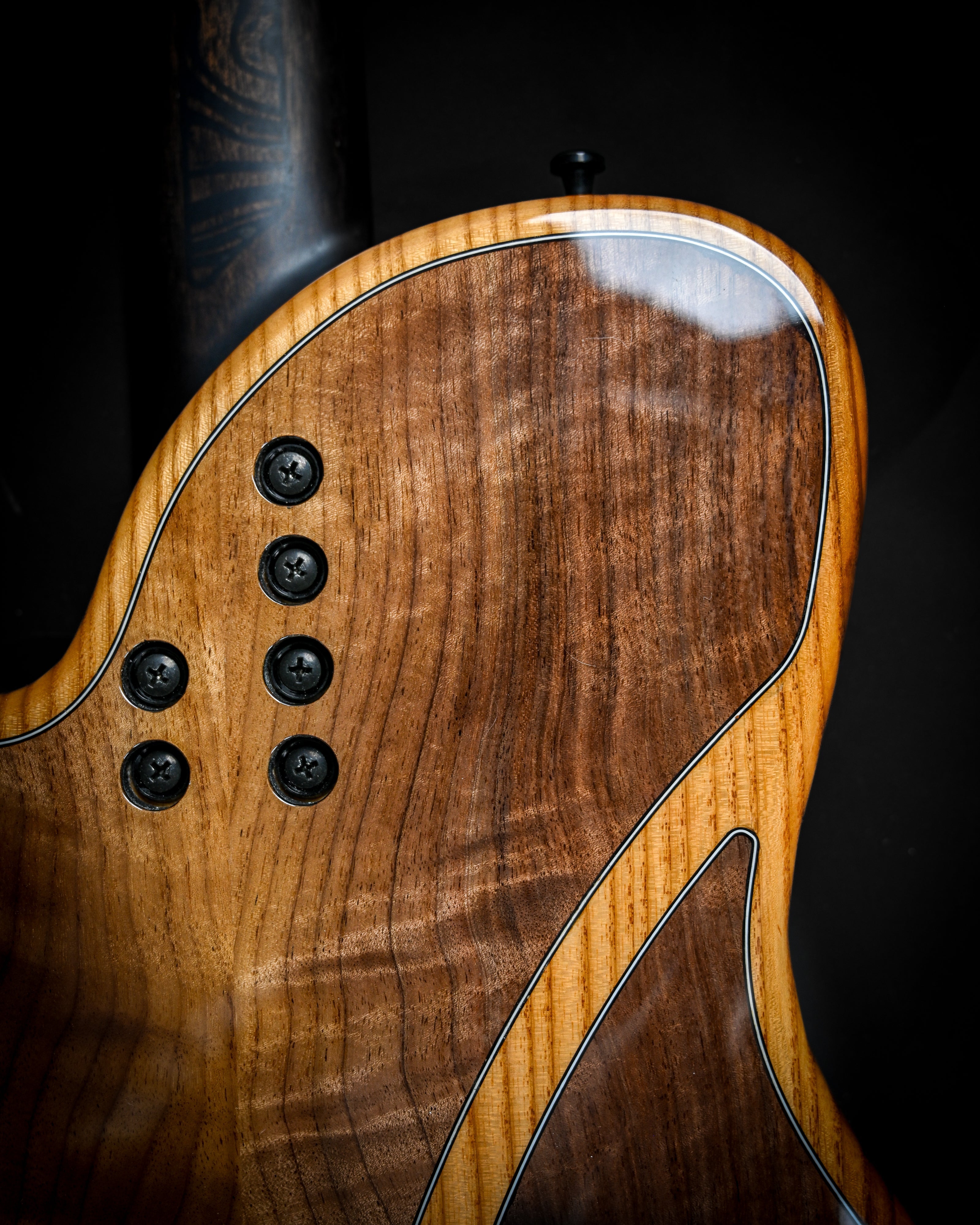
Every neck joint argument I've ever heard is conducted on the wrong axis, and conducted with enormous confidence. People argue tone. They argue sustain, "coupling," resonance, the warmth a glued joint supposedly transfers that four screws and a steel plate supposedly can't.
It's a satisfying argument because it sounds like physics. It almost never has to survive contact with a measurement.
So let's start with the measurement, because that's the part the legend skips.
The experiments, and what they found
There are two studies. Not many for a debate this old, but two more than the other side has ever produced.
R.M. Mottola, writing in American Lutherie #91, built a rig to settle the sustain question with instruments made specifically for the test. He ran power analysis, spectrographic analysis, and blind listening. The longest sustain turned up on the bolt-on necks. The shortest turned up on neck-through construction — the design marketed precisely on its supposedly superior sustain. And when listeners heard single notes played back, they could not reliably tell the joint types apart at all.
The second study is from the Sorbonne's musical-acoustics lab. Paté, Le Carrou, Navarret and colleagues — Acoustics 2012, Nantes — built three guitars based on a Gibson Les Paul Junior, identical except for the junction: screwed, glued, or neck-thru. Same hardware down to the pickup, the differences made invisible. Twenty-two expert guitarists, thirteen of them professionals, played all three blind. The result, as we'll see in detail later: rankings split almost evenly, the neck-thru most often landed in the middle, and the researchers themselves observed that the neck-thru's reputation may be a commonly held opinion rather than one grounded in actual comparative experience.
I'm not going to oversell either of these. Two studies on small populations of purpose-built instruments are not yet a closed file. But sit with the asymmetry, because it's the whole essay. The conventional hierarchy — neck-through best, set neck middle, bolt-on worst — has been repeated for fifty years with no controlled measurement behind it. The two times anyone actually measured, the results came back flat to reversed.
The burden of proof has always sat with the glued-joint camp. Both times anyone tried to meet it, the evidence walked the other way.

Take notes, this is some serious business
Blame Leo
It's worth pausing on how we got here, because the cheap-versus-premium hierarchy in everyone's head wasn't built by acoustics. It was built by manufacturing economics and brand positioning, and then it hardened into received wisdom.
When Leo Fender designed the Telecaster in 1949–50, he didn't choose a bolt-on neck because it was cheap. He chose it because it was serviceable. Fender came out of a radio repair shop, not a lutherie school. He spent his days fixing other people's gear and listening to gigging musicians complain about it, and the design brief he wrote for himself was explicit: build instruments that working players could maintain, modify, and repair without scrapping them.
The detachable neck wasn't a compromise to hit a price point — it was the engineering principle of the whole guitar. Modular construction. Replaceable wear parts. A neck a tech could swap on a bench in twenty minutes instead of a workshop job that took a week.
The cost advantage came along for the ride. Because bolt-on construction was friendlier to a production line, it also happened to be cheaper to manufacture — which is what eventually got the design tagged as "the budget option." Lower-end importers adopted it for exactly that reason in the decades that followed, and a generation of badly cut neck pockets and stripped screw holes did the rest. People stopped seeing the engineering and started seeing the price tag.
Meanwhile, Gibson and the traditional luthiery world had a story they were happy to keep telling. Set necks were what real guitars had. They came from the older European tradition, they required more skill, they were expensive because they were better. The neck-through era in the 1970s and 80s added another layer: "string-through-body coupling," continuous wood, premium billet, the marketing language of unbroken vibration paths. None of it had measurement behind it. All of it sold guitars.
This is the IRYW move, and it's the same one I keep making in this series. A commercial story gets mistaken for a physical one. The market repeats it, players inherit it as common sense, and by the time anyone thinks to measure, the legend is older than the people questioning it.

The face says it all
Rigged, again
Here's the other reason the legend feels so true: almost nobody is comparing joints. They're comparing price brackets and calling it a comparison of joints.
Think about what a typical bolt-on looks like in a player's mind, and what a typical neck-through looks like. The bolt-on is the cheap import — soft wood, a loose pocket, four coarse screws driven into stripped holes, a neck that rocks if you breathe on it. The neck-through is the high-end showpiece — premium billet, careful construction, a price tag three times higher. Then someone plays both, declares the expensive one sounds better, and credits the joint.
Of course it sounds better. It is better — at everything except the one variable supposedly under test. You haven't isolated the neck joint; you've confounded it completely with wood quality, build precision, hardware, setup, and cost. It's like concluding that manual transmissions are faster than automatics by racing a tuned sports car against a tired economy hatchback. The transmission isn't what you measured.
This is why Mottola's purpose-built instruments matter so much. When you hold everything else constant and change only the joint, the spread you were so sure about mostly evaporates. The legend survives precisely because that controlled comparison almost never happens in the wild.
More Contact, More Transfer, More Sustain
Now the intuition the legend rests on. A neck-through is one continuous piece of wood, so the string's energy supposedly flows uninterrupted from nut to bridge. A set neck makes broad glued contact. A bolt-on just clamps two pieces together with a pocket and some screws. More contact, the story goes, means better transfer, means more sustain. It sounds obvious.
It's backwards, and it's backwards in a way worth understanding.
Sustaaaaaaaaaaaaaaain

You have no idea how much work it is to find these pictures
A vibrating string is an energy store. It rings as long as it holds its energy and dies as fast as it leaks it. The string couples to the rest of the instrument mainly at the bridge and the neck, and string-to-structure coupling happens mostly up at the neck.
What matters at that coupling point is not how much wood is touching. It's mechanical impedance — how stiff and how massive the boundary is that the string is anchored to.
And here's the counterintuitive part. For sustain, you do not want the string to transfer its energy efficiently into the body. Efficient transfer is exactly how a string goes quiet: it pours its motion into the wood, the wood damps it, the note dies. You want the opposite — a stiff, high-impedance boundary that reflects energy back into the string instead of swallowing it. Long sustain comes from a structure that refuses the string's energy, not one that welcomes it.
Seen that way, the Mottola result stops being a paradox. A continuous neck-through has more distributed mass and more uninterrupted wood for vibration to travel into and dissipate — more pathways to bleed the string dry. A bolt-on, clamped hard, presents the string with a rigid, reflective wall.
This isn't hand-waving from first principles, either. A team at the Sorbonne's musical-acoustics lab — Paté, Le Carrou, Navarret and colleagues — built three guitars identical except for the junction and measured the driving-point conductance at the neck, the quantity that captures how readily energy leaves the string at that point. The pattern they found: where neck conductance is high at a note's frequency, that note's fundamental decays unusually fast. High conductance, energy drains, note dies young. It's the impedance argument caught in the act.
I'll flag the honest caveat now rather than bury it: the relationship held for most notes but not all — they found a non-negligible number of exceptions, where a high conductance reading didn't produce fast decay, or fast decay appeared with no conductance peak. The neck is clearly the dominant leak, but it isn't the only one, and any builder who tells you the physics is fully solved is selling something. What's not in dispute is the direction: sustain lives or dies at the neck, which is precisely the variable the "continuous wood transfers better" crowd never tested.
Where Notes Go to Die
If you want peer-reviewed confirmation that this is how electric guitars actually behave, look at the dead-spot literature — particularly the work of Helmut Fleischer at the Universität der Bundeswehr München, who measured electric guitar and bass vibrations using laser Doppler vibrometry across dozens of instruments.
A dead spot is what happens when a specific fretted note hits a resonance of the neck. The string and the neck start vibrating at the same frequency, energy floods out of the string into the neck, and the note dies in a fraction of its expected sustain. You can predict where dead spots will fall on a given instrument purely from the neck's measured resonant frequencies — they aren't mysterious, they aren't subjective, and they aren't tonewood.
They are a coupling failure between string and structure, and Fleischer's framing of why they happen is the cleanest possible statement of the impedance argument: when the string's support is non-rigid, energy flows out of the string and the signal decays faster than it would with a rigid support. Higher impedance at the support means longer sustain. Lower impedance means death.
I have to be careful here, because honesty is the whole point of this series. Fleischer and Zwicker explicitly investigated whether joint type — bolt-on versus glued — showed up in the conductance measurements, and they found no clear difference. So I am not going to claim bolt-on guitars have fewer dead spots. That would be inventing data, and inventing data is what I'm accusing the other side of.
What the dead-spot literature does confirm is the underlying physics: sustain is governed by impedance at the string's support, the neck dominates that support, and what kills sustain is the neck being too easy to move, not the joint being too easy to disassemble. The variable people fight about isn't the swing variable. The variable people don't talk about — overall neck stiffness, headstock mass distribution, support rigidity — is.
The bolt-on debate has been about the wrong joint property for fifty years.
The Bolt Is the Point
This is where the screws earn their keep. A glued joint relies on the adhesive layer and two mating wood faces. A torqued bolt-on adds something a glued joint doesn't have: clamping preload. The bolts don't just hold the neck on — they squeeze the joint into a single rigid body under sustained mechanical tension.
That preload tends to raise the stiffness of the coupling, the exact property the impedance physics says matters. The "weakness" everyone imagines — that it's only bolted, not truly bonded — is, mechanically, closer to a strength. You're not making gentle contact. You're putting the joint under load and locking it there.
But this argument only holds for a properly built bolt-on. The cheap-import reputation isn't unfair — it's earned, by a generation of guitars where the joint was executed badly. So before I keep claiming engineering virtues, let me define what a real bolt-on joint actually looks like, because the difference between the bench-built version and the assembly-line version is the difference between everything I've just said being true and being aspirational.
The neck pocket has to be cut to tolerance on all five surfaces — bottom and the four walls — so the neck contacts the body across its full footprint, not just at a few high spots. Any gap, any rocking, any shim stack stuffed under the heel to cover a sloppy cut, and the impedance argument collapses; you've replaced rigid coupling with a wobble. The screws have to be tightened in sequence to even out preload across the plate, the way you'd torque a cylinder head, so one corner isn't carrying load the others aren't.
The neck plate matters too — it's there to distribute the clamping force across a larger area of the back of the body, which is why a proper steel plate is non-negotiable and why the cosmetic chrome covers on cheap guitars are missing the point. And the heel itself wants to be dense, straight-grained hardwood that can take sustained compression without crushing.
Do all of that and the bolt-on isn't a compromise on a glued joint. It's a stiffer, more deterministic version of one.

Screws Are for Drywall
And you can take that logic further than Fender ever did. The traditional wood screw bites directly into the heel, and soft maple is a poor thread material — drive it hard enough for real preload and you crush fibers; remove and reinstall the neck a few times and the hole strips.
Threaded inserts fix this at the root. You set a steel insert into the heel and run a machine screw into metal threads, which gives you a true, repeatable, high-clamping joint — a metal-to-metal connection that holds its preload and survives being taken apart again and again. Tighter, more consistent clamping means less energy lost at the joint and a stiffer coupling, which is the whole sustain argument made deliberate instead of accidental.
I'll keep myself honest here, because IRYW only works if I do: not everyone can measure a tonal difference from inserts. At least one veteran tech has gone at it with an oscilloscope and an RTA and found nothing he'd stake money on. So I won't promise inserts make your guitar sing. What they unarguably do is give you the stiffest, most repeatable version of the joint — and a neck you can remove a hundred times without ever chewing out the wood.
The performance case is plausible. The serviceability case is a certainty.
Three Necks, One Tele
The abstract durability argument is easy to nod along to. What it means in practice is harder until you've seen it.
A working pro pulls the neck off her Strat to fly with it, every tour, for fifteen years. Same neck, same body, four screws each way. The instrument arrives in tune most of the time and back in tune within a minute the rest. Try that with a Les Paul.
A Telecaster comes through the shop with its third neck. The first one twisted in a humid summer in 1982, the second cracked at the headstock in a fall in 1997, and the body is still the body the original owner bought new — same routing, same finish, same wear pattern around the bridge plate. Three generations of necks, one guitar.
A Les Paul comes through the same shop with a headstock break, which is the joint Gibson buyers have been quietly accepting as a known failure mode for sixty years. The repair is competent. The guitar is never the same. It sounds different, plays different, sits in the rack for years before the owner sells it. The player isn't wrong — something is different — but the guitar was never designed for the repair it just received. It was designed for the moment before the repair was needed.
These aren't anecdotes about which guitar is better. They're about which design philosophy expects something to go wrong. One expects it. One doesn't. Guess which one ages better.
You Heard What You Paid For

There's a deeper reason this argument resists evidence, and I've written about it before — in Vol. IV, on tonewood, and in Vol. V, on beauty. Players hear with their expectations. When you've been told for thirty years that neck-throughs sustain longer, your ears confirm it, because that's what ears do.
The legend isn't just a bad theory; it's installed perceptual machinery. Players who own neck-throughs hear the sustain they paid for. Players who own bolt-ons hear the snap and attack they were promised would compensate for the sustain they're not getting.
The blind listening in Mottola's rig, and the blind rankings in the Paté study, cut through that machinery exactly when machinery is supposed to fail — under blind conditions, where players can't see what they're holding. Both times, the hierarchy collapsed. The fact that the wider community didn't update on either result tells you the legend isn't operating as a hypothesis. It's operating as an identity. That's not a critique of guitarists — it's how perception works in any expert community. But it's why even two careful studies can fail to move the needle.
The needle isn't connected to the data.
What Nobody Has Measured
I want to be plain about the limits of my own argument, because we need more data is the slogan of every honest person in a contested field, and I'd be a hypocrite to skip it.
The two controlled studies are what they are. Both used small populations of purpose-built instruments — Mottola's rig and the Paté team's three Les Paul Juniors — which is necessary for proper variable isolation but limits how confidently you can generalize. Now to what those studies actually showed, in detail, because the Paté findings deserve unpacking.
The blind rankings split 7/8/6 across screwed, glued, and neck-thru. Statistically, a wash. But the neck-thru — the construction the guitarist world treats as the premium option — landed most often in the middle. The researchers flagged the irony themselves: the neck-thru's superiority, they wrote, may be a commonly accepted opinion rather than one grounded in actual comparative experience. That is the entire thesis of this essay, stated by a peer-reviewed acoustics lab that went in with no axe to grind.
And note what the players cared about. Of all the criteria they volunteered, "sustain" — the thing every advertisement screams about — was chosen by only five of twenty-two, and wasn't the deciding factor for any of them. The feature the marketing sells hardest is the one the players reached for least.
I'll keep the honesty discipline, though. The Paté study's cleanest finding is disagreement — no consensus that any junction sounds better — which supports "the hierarchy is a myth," not "bolt-on is best on tone." Mottola found bolt-on sustaining longest; the Paté team found no reliable difference and the neck-thru reputation unearned. Used together honestly: not one controlled study has ever found neck-through superior.
That's still not the definitive study — thirty instruments, identical wood lots, blind listener panels at scale, sustain-decay instrumentation across all twelve frets of the first position. That study doesn't exist. It should.
Until it does, the honest position isn't bolt-on is proven better. The honest position is every controlled measurement we have either leans bolt-on or finds no reliable difference, the physics points the same way, and the opposite camp has been running on faith for half a century. That's enough to flip the burden of proof. It is not enough to close the file.
Maybe I'm Not So Right
This is an IRYW essay, so I'm obligated to argue against myself, and here it's easy, because the glued-joint people have real points.
A set neck or neck-through with no heel block gives genuinely cleaner access to the top frets. A glued joint has no neck pocket, so it can't suffer the failure mode of a sloppily cut one — the gap, the wobble, the shim stack hiding under the plate. And a properly cut dovetail is one of the most honest pieces of joinery in the instrument; it's hand skill made visible, and it earns its respect. All true.
But notice what every one of those advantages is about: fit, feel, and craft. Not measured performance, and not durability. The glued joint wins on the things you admire when the guitar is healthy — and it has the most to lose the day the guitar isn't, which is the part nobody markets.

Are you suggesting that ergonomic bolt-ons were possible since the beginning ?
Beware of Your Neck Wear
Frets are consumables. Truss rods seize. Nuts wear out. Wood moves with the seasons no matter how well it was dried, and necks twist. And then the failure nobody plans for — the drop, the headstock break, the case that came off the amp. The neck takes the hit, because the neck is out front.
On a bolt-on, almost every one of those is contained. A bad fret level is bench work; a dead truss rod, a broken headstock, a tired thirty-year-old neck — back out four screws, and the body lives on. The repair is modular because the construction is modular.
On a glued joint, a reset means steam, patience, and real risk to surrounding wood and finish, and a bad enough break can total an instrument that's otherwise perfect. There's a quiet irony here too: a flawed neck-through can force you to scrap a flawless body, because the two were never meant to part.
A guitar you're afraid to gig is not performing. It's being insured.
The Truth, Finally
On performance: the joint barely matters, the one real measurement leans toward bolt-on, the impedance and preload physics points the same way, and most of the "evidence" against it turns out to be a comparison of price tags wearing a lab coat. We need more data, and so does everyone who's insisted on the opposite for half a century with none at all.
On durability: it isn't close. The neck is the part most likely to need work, and the bolt-on is the only joint that treats that as a design input instead of a tragedy.
Glue it if you want the joinery. Bolt it — properly, into steel — if you want the guitar, the sustain, and the next thirty years.
More words, more incredibly well cured illustrations
More of me being right. More of you being wrong.


Partager :
The Truth about Intonation
The Truth About Dead Spots