



Scale length is one of those guitar specifications that everyone repeats and almost no one examines. It gets quoted in inches with great confidence — 25.5", 24.75", “Fender scale,” “Gibson scale” — and then loaded with claims about tone, sustain, warmth, brightness, and feel that range from accurate to half-true to flatly wrong.
This article does what the rest of the series does: it separates what scale length actually does, mechanically and measurably, from what the internet has decided it does. Some of the common wisdom holds up. A surprising amount of it is folklore dressed as physics.
And a few of the most repeated claims — the reverse headstock changing your tone, the idea that the wood behind the nut or bridge is doing something — are simply false, in ways that are easy to demonstrate once you understand what scale length is.
So let’s start there.
What scale length actually is
Scale length is the vibrating length of the open string: the distance from the nut to the saddle. That’s it. It is the length of string that is free to vibrate when you play an open note.
Two things follow immediately, and both matter for the myths later.
First, scale length is a theoretical measurement. On almost every guitar, the figure printed on the spec sheet is not something you can measure directly with a ruler from nut to saddle, because the saddles are deliberately set back from their theoretical position to correct intonation.
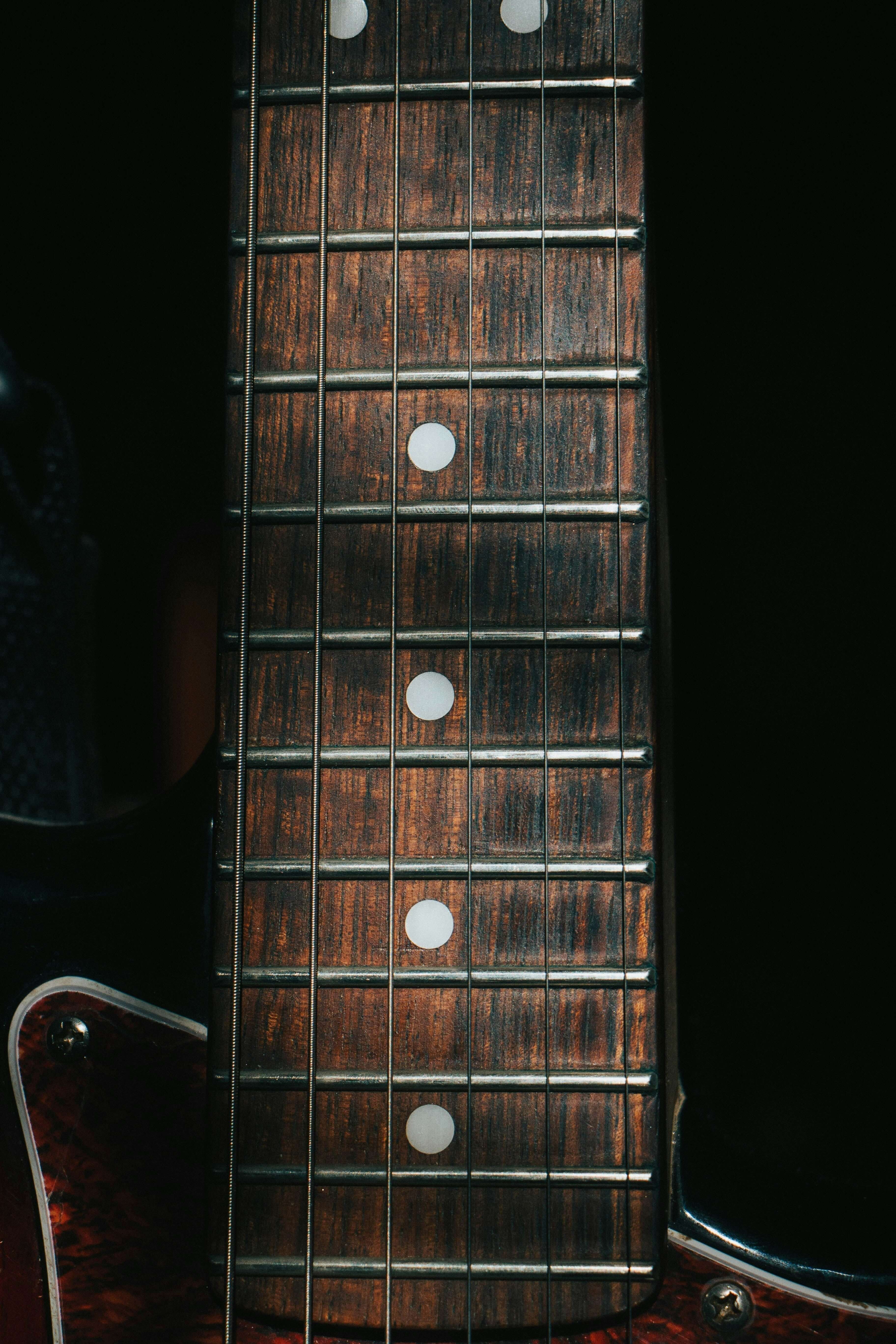
The standard way to find the true scale length is to measure from the nut to the center of the 12th fret and double it. The 12th fret sits at the exact mathematical halfway point of the vibrating string. The saddle then gets compensated — moved back by a few millimeters, more on the wound strings — so that the fretted notes play in tune despite the string stretching slightly when you press it down. So “25.5 inches” describes the geometry the fretboard was built around, not the literal nut-to-bridge distance.
Second — and this is the foundation for half of what follows — only the length between the two contact points vibrates. The string continues past the nut to the tuners, and past the saddle to the bridge anchor or the tailpiece. None of that string length is part of the scale. None of it vibrates as part of the played note. Hold that thought; we’ll need it.
How fret spacing works (and why the math is fixed)
The position of every fret is determined entirely by the scale length, through one constant: the twelfth root of two, roughly 1.0594631.
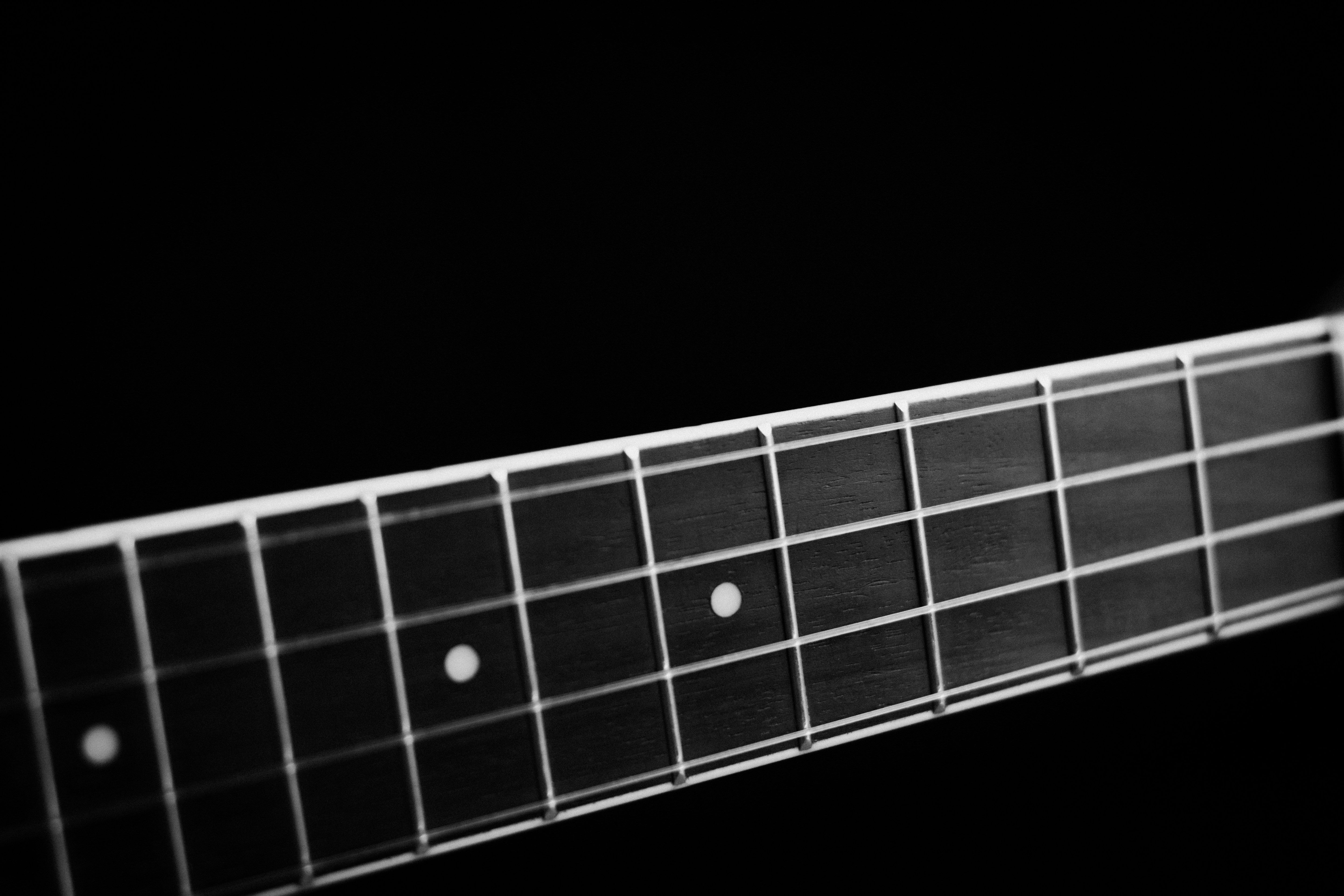
Each fret divides the remaining string length so that every semitone is the same ratio as the last. The distance from the nut to the first fret is the scale length divided by 17.817. The octave — the 12th fret — lands at exactly half the scale length. This is equal temperament, and it’s why a longer scale spreads the frets further apart and a shorter scale packs them closer together.
This is also why scale length is felt before it’s heard. A player moving from a 24.75" Gibson to a 25.5" Fender notices the stretch in the lower frets first, where the spacing difference is largest. Over the whole fretboard the geometry is fixed and non-negotiable: you cannot change fret spacing without changing scale length, and you cannot change scale length without moving every fret. The two are the same fact described two ways.
What scale length does to feel: string tension
This is the real, dominant, measurable effect of scale length, and it’s worth getting precise about because the popular version is slightly wrong.
For a given string — same gauge, same material — tuned to the same pitch, a longer scale length requires higher tension. The relationship is direct: tension rises with the square of the vibrating length for a fixed pitch and string. Move from 25.5" to 24.75" and, all else equal, tension on each string drops by roughly 6%. That isn’t enormous, but it’s clearly felt in the hands.
Higher tension (longer scale) means:
• The strings feel stiffer and push back harder under the fingers.
• Bends take more effort and the string resists more.
• The attack feels tighter and more defined, especially in the low end.
Lower tension (shorter scale) means:
• The strings feel slinkier and more forgiving.
• Bends and vibrato come easier.
• The feel is looser, sometimes described as “rubbery” at the extremes.
This is the single most important thing scale length does, and notice that it’s a feel property first. The reason short-scale instruments are often recommended for players with smaller hands, or for beginners, isn’t only the narrower fret spacing — it’s that the lower tension is simply easier to fret and bend.
There’s a practical lever here that the spec sheet hides: you can compensate. A longer-scale guitar strung with lighter gauges and a shorter-scale guitar strung with heavier gauges can be brought to very similar tension. Tension is a product of scale length, gauge, and pitch together — not scale length alone. This matters enormously for the tone discussion, because it means many of the “tonal” differences attributed to scale length are really tension differences, and tension can be dialed in by string choice independent of scale.
What scale length does to tone
Here is where the folklore is thickest, so let’s be careful.
The honest version: scale length has a real but secondary effect on the tonal character of a plucked string, and it works through tension and through the harmonic content of the string’s vibration — not through any magic in the number itself.
The defensible claims
A longer scale, at higher tension, tends to produce a tighter, more focused low end and stronger upper harmonics — what players hear as “clarity,” “tightness,” or “brightness,” particularly noticeable on the low strings of a baritone or a drop-tuned instrument. The higher tension lets a thicker string vibrate more cleanly without flopping, so the fundamental stays well-defined. This is the genuinely useful insight behind long-scale and multiscale instruments for low tunings: it’s not that the wood got brighter, it’s that the string is under enough tension to behave itself.
A shorter scale, at lower tension, tends toward a warmer, rounder, more compressed character with a slightly softer attack. The string’s reduced tension and the different balance of harmonics produce what’s commonly called the “short-scale” sound — the thing people are reaching for when they describe a short-scale bass as “vintage” or “thumpy.”
Where the folklore overreaches
The claim that scale length is a primary driver of an electric instrument’s tone does not survive contact with the signal chain. On a solid-body electric, the dominant factors are the pickups, where they sit under the strings, the strings themselves, and everything downstream — amp, speaker, room. (This is the same conclusion the tonewood article reached, for the same reasons.) Scale length is in the mix, but it is not near the top of it.
The phrase “more sustain” attached to longer scales also deserves a caveat. Higher tension stores more energy in the string, and that can contribute to sustain — but sustain on an electric is governed far more by the rigidity of the neck and body, the quality of the nut and saddle coupling, fretwork, and the pickup’s magnetic pull on the strings than by the scale figure. A well-built 24.75" instrument will outsustain a poorly-built 25.5" one every day of the week. Sustain is a system property, not a scale-length property.
The most useful way to think about it: scale length sets the conditions the string vibrates under. It does not, by itself, make a guitar bright or warm. It biases the string toward certain behavior, and that bias is real, but it’s one ingredient among many — and on an electric, several of the others are louder.
The myths worth killing
This is the part the series exists for. These claims circulate endlessly and they’re either false or badly confused.
The reverse headstock myth
The claim: a reversed headstock changes your tone — usually said to make the guitar brighter, snappier, or to “tighten” the low strings — because it lengthens the string behind the nut on the bass side and shortens it on the treble side.
The reality: it does not change your tone, because the string behind the nut is not part of the vibrating length. Your scale length is fixed by the nut-to-saddle distance, and reversing the headstock does not move the nut or the saddle. The played note is identical.
What a reverse headstock does change is the length of dead string between the nut and the tuner. On a standard headstock the low strings have the shortest run to their tuners; reverse it and the low strings now have the longest run. This changes two real things: the tension behind the nut (which affects break angle and how the string sits in the nut slot, with minor consequences for tuning stability and feel) and, very subtly, the “give” or compliance the player feels when bending, because there’s slightly more string available to stretch. Some players genuinely prefer the feel. That’s a legitimate reason to want one.
But the pitch, the harmonic content of the open string, the scale length — none of it changes. The reverse headstock is a feel-and-aesthetics decision, occasionally a tuning-stability one. It is not a tone mod, and anyone telling you it brightens your sound is describing a placebo or confusing it with the genuine tension-behind-the-nut feel difference.
The “extra length past the contact point does something” myth
This is the reverse headstock myth’s parent, and it’s worth stating in full generality: string length beyond the nut and beyond the saddle is acoustically dead. It does not vibrate as part of the note. It contributes nothing to pitch and nothing to the fundamental tone.
This is why string-through-body versus top-load bridges, the distance from saddle to tailpiece on a Tune-o-matic, the length of string wrapped around the tuner post — none of these change your scale length or your fundamental pitch. They are outside the two contact points.
Now, the honest footnote, because precision is the whole point of this series: the dead length is not perfectly inert. The break angle over the nut and saddle, and the amount of string behind them, affect how firmly the string is seated against the contact points, the downforce on the saddle, and therefore the efficiency of energy transfer and the string’s compliance under bending. String-through-body construction increases break angle over the saddle, which some players feel as a stiffer, more “locked-in” response. These are second-order effects on feel and energy coupling — real enough to discuss, far too small to be the tonal transformation the marketing implies. The fundamental pitch and the scale length are untouched. Anyone who tells you a string-through body “adds sustain and tightness” is pointing at a real but tiny coupling effect and inflating it into a tone story.
The “longer scale = objectively better” myth
There is no better. Scale length is a set of tradeoffs, not a quality ladder. Longer gives tension and low-end focus at the cost of stretch and bending effort. Shorter gives ease and warmth at the cost of low-end definition in extreme tunings. Pick the one that suits the music and the hands. A 25.5" guitar is not a more serious instrument than a 24.75" one; it’s a different tool.
The “you can hear a quarter-inch” myth
The difference between 25.5" and 25" is real on paper and essentially inaudible as a tonal change in isolation, on a solid-body electric, through an amp, in a mix. What you might feel is the small tension difference. What you will almost never identify in a blind test is the scale length from tone alone. Most of what players attribute to small scale differences is the tension change, the string gauge they happened to pair with it, or expectation. The further apart the scales (a 24" short-scale versus a 27" baritone), the more there is to actually hear — but a half-inch is a feel difference, not a tone fingerprint.
The common scale lengths, and what they’re actually for
|
Scale |
Common on |
Character |
|
24.0" |
Short-scale electrics (Jaguar, Mustang) |
Slinky, warm, easy bends; lower tension |
|
24.75" |
Gibson-style (Les Paul, SG, 335) |
Warmer, looser feel, closer frets, easier bends |
|
25.0" |
PRS |
A deliberate middle ground between the two camps |
|
25.5" |
Fender-style (Strat, Tele) |
Brighter, tighter, more defined; a long-standing standard |
|
26.5"–27" |
Baritones, 7/8-string |
Tension to keep low tunings clear and defined |
|
28"+ |
Extended baritones, some basses |
Built for very low tunings |
The PRS choice of 25" is the most instructive entry in that table: it’s a designer deciding, explicitly, that the half-inch between the two dominant scales is a usable middle — slightly tighter than Gibson, slightly slinkier than Fender. That’s scale length used as a deliberate design lever rather than an inherited default. It’s also a quiet admission that the difference between the camps, while real, is small enough that splitting it is a viable third option.
Basses
The same logic applies, scaled up. Short-scale basses (around 30") give the warm, round, fundamental-heavy “thump” associated with a lot of vintage recordings, plus an easier reach that matters more on a bass-sized neck. Long-scale (“standard,” around 34") gives the tighter, more articulate, more defined low end that most modern playing assumes. Extra-long (35"+) exists to keep a low B clear and tight on 5- and 6-string basses — the same low-tuning logic as the guitar baritone. On a bass the tension and reach differences are larger and more consequential than on a guitar, which is why short-scale versus long-scale is a more serious decision for a bassist than for a guitarist.
Multiscale: the one place scale length is a genuine design tool
Multiscale (fanned-fret) instruments give each string its own scale length — longer for the low strings, shorter for the high ones — by angling the frets. A typical guitar fan might run 25.5" on the low E to 24" on the high E; a baritone or extended-range fan goes wider.
This is the most honest and useful application of everything above, because it treats scale length as exactly what it is: a tension-and-clarity lever applied per string. The low strings get the longer scale they need to stay tight and defined, especially in low tunings. The high strings get the shorter scale that makes them easier to bend and gives them a warmer, less brittle top. Each string sits in a tension range that suits it, instead of the whole instrument compromising on one figure.
The tradeoffs are real and worth being straight about. There’s an adjustment period — the angled frets look alarming and feel slightly unfamiliar for the first while, particularly around the perpendicular fret where the fan reverses direction. Chording high up the neck takes a short recalibration. And the instrument is harder to build well, which is reflected in the price. But the ergonomic and tonal logic is sound, not marketing: it’s the only design that lets you stop compromising between the low string’s needs and the high string’s needs. For extended-range and low-tuned instruments especially, it’s less a gimmick than the correct answer to a real problem.
One caveat in keeping with the rest of this article: multiscale solves a tension-and-clarity problem, and it solves it genuinely. It does not transform a six-string in standard tuning into a different-sounding instrument. The benefit scales with how far you’re pushing into low tunings and wide ranges. On a standard-tuned guitar the advantage is mild and mostly ergonomic; on a 7- or 8-string in a low tuning it’s substantial.
So what should you actually take from this?
Scale length is real, and it matters — but it matters in a specific and limited way that the common wisdom consistently misstates.
It is, first and foremost, a feel specification. It sets fret spacing, which your hand notices immediately, and it sets string tension for a given gauge and pitch, which your hand notices constantly. Those are the effects you will actually experience.
Its tonal effect is real but secondary, and it works entirely through tension and harmonic content — not through any property of the number itself. On an electric, it sits well below the pickups, strings, and amplifier in order of importance. The further apart two scales are, the more there is to hear; a half-inch is a feel difference, not a sound you’ll pick out blind.
And the length of string beyond the nut and the saddle does nothing to your pitch or your fundamental tone. The reverse headstock doesn’t brighten you. The string-through body doesn’t add meaningful sustain. These contact-point-and-beyond effects are real only as small changes in feel and energy coupling, and they get wildly overstated.
The most useful frame, the one we build instruments around: scale length sets the conditions under which the string vibrates. Choose it for the tension and reach the music wants, pair it with the right string gauge, and let the pickups and the amp do the work they’re actually responsible for. Everything else is folklore.
No fluff, no dogma — just the geometry, and what it does.

Share:
A Pro Luthier’s Bibliography
Man or Machine ?