



Even the best guitar in the world loses performance if it is not perfectly set up. Humidity, temperature changes, time, or simply regular use can affect its stability, playability, or tuning accuracy. A good setup not only transforms your playing experience but also extends the life of the instrument.

Here are the five warning signs you should watch for: if you notice them, it’s probably time to have your guitar professionally set up.

  1. Your strings buzz or some notes no longer sound

A metallic “buzz” on certain frets, muffled notes, or notes that don’t sound at all? These symptoms often indicate a neck relief issue (improperly adjusted truss rod), too low action, or worn or uneven frets.

A good setup consists of precisely adjusting the neck’s curvature, saddle height, and fret leveling to ensure clean, smooth, and silent play across the entire neck.

  1. You constantly retune your guitar

If your guitar frequently goes out of tune, even after a proper string change, the cause may be:

  • A poorly adjusted or dry nut that binds the strings,

  • An insufficient headstock angle,

  • An unstable or poorly lubricated bridge,

  • Or a neck under tension due to climate variations.

A professional setup checks all these points and ensures lasting tuning stability—essential both on stage and in the studio.

  1. Your notes are out of tune higher up the neck

You are perfectly in tune on open strings, but as soon as you go up the neck, everything sounds off? This is an intonation problem. Each string must be calibrated so that fretted notes match the expected pitch exactly.

Adjusting intonation means fine-tuning the length of each string at the bridge according to its gauge and the neck geometry. Without this, even the best pickups cannot compensate for poor tuning accuracy.

  1. Your guitar is tiring to play

An instrument that “pulls” too hard on your fingers, requires excessive effort for each bend, or exhausts you within minutes is not a good playing companion. But this doesn’t mean the guitar is bad — it may simply be poorly set up for you.

A good luthier will adapt the action, radius, string gauge, and even the truss rod adjustment to your playing style and personal preferences, for a custom playing comfort.

  1. Crackling or signal dropouts

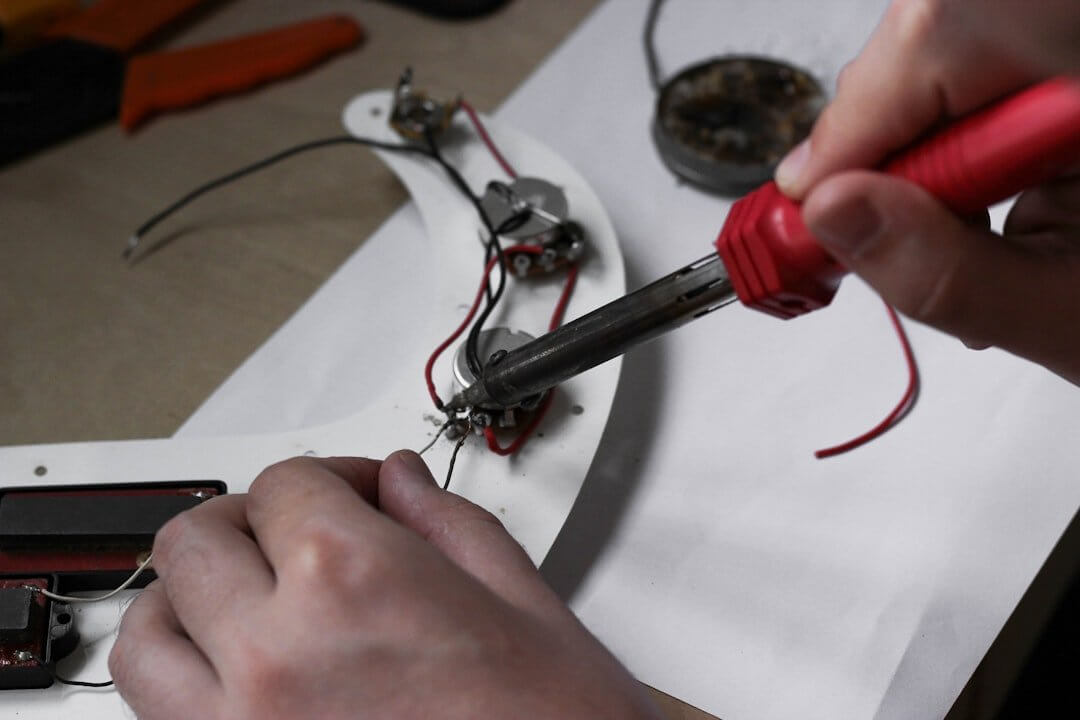
Electronic problems can go unnoticed but quickly accumulate: scratchy pots, weak pickups, unstable jack, dry solder joints, oxidation... These issues can degrade your sound or cause dropouts mid-performance.

A full circuit inspection, component cleaning, and connection checks ensure a clean, reliable signal, ready to withstand the demands of stage or studio.

Conclusion: Setup is the maintenance of performance

Like a sports car or a precision instrument, a guitar needs regular maintenance to perform at its best. You play better, tire less, and your instrument responds with fidelity and accuracy.

At Belforti Instruments, we apply the same rigor to setups as to the crafting of our instruments: care, precision, listening, and a deep understanding of each musician.
You deserve more than a standard setup: you deserve a custom setup.


Other Articles

View all

Stacks of tonewoods for solid-body electric guitars, highlighting the truth about tonewoods in solid-body electric guitars.

The Truth About Tonewoods in Solid-Body Electric Guitars

What role does wood actually play in shaping the tone of an electric guitar? This article unpacks decades of acoustic research, psychoacoustics, and measured data to separate myth from measurable fact. From damping and resonance to human hearing thresholds, we examine where tonewood matters—and where it doesn’t. Ideal for luthiers, players, and skeptics alike. No fluff, no dogma—just evidence.

Read moreabout The Truth About Tonewoods in Solid-Body Electric Guitars

Paris bridge at dusk near luthiers in Paris – Tradition, Craft, and Innovation in the City of Light.

Luthiers in Paris – Tradition, Craft, and Innovation in the City of Light

Paris has long been a centre of excellence for stringed instrument making, from historic violin masters to today’s innovative electric guitar builders. This article explores the craft, history, and future of luthiers in Paris, and how workshops like Belforti Instruments are blending tradition with modern design to create instruments for musicians worldwide.

Read moreabout Luthiers in Paris – Tradition, Craft, and Innovation in the City of Light

Close-up of guitar neck illustrating Truss Rods and Neck Relief: A Luthier’s Guide to Guitar Setup.

Truss Rods and Neck Relief: A Luthier’s Guide to Guitar Setup

Want your guitar to play smoother and sound better? This guide breaks down everything you need to know about Truss Rods and Neck Relief—from how they work to adjusting them safely. Whether you're a DIY enthusiast or just curious, this luthier-approved article covers the essentials for better tone, action, and playability.

Read moreabout Truss Rods and Neck Relief: A Luthier’s Guide to Guitar Setup

Soldering a guitar potentiometer, showcasing craftsmanship in electronics for the article About Potentiometers.

About Potentiometers

This in-depth guide explores everything you need to know about guitar and bass pots. Learn how different pot values, tapers, and types affect tone and functionality. Whether you're working with passive circuits or active electronics, this article covers the best options for volume, tone, and blend controls—with practical installation tips and insights into modern trends like smart pots.

Read moreabout About Potentiometers

Electric guitar resting on an amp, possibly showing signs it needs a setup. Top 5 signs your guitar needs a setup.

Top 5 signs your guitar needs a setup

Is your guitar no longer responding like it used to? Buzzing strings, approximate tuning, degraded playing comfort… All these signs indicate that a setup is needed.
In this article, we review the five most common symptoms and explain why a professional setup can radically transform your playing experience.

Read moreabout Top 5 signs your guitar needs a setup

Close-up of a hand playing a guitar, illustrating Guitar Setup : What is it ? (and what it isn't)

Guitar Setup : What is it ? (and what it isn't)

A professional setup can make your guitar or bass feel like a whole new instrument — but there’s often confusion around what a setup actually does. This article breaks down what’s included in a setup, what improvements you can realistically expect, and where the limits lie. From action and intonation to pickup balance and tuning stability, we’ll cover how a setup works and how to communicate your preferences to get the most out of the process. Whether you're a seasoned player or new to the world of lutherie, understanding this service will help you play better — and avoid disappointment.

Read moreabout Guitar Setup : What is it ? (and what it isn't)

Strings Attached: Understanding Guitar and Bass Strings - Close-up of red bass guitar headstock.

Strings Attached: Understanding Guitar and Bass Strings

This in-depth guide breaks down the components that make up guitar and bass strings, from core materials and winding methods to gauge selection and lifespan. Learn how tension, construction, and maintenance affect tone and playability. Whether you're a player searching for your sound or a builder refining your craft, understanding strings is essential.

Read moreabout Strings Attached: Understanding Guitar and Bass Strings

Close-up of fret slots being cut on a guitar fingerboard using precision tools. Fretslots. Why ?  Learn about their importance in music.

Fretslots. Why ?

Why Fretslots ? Fret slots are critical to a guitar’s performance, yet often overlooked. This article explores slotting techniques, common pitfalls, and why radiused fret slots are a superior choice for serious luthiers.


Read moreabout Fretslots. Why ?

Custom Guitar 101: Everything You Can Customize

Custom Guitar 101: Everything You Can Customize

Curious about building a custom guitar? This article breaks down every major customization option available in high-end lutherie—from woods and neck profiles to pickups and aesthetic details. Whether you're a seasoned player or a curious first-timer, learn how tools like the Belforti configurator help you design the perfect instrument with ease.

Read moreabout Custom Guitar 101: Everything You Can Customize

2025 Guitar Trends: Materials, Specs, Styles, and Sounds

2025 Guitar Trends: Materials, Specs, Styles, and Sounds

In 2025, the guitar industry embraces a refined balance between tradition and innovation. Sustainability drives tonewood choices, with roasted maple, regional species, and reclaimed materials gaining ground. Specs focus on playability, with compound radius fingerboards, ergonomic necks, and noiseless electronics becoming standard. Visually, vintage-inspired designs meet modern aesthetics like metallic finishes and aged hardware. Sonically, players seek clarity and dynamics over raw power, favoring versatile electronics and responsive pickups. Sustainability is no longer optional — eco-friendly finishes and responsible sourcing are integral to premium craftsmanship. Overall, the guitars of 2025 reflect a market that values comfort, individuality, and environmental responsibility.

Read moreabout 2025 Guitar Trends: Materials, Specs, Styles, and Sounds