



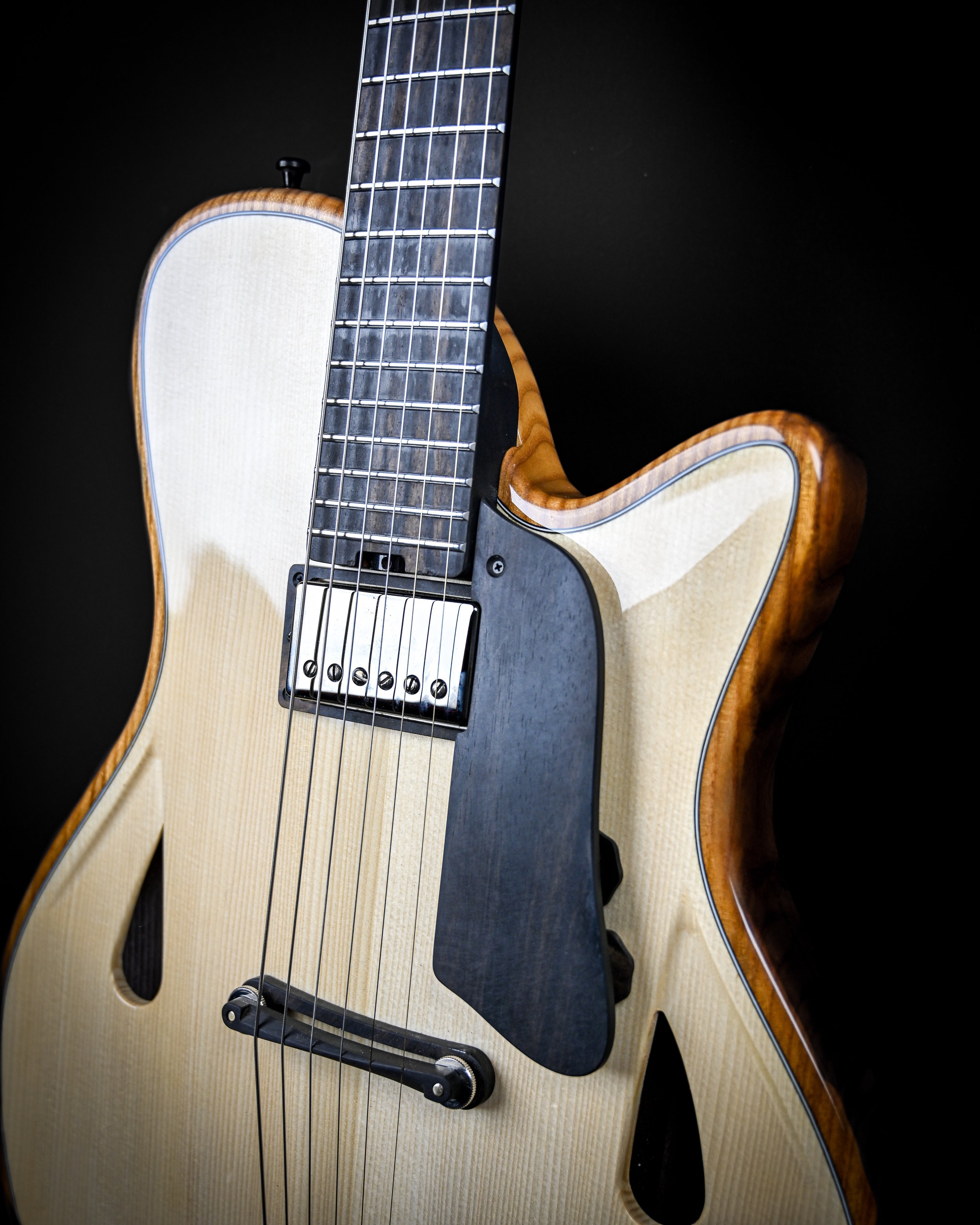
There is a conversation I have had, in some form, several hundred times. It happens at the workshop door, on Instagram DMs, in the comments under videos of beautiful instruments. It begins with admiration, drifts toward curiosity, and lands, almost always, on the same sentence:
“That’s a lot of money for a guitar.”
I want to address this directly, because the assumption embedded in that sentence has quietly become one of the most damaging ideas in our trade. It is not damaging because it is rude — it is not. It is damaging because it is wrong, and because being wrong about this has consequences. It distorts what we expect from instruments. It distorts what the market is willing to support. And, slowly, it strangles the ecosystem of skill, knowledge, and material expertise that makes serious instruments possible at all.
So: guitars should be expensive. Not all guitars — I will get to that — but the kind of guitar that is actually a guitar, made the way a guitar can be made when nobody is cutting corners, should cost what it costs. And that price, in a sane world, would not surprise anyone.
This is the argument.
What is actually in a guitar
Let us begin with the object itself, because most of this conversation suffers from a simple problem: people who buy guitars rarely know what is inside them. Not because they are incurious, but because the industry has spent forty years training them not to look.
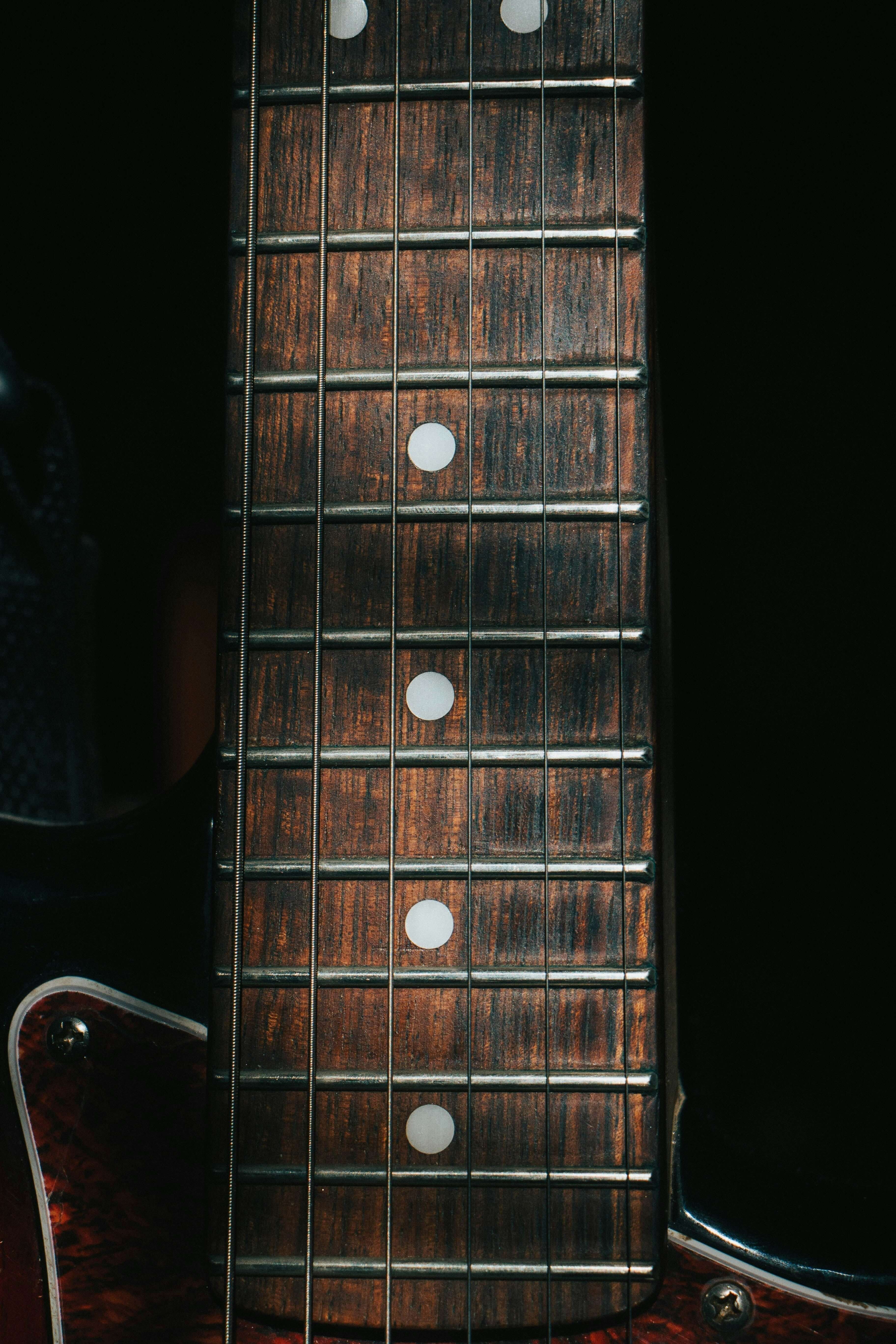
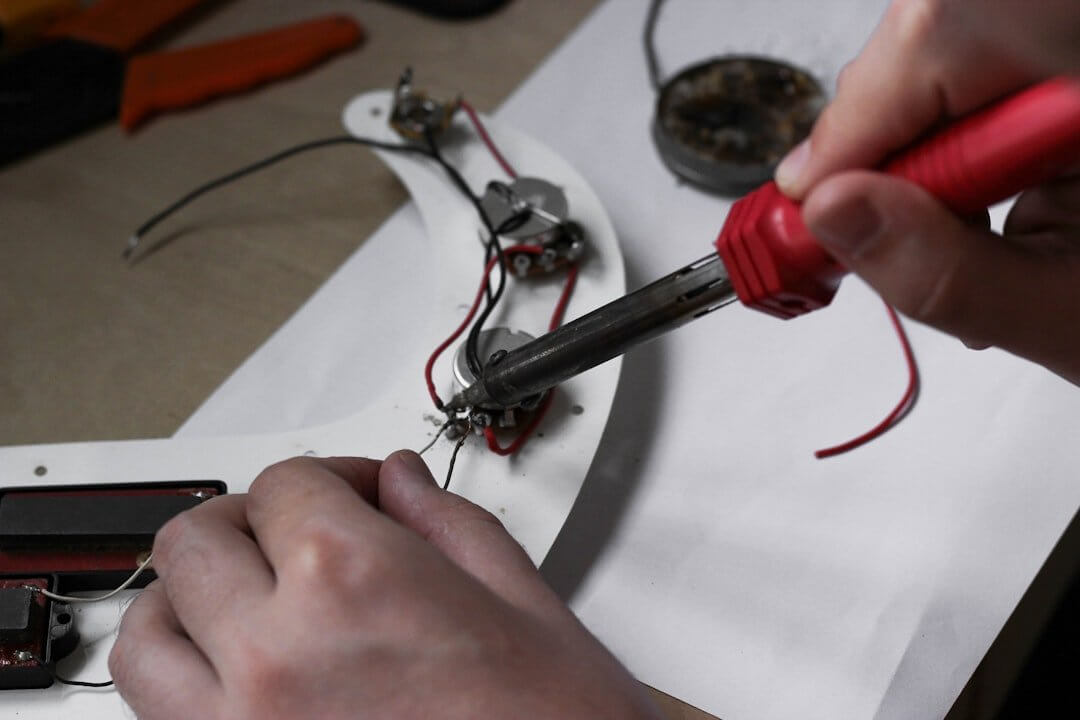
A solid-body electric guitar — the supposedly “simple” instrument — contains, at minimum: a body cut and shaped from tonewood selected for density, grain orientation, and acoustic behaviour; a neck whose carve, scale length, fingerboard radius, and truss-rod geometry must be calculated and executed within tolerances of a tenth of a millimetre; a fretboard slotted and radiused to match that geometry; between twenty-one and twenty-four frets, each crowned, levelled, and dressed so the instrument plays cleanly across its full range; a nut cut to specific string heights and break angles; bridge and tailpiece hardware that must be intonated to actual string behaviour rather than the marketing copy of their manufacturer; an electronic circuit composed of pickups, potentiometers, capacitors, switches, and wiring whose values determine the entire voice of the instrument; a finish — typically a multi-stage system of sealers, fillers, colour coats, and clear coats — that must protect the wood while remaining acoustically inert enough not to choke it; and a setup process that brings all of this into a single playable whole.
That is the short list. It excludes inlay, binding, the headstock veneer, the strap buttons, the truss-rod cover, the tuning machines, the string trees, the cavity shielding, the orientation of the wood blanks in their original log, the moisture content of every component at the moment of glue-up, and the dozen jigs and templates required to do any of this consistently.
An acoustic guitar adds another order of complexity entirely: a thin top braced internally in a pattern that determines its entire acoustic response, sides bent over heat into a structure that has to survive thirty years of string tension without distortion, a neck joint that must transmit energy without failing, and the entire calculus of voicing — that is, of tuning the structural and acoustic behaviour of the box before it is closed forever.
None of this is mysterious. All of it is hard. And every one of these elements is a place where a builder can spend an extra hour, or skip it entirely, and the difference will not be visible in a photograph.

The thing nobody photographs
This is the part of the conversation people miss most consistently: the cost of a guitar is not the cost of materials. It is the cost of decisions.
A boutique builder makes, conservatively, several hundred decisions per instrument. Which billet of mahogany. Which orientation of the grain through the neck blank. How thick to leave the top. Whether to chamber the body, and where. Which fret wire, in which size and alloy. Which pickup, wound to which spec. Which pot taper. Which capacitor value. Which finish system. Which sequence of cuts. Which jig to use, and whether to make a new one. Whether yesterday’s humidity is going to bite tomorrow’s glue joint.
A factory makes those decisions once, twenty years ago, and then makes the same guitar four hundred thousand times. This is not a moral failing; it is the entire point of a factory. It is what factories are for. But it is also why a factory guitar and a workshop guitar are different products, and why pretending they are the same product at different prices is the central confusion of our market.
When you buy a small-production instrument, you are not paying for a more expensive piece of wood. You are paying for the time of a person who is making those decisions live, on your instrument, for the first and only time. That time is the product. The wood is the souvenir.
A small detour through the rest of the orchestra
Walk into a violin shop. Ask the price of a working instrument — not a student violin, not an antique, but a contemporary instrument by a living maker, the kind a serious amateur or working professional would actually own. You will be quoted somewhere between fifteen and forty thousand euros, and nobody in the room will think this is strange.
Ask about a bow by a respected contemporary archetier. Three to eight thousand euros, routinely, for a stick of pernambuco with horsehair on it. Nobody blinks.
Ask about a hand-made oboe. Twelve thousand euros and up, and there is a two-year waiting list because the global pool of makers who can do this work is small enough to fit in a single room.
Now ask about a hand-made electric guitar. Five thousand euros, and the conversation immediately becomes whether this is reasonable.
I want to be precise about what I am claiming here. I am not claiming that violins are worth what they cost because they are old, or because of mystique, or because classical music has more cultural prestige than rock. I am claiming something narrower: that the price structure of the violin trade reflects a sober, accurate accounting of what it costs to make a fine instrument by hand, and the price structure of the guitar trade does not. The violin trade has not been swept by mass production in the same way. It has retained an honest relationship between price and labour. The guitar trade lost that relationship somewhere around 1965 and has not recovered.
A modern hand-built electric guitar requires no less skill than a hand-built violin. It requires different skill — more electronics, less arching, comparable joinery, comparable finishing, considerably more setup complexity owing to the moving parts — but it does not require less. The wood is comparably expensive at the high end. The tooling investment is comparable. The hours per instrument are, for a serious workshop, comparable. And yet the market expects the violin to cost a year’s wages and the guitar to cost a weekend.
This is not because guitars are simpler. It is because the guitar market was, in the second half of the twentieth century, the test case for industrial-scale instrument manufacturing in a way the violin world never was — and the price expectations of that era have outlived the conditions that produced them.

A small detour through the other direction
I owe the title of this series its honesty, so let me make the move that complicates the argument.
Some classical instruments are overpriced. Genuinely. Not because the labour is dishonest but because the trade has, in places, stopped innovating. There are violin shops where the highest praise an instrument can receive is that it sounds like a 1720 Cremonese instrument, and where any departure from that target is treated as a failure. There are bow makers who will not touch a non-traditional material under any circumstance, even as pernambuco approaches functional extinction. There are oboe makers who have not meaningfully redesigned their key systems since the Conservatoire model of the 1880s.
This is its own pathology. An instrument tradition that defines excellence as fidelity to a 300-year-old object has, by definition, capped its own ceiling. You can charge a great deal for a meticulously executed copy of an old idea, and at some point you are charging for the meticulousness alone, because the idea itself stopped accruing value the day its originator died.
The guitar world, for all its problems, does not have this pathology — or has it only in patches, mostly around vintage worship of pre-CBS Fenders and 1959 Les Pauls. The living edge of the trade is still genuinely innovating: in neck geometry, in tonewood selection from sustainable sources, in pickup design, in bracing systems, in compound radii and multi-scale fretboards, in the integration of carbon fibre and traditional joinery, in the application of non-destructive grading techniques to wood selection. A serious contemporary guitar can be a serious contemporary object — a thing being made now, in response to now, by someone who is solving problems that did not exist a generation ago.
That is worth paying for. Arguably it is worth paying for more honestly than a 47th copy of a Stradivari pattern, which is the move I am making to earn my title: the classical instrument trade is sometimes overpriced for what it is, and the guitar trade is usually underpriced for what it could be. The asymmetry runs in both directions.
The race that no one wins
The pressure on guitar prices runs only one way, and it runs hard. Every year, the floor of what an “acceptable” guitar costs moves slightly downward in real terms. Every year, a new manufacturer in a country with lower labour costs releases an instrument that looks, in a photograph, indistinguishable from an instrument costing three times as much. Every year, the discourse around guitar value gets a little more punitive: why would anyone pay X when you can get Y?
This is the race to the cheapest, and the thing about a race to the cheapest is that there is no finish line. There is always a country with lower wages. There is always a corner that has not yet been cut. There is always a process that can be automated. And there is always a buyer who will rationalise the result as good enough, because the alternative is admitting that the price they want to pay does not exist in reality.
The consequence, accumulated over decades, is a market that has trained itself to misjudge value. A buyer encountering a five-thousand-euro instrument has, by this point, a reflex: that is expensive. They do not have the reflex they should have, which is: expensive compared to what? Compared to a factory instrument from a country where labour costs a tenth of what it costs in France, yes. Compared to a violin from the workshop next door, no. Compared to the actual labour input required to make this object honestly, no. Compared to a bicycle, a watch, a piece of furniture, or any other artefact of comparable complexity made at comparable scale by comparable labour, no.
The race to the cheapest has not made guitars cheaper. It has made our judgement about guitar prices wrong. Those are different things.
What gets lost
Here is what concerns me most, and where I will be plainest.
When the market shifts decisively from small-production to mass-market, the trade loses things that cannot be reconstituted later. It loses, first, the population of working makers who maintain skills at the high end. Those people do not exist independently of demand for their work; they are not preserved in amber, waiting for the market to come back. When they retire, their workshops close, their apprentices disperse, their suppliers go under, and the knowledge that lived in their hands goes with them.
It loses, second, the diversity of approaches. A mass market rewards convergence: every guitar must be a slightly different version of a small number of canonical designs, because that is what scales. A small-production ecosystem rewards divergence: this maker bevels the body differently, that maker chambers it, this one has a thing about neck profiles, that one has spent ten years on a particular bracing pattern. Diversity is the engine of an instrument tradition. It is what allows the next idea to happen. A trade with twelve makers in it can produce a revolution; a trade with two factories in it cannot.
It loses, third, the supply chain. Boutique tonewood dealers, small parts manufacturers, specialist finish suppliers, the people who wind pickups to weird specs because someone asked them to — none of these survive in a market that only buys what factories buy. They go out of business one by one, quietly, and the next generation of makers inherits a poorer toolbox.
And it loses, fourth, the knowledge transmission. A young person who wants to learn to build guitars properly needs somewhere to learn. Schools matter, and the good ones are doing serious work. But schools are downstream of an ecosystem. If there are no working boutique shops to apprentice in, no small builders running viable businesses, no examples of what a life in this trade can look like at scale — then the schools train people for a trade that does not exist when they graduate.
These losses are not theoretical. They have happened, repeatedly, in adjacent trades. The Japanese woodworking tradition lost half its specialist tool-makers in two generations. The French archetier population is small enough to be counted on two hands. Hand-engraved firearms, once a thriving trade in three European countries, is now a curiosity. The mechanism is always the same: a market trains itself to expect a price that does not reflect the cost of doing the work, the people doing the work retire or starve, and a few decades later everyone wonders where the knowledge went.
What I am not arguing
I am not arguing that every guitar should be expensive. There is a real and honourable place for the well-made affordable instrument, the kind of factory guitar that gets a beginner playing and a working musician through a tour. Those instruments matter. The market for them is not the problem.
The problem is when the expectations set by that market metastasise upward — when the buyer of a serious instrument approaches it with the price reflexes of someone shopping for an entry-level model. When the bottom of the market becomes the benchmark for the whole of it. When “this should cost less” becomes the default response to any object made by hand at scale.
I am also not arguing that price equals quality. There are expensive guitars that are not very good and inexpensive ones that punch far above their cost. The relationship between price and quality is loose at every tier of the market. What I am arguing is that there is a floor below which a serious hand-built instrument cannot be made honestly, and that floor is considerably higher than the discourse around guitar prices currently admits.
The plain version
If you want a guitar to be cheap, somebody is paying for it. It is either the maker, working below sustainable wage; or the supply chain, squeezed thinner each year; or the wood, harvested from forests that cannot replace it; or the next generation, who inherit a trade with fewer skills in it than the one we inherited. Cheap is a transfer, not a discovery. The money still gets paid; it is just paid by someone other than the buyer, and usually paid in something other than money.
A guitar made properly, by a person who knows what they are doing, in a workshop that pays its bills, with materials sourced honestly, in a country with adult labour law, takes the time it takes and costs what it costs. That cost is not arbitrary. It is not greed. It is not “boutique markup.” It is arithmetic.
The next time you encounter the price of a serious instrument and feel the reflex to say that is a lot for a guitar, I would invite you to try a different sentence: that is what a guitar costs, and the strange thing is how many things in the world cost less than they should.
The strange thing, in fact, is not that good guitars are expensive. The strange thing is that we have spent two generations training ourselves to think they shouldn’t be.
—
Belforti Instruments builds electric guitars and basses at small scale in Montrouge and Rueil-Malmaison. We make twenty to thirty instruments a year. We are not apologising for any of it.



Compartir:
La Verdad Sobre las Maderas Tonales en las Guitarras Eléctricas de Cuerpo Sólido