



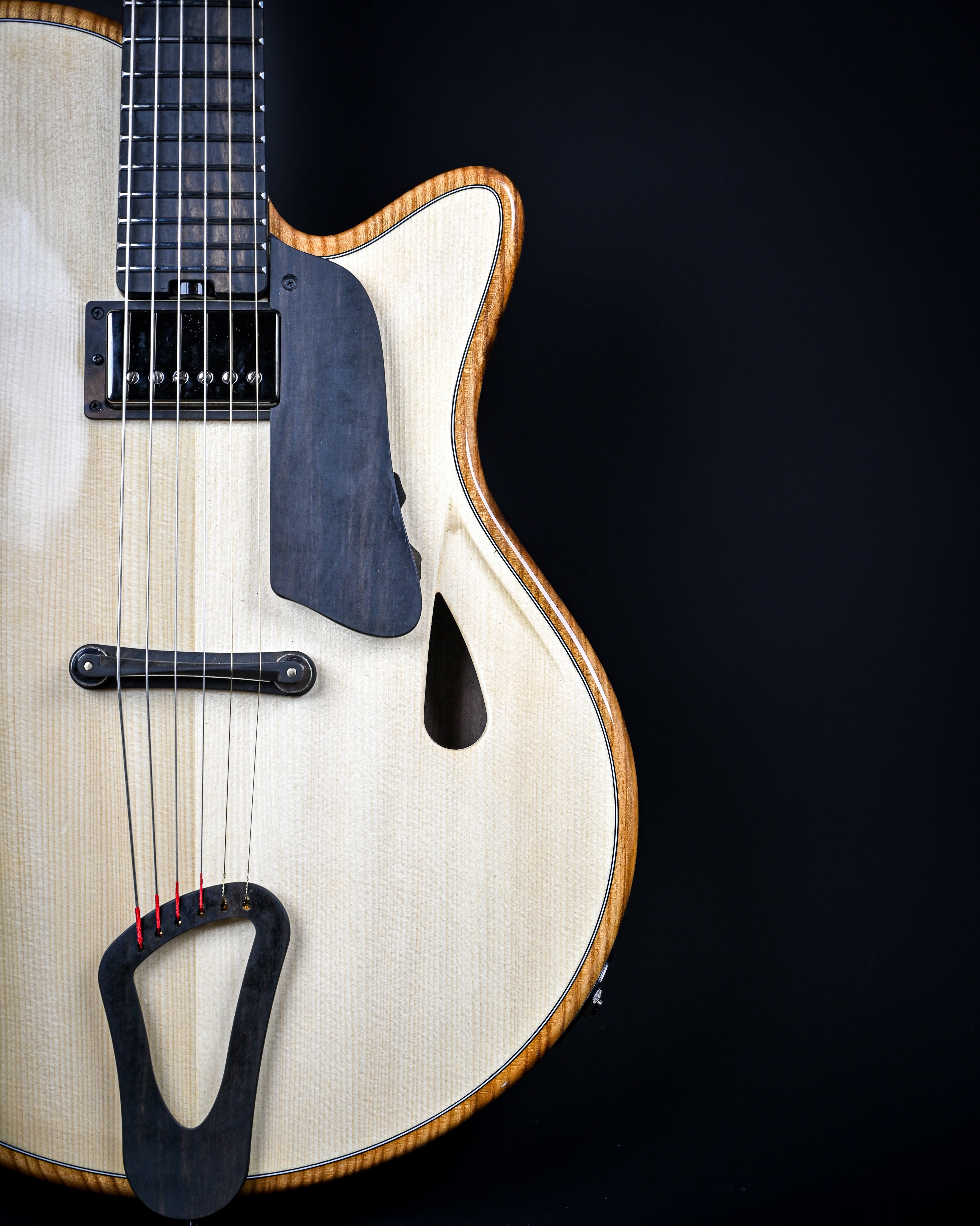
There is a curious thing about the archtop guitar. Almost a century after its invention, the instrument is still defined by the engineering decisions made for big-band stages in the 1920s and 1930s. Deep body, thick carved top, hot-hide-glued joints, maple-and-spruce architecture, suspended bridge, trapeze tailpiece — the recipe has barely changed.
This is partly tradition, and tradition is good. The classic archtop has a voice that sixty years of jazz records have made unmistakable. But it is also partly inertia. Players today rarely use an archtop the way Charlie Christian did in 1939. They record it. They amplify it. They take it on planes. They use it for chord-melody arrangements that would have been unrecognizable to swing-era guitarists. And the classic recipe, optimized for one job, sometimes works against them in the new ones.
The modern archtop — the one that has been quietly emerging in boutique workshops over the last two decades — is the instrument that tries to keep what makes an archtop an archtop, while letting it serve these new uses. This piece is about how it behaves, and why, using one such instrument we recently studied in detail.
The archtop's secret: every body has favorite notes
Before we can talk about what changes in a modern archtop, we need to talk about what every archtop does.
When you pluck a string on an acoustic guitar, the string itself produces almost no sound. It is too thin to move enough air. What you hear comes from the body — the top plate and back plate vibrating in sympathy with the string, pushing air around at a much larger scale. The guitar is a converter: it turns the mechanical vibration of a string into airborne sound.
Here is the catch. The body does not respond equally to all frequencies. Like every physical object that can vibrate — a wineglass, a bridge, a tuning fork — it has preferred frequencies at which it resonates strongly, and other frequencies where it barely responds at all. These preferred frequencies are called the modes of the body. They are determined by the body's shape, its material, its thickness, the way its parts are joined.
If a note you play happens to fall right on one of these modes, the body lights up and the note comes out strong. If a note falls in a valley between modes, the body stays quiet and the note comes out weak. Players call these the wolf notes (the strong ones, which sometimes sound almost feral) and the dead notes (the weak ones, which seem to disappear under your fingers).
Every guitar has them. But the archtop, with its deep box and stiffly carved plates, has them especially pronounced. The modes are widely separated in frequency and sharply peaked. The peaks and valleys are dramatic. This is why archtops have such a vocal, individualized character — and why every archtop player learns, by experience, which notes ring out on which strings and which ones to avoid in which positions.
This vocal quality is part of what jazz musicians have loved about the archtop for ninety years. It gives the instrument personality. The notes do not all sound the same, and the player works with that, choosing positions and voicings that play to the instrument's strengths. The Charlie Christians and Wes Montgomerys of the world built their phrasing around the way their guitars wanted to speak.
But personality cuts both ways. In some musical contexts, the same vocal quality becomes a liability.
Where the old recipe pushes back
Imagine you are recording chord-melody arrangements for a jazz album. Each chord contains four or five notes played together, and one of them — usually the top voice — carries the melody. For the listener to hear the melody, that top voice has to stay clearly audible above the rest of the chord.
On a classic archtop, this is harder than it sounds. The chord's bass note might happen to fall on a strong mode and jump out at twice the volume you intended. The melody note might fall in a dead spot and disappear. You play the chord as written, and the balance comes out wrong — not because of how you played, but because of how the instrument responded.
You can compensate. Experienced players do, all the time. But the compensation is exhausting. It means thinking about the instrument's quirks at every moment instead of thinking about music. It means re-doing takes because the same chord sounded different two minutes apart. It means an engineer in the control room asking, can you play it again, but bring down that A?
Now imagine you are on stage, amplified through a stage monitor. The classic archtop's strong modes are exactly the frequencies most likely to feed back through the system. Crank the volume up past a certain point and the guitar starts howling at the frequency of its dominant body mode. You can EQ it out, dampen the soundhole with a feedback buster, work around it — but again, you spend your attention on the instrument instead of on the music.
And then there are the practical things. The traditional archtop is built with hide glue joints that move with humidity. The thick maple neck shifts with the seasons. You take the guitar from a humid coastal hotel to a dry mountain stage, and three days later your action is wrong, your intonation has drifted, the truss rod needs another quarter turn. For a working musician who travels, this is not romantic — it is friction.
None of these things means the classic archtop is bad. They mean it was designed for a world that worked differently. The question for contemporary lutherie is: can the instrument be redesigned for today's world without losing what made it worth playing in the first place?
Three things modern builders are doing
Across the boutique workshops thinking about this question, a few common moves keep appearing. Different builders combine them differently, but the same general principles show up again and again.
Making the body more uniform
The first move is to flatten the response curve. Instead of having a few very strong modes with deep valleys between them, you aim for a body that responds more evenly across the playing range — fewer dramatic peaks, fewer dead spots, fewer wolves.
How you get there involves several decisions: how stiff the plates are, how they are coupled to the rim, how the air inside the box resonates with them. The traditional choices — thick carved spruce top, glued construction, maple back — produce a few very strong modes by design. Modern choices can tune the response so the energy is distributed more smoothly.
The trade-off is real. A flatter response means a less individualized voice. The instrument is more neutral, more predictable. Whether this is good or bad depends entirely on what you want to do with it. For a Django-style player who wants each note to have its own character, this is a loss. For a chord-melody player who wants their voicings to come out the way they wrote them, this is a gain.
Making the neck quieter
The neck of a guitar is supposed to be a passive component — its job is to hold the strings, not to make sound. But in practice, every neck has its own resonances, and these resonances can interfere with the body's. When the neck wants to vibrate at the same frequency as a note you are playing, it absorbs some of the energy that should have gone into the top. The result is a note that sounds weaker than it should.
Traditional archtop necks, made of one or two pieces of maple with a truss rod, tend to have their main resonance somewhere in the middle range — exactly where most chords are played. This was rarely noticed in the swing era because nobody was looking for it, and the instruments were good enough that nobody complained. Modern measurements show it clearly.
The modern solution is to stiffen the neck enough that its main resonance moves out of the playing range. Carbon fiber reinforcement is the most common approach today — two thin rods or a single stiffening element built into the neck along its length. The neck becomes essentially a quiet structural support, contributing little or no resonance of its own to the instrument's response.
There is a side benefit. A neck stiffened with carbon fiber barely moves with humidity. The instrument needs fewer adjustments through the seasons. For a player who travels, this is genuinely valuable.
Making the body smaller
The third move is to reduce the body depth. Traditional archtops are deep — somewhere around 8 to 10 cm at the rim — because depth helps project acoustically in an unamplified setting. But when the instrument is going to be amplified or recorded anyway, depth stops paying for itself. And it brings its own problems: more stage feedback risk, more bulk against the player's body, more low-frequency boom that can muddy a mix.
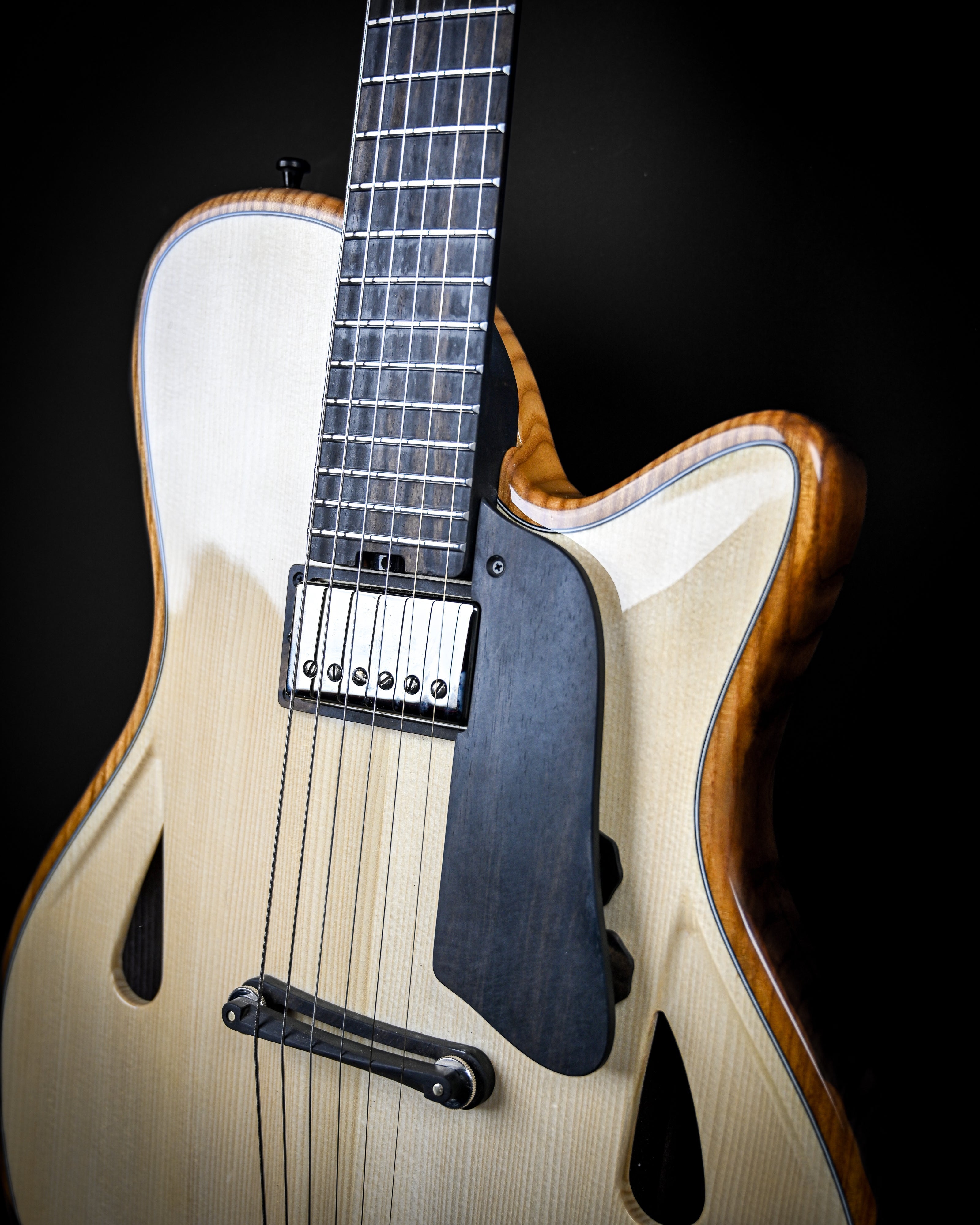
Modern thinline archtops — bodies around 5 cm deep — sacrifice some unamplified bass response but gain in nearly every other dimension. They feed back less. They sit better in a mix because they take up less acoustic space in the low frequencies. They are more comfortable to play for long sessions. And the smaller air volume inside the box raises the body's lowest resonance, which contributes to the overall flattening of the response curve we mentioned earlier.
Of course, you cannot just take a traditional archtop and slice off three centimeters of depth. The instrument needs to be redesigned around the new proportions — the tailpiece, the bracing, the carving of the plates, the way the strings transmit energy into the top. The thinline is not a compromise; it is a different instrument.
What it adds up to
When you combine these three moves — flatter body response, quieter neck, shallower box — you get an instrument that behaves measurably differently from a classic archtop. Side by side with a traditional instrument, the differences show up clearly.
The number of problematic notes drops. Where a traditional archtop might have four or five notes that consistently jump out or disappear, a well-designed modern archtop typically has one or two, and they are more localized — confined to a specific position on a specific string rather than appearing all over the fretboard.
The same note played at different positions sounds more consistent. On a classic archtop, an A3 played on the fifth string can be six or eight decibels louder than the same A3 played on the fourth — a noticeable difference. On a modern archtop, the difference is smaller, typically half that or less. The player can choose positions based on what is comfortable or musically convenient, rather than based on what the instrument will allow.
The bass-to-treble balance shifts. The classic archtop has a richer low end; the modern one has a more present midrange. Neither is better in absolute terms, but they suit different uses. The classic excels at solo acoustic playing where the bass is doing real musical work. The modern sits more easily in an ensemble or a recording where other instruments occupy the bass range.
And the instrument is more stable across humidity and temperature changes. This is unsexy but matters in practice. An instrument that doesn't drift much is an instrument you can rely on.
What you do not get
It is important to be honest about what gets left behind.
You do not get the deep, woody, slightly unruly voice of a 1940s Gibson L-5. You do not get the way certain notes seem to glow on a great vintage archtop, the way the bass feels physically present when you play it solo in a small room. You do not get the sense that the instrument is having its own opinions about the music. These things require the very modes and resonances that the modern design is trying to tame.
A modern archtop is not, and should not pretend to be, a vintage archtop. It is a different instrument, designed for different uses. Many players will own one of each, and use them for different contexts — the classic for the gig where the room is small and the music is acoustic, the modern for the studio session and the festival stage and the trans-Atlantic flight.
Choosing the modern archtop is not a rejection of the classic. It is a recognition that one instrument cannot do every job, and that some jobs in 2026 are not what they were in 1937.
The Aeri
The instrument we have been describing — though we have been speaking in general terms — is, in our shop, called the Aeri. It is the first model in our archtop line, and the recipe behind it is the one this article has been talking about: thinner body, stiffer neck, more uniform response, designed for the player who works in contemporary contexts but still loves what an archtop does.
We chose the name Aeri for its quality of lightness and airiness — the suggestion of an instrument that does not weigh on the player, either physically or musically. An archtop that gets out of the way.
Like every prototype, it has its own quirks that we are still learning from. One specific note has more dampening than we would like; another has a slightly stronger ring than the surrounding notes. These are things we measure carefully, and that inform the next iteration. The instrument is not finished — instruments never are.
But the principles are sound, and the measurements bear them out. The modern archtop, as we have built it, does what we hoped it would do. For the right player, in the right context, it is the instrument we wish had existed when we started building.
If any of this resonates with how you play — or how you wish your archtop would play — we would be glad to talk about it.
— Belforti Instruments



Compartir:
IRYW : Guitars Should Be Expensive