



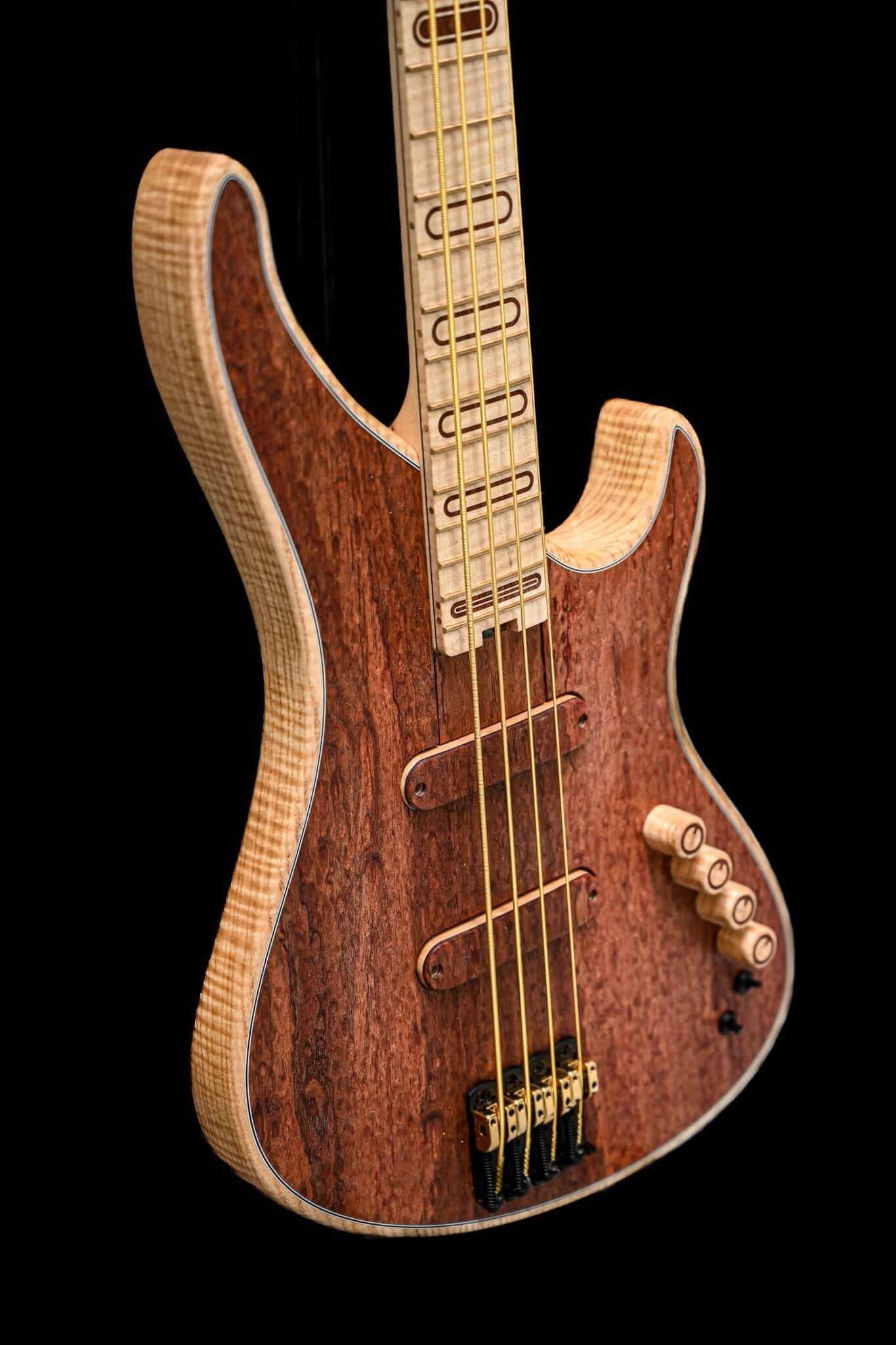
1. Introduction
Every guitar forum has hosted this debate. On one side: purists who insist only wood, construction and acoustics matter. On the other: players who swear their gorgeous instruments sound better. They're both right, and both wrong — because the relationship between beauty and sound is more interesting than either camp wants to admit.
Aesthetics have always been entangled with quality in art, architecture, and craft. In musical instruments, beauty operates at several layers at once — psychological, emotional, physical. The objective acoustics are set by materials and design, but the subjective experience of tone is shaped by expectation, association, and engagement. A player who finds an instrument visually arresting will play it with more confidence, more nuance, more conviction — and that, in turn, changes what comes out of it.
There's a small library of empirical work that backs this up, scattered across neuroaesthetics, music psychology, instrument acoustics, and the psychology of expertise. Most of it doesn't talk to itself. The argument of this piece is that when you do put it in the same room, a coherent picture emerges: visual beauty isn't decoration sitting on top of the music. It's an input into the music. The same brain regions process beauty and musical reward, the same emotional states modulate both visual response and motor execution, and the same psychological feedback loops link a player's belief about their instrument to what their fingers actually do.
So the question isn't really whether beauty affects sound. The question is how deep the entanglement runs.

2. The Psychology of Beauty Bias and Cross-Modal Perception
Every guitar forum has hosted this debate. On one side: purists who insist only wood, construction and acoustics matter. On the other: players who swear their gorgeous instruments sound better. They're both right, and both wrong — because the relationship between beauty and sound is more interesting than either camp wants to admit.
Aesthetics have always been entangled with quality in art, architecture, and craft. In musical instruments, beauty operates at several layers at once — psychological, emotional, physical. The objective acoustics are set by materials and design, but the subjective experience of tone is shaped by expectation, association, and engagement. A player who finds an instrument visually arresting will play it with more confidence, more nuance, more conviction — and that, in turn, changes what comes out of it.
There's a small library of empirical work that backs this up, scattered across neuroaesthetics, music psychology, instrument acoustics, and the psychology of expertise. Most of it doesn't talk to itself. The argument of this piece is that when you do put it in the same room, a coherent picture emerges: visual beauty isn't decoration sitting on top of the music. It's an input into the music. The same brain regions process beauty and musical reward, the same emotional states modulate both visual response and motor execution, and the same psychological feedback loops link a player's belief about their instrument to what their fingers actually do.
So the question isn't really whether beauty affects sound. The question is how deep the entanglement runs.
3. The Aura of Beauty and Craftsmanship

3.1. Aura, empirically
Walter Benjamin coined the term "aura" in 1935 to describe the quality of an original artwork that reproductions can never fully capture — the felt presence of the object's history and the hand that made it. He thought industrial reproduction would erode it. He turned out to be only half right. Reproduction is everywhere, and yet originals — first pressings, prototype guitars, instruments touched by famous hands — continue to command absurd premiums and trigger measurable psychological responses.
What Benjamin treated as a philosophical concept has since been investigated empirically in consumer psychology and the psychology of authenticity. Subjects rate identical objects more highly when told the object is original rather than a copy. They report stronger emotional responses to objects with credible craft narratives. They show more willingness to pay, more memory for detail, more reluctance to discard. The aura is real in the limited but important sense that it predictably shapes behavior.
For an instrument, aura accumulates from visible cues — wood selection, joinery, finish, hardware quality, the small evidence that someone cared at every stage. The player reads these cues consciously and unconsciously, and they shape engagement before a note is sounded.
3.2. Excellence as a state-inducing object
Mihaly Csikszentmihalyi, who spent his career studying flow states, observed that some objects reliably induce more engagement than others. He called the most reliable ones artifacts of excellence: objects whose evident craftsmanship invites the user to bring their best work to bear. A well-made hand tool, a properly weighted knife, a finely fitted guitar — each carries an implicit standard that the user feels addressed by.
This isn't romantic projection. It's measurable in attention, persistence, and reported flow during use. When the object is good, people work harder to do it justice. They focus longer, they recover faster from mistakes, they care more about the outcome. For a musician, that translates directly into how a phrase gets played. The instrument that demands more from you tends to get more out of you.
3.3. The halo effect, instrument edition
The halo effect — a positive impression in one domain bleeding into evaluation of unrelated domains — is one of the oldest documented biases in social and consumer psychology. Attractive job applicants are rated as more competent. Well-designed products are perceived as more reliable. Books with elegant covers are remembered as better-written.
With instruments, the visual halo affects perceived tone, perceived build quality, perceived value, and perceived reliability. Players asked to evaluate the same audio recording of an instrument they've been shown a photograph of will rate the tone differently depending on which photograph they saw. This is sometimes presented as a kind of foolishness to be corrected for. It isn't. It's how brains build perceptual judgment under uncertainty: by integrating every available cue, including visual ones. The bias is the system working correctly. The job for a thoughtful player is to know it's running, not to pretend it isn't.
4. The Player-Instrument Emotional Loop
If beauty primes reward circuitry, and reward circuitry feeds into emotional state, and emotional state modulates motor execution, then visual beauty has a direct route into the player's hands. This section traces that route.

4.1. Emotional state changes how you play
There is a wide literature on how emotional state alters motor performance, going back decades. The findings converge on a small set of clear effects. Positive affect, in the moderate-to-elevated range, is associated with better fine motor control, more consistent timing, wider expressive range, and better fluency of transitions. Anxiety, by contrast, produces measurable muscle tension, particularly in the small stabilizing muscles of the hands and forearms; degrades timing precision; narrows dynamic range; and stiffens articulation.
The mediating mechanisms are concrete. Dopamine, the neuromodulator most strongly implicated in reward, also plays a role in fine motor refinement and in the consolidation of motor learning — which is why dopaminergic disorders like Parkinson's disease produce both motivational and motor symptoms. Cortisol, the stress hormone, has the opposite effect on small-muscle control. Confidence allows the body to relax into the technique it has trained for; anxiety pulls it back into a more cautious, mechanical mode. None of this is mysterious. It's the same mind-body coupling athletes have known about forever — except in musical performance, the consequences are audible in real time.
This is why a player who feels good about their instrument plays measurably better than the same player feeling indifferent about a different instrument. The pathway runs through emotional state, not through any acoustic difference.
4.2. Six routes from feeling to sound
In 2008, Patrik Juslin and Daniel Västfjäll published a paper in Behavioral and Brain Sciences that has become one of the most cited works in music psychology. Their target was a long-standing confusion in the field: researchers kept studying emotional response to music without distinguishing how the emotion was induced. Juslin and Västfjäll argued that music can produce emotion through at least six distinct mechanisms, and that lumping them together had been holding the field back.
The six mechanisms: brain stem reflex (loud, sudden, or dissonant sounds trigger arousal automatically); evaluative conditioning (a piece you heard during a happy moment now reliably evokes that happiness); emotional contagion (we read emotional expression in music the way we read it in faces and voices, and partly catch it); visual imagery (music evokes mental images that carry their own emotional weight); episodic memory (a piece can return you to a specific time and place, with the feelings attached); and musical expectancy (the music sets up, fulfills, or violates expectations, and those resolutions produce emotional responses in their own right).
Each of these is a doorway through which an instrument's beauty can enter the music. The look of the guitar feeds visual imagery, which colors the player's interpretation. The instrument's history and personal associations engage episodic memory. The pleasure of the instrument's craft engages the same reward circuitry that evaluative conditioning relies on. The performer's own visible engagement with a beautiful instrument intensifies emotional contagion for the audience. None of these is hand-waving; each is a documented mechanism. Beauty has more than one way in.
4.3. The audience sees what they hear
In 1993, Jane Davidson published a study in Psychology of Music that should be required reading for anyone who thinks music is a purely auditory art. She asked pianists to perform the same piece in three different expressive manners — deadpan, projected (normal concert intent), and exaggerated — and recorded each performance using a point-light technique: reflective markers placed on the players' joints, filmed against a dark background. The result was video that showed only the dots of light moving in space, no faces, no instrument, no context.
Observers viewed the performances in three modes: vision-only (just the moving dots), sound-only (just the audio), and combined. The finding that startled the field was this: observers reading the moving-dot videos identified the performer's expressive intent more reliably than observers listening to the audio alone. The body, isolated from sound, carried the expression more clearly than the sound, isolated from the body.
Subsequent work has refined and qualified this finding, but the basic point holds: live performance is an audiovisual event, and the visual channel carries real informational weight about expression and intent. For the audience, watching the player matters — and for the player, knowing they're being watched matters. A musician who feels confident in front of their instrument moves differently than one who doesn't, and that difference reaches the audience whether anyone names it or not.
4.4. Marc Leman's embodied music cognition
Marc Leman, a Belgian music cognition researcher, has spent the last two decades arguing that music is fundamentally embodied — that meaning in music is not extracted by a disembodied listener but co-constructed by a body in motion, anticipating, mirroring, entraining. In this framing, the player and the audience are linked by a shared physical-emotional resonance that no acoustic analysis can fully capture.
The practical consequence is that the performance loop runs through several bodies at once: the player's, the audience's, and the player's again as audience response feeds back. A confident, engaged player projects more — not because they play louder, but because their entire bodily presence is more legible. An audience that reads engagement responds with attention, which feeds back to the player as confirmation, which feeds the next phrase. This is not metaphor. It's a system with measurable inputs and outputs, and visual cues are part of every link in the chain.
4.5. What the standard measurements miss
Standard acoustic metrics — frequency response, harmonic content, attack envelope, sustain — describe what comes out of an instrument when something is done to it. They don't describe what the instrument and player do together. The interaction is where the music lives, and it's where micro-variation lives: minute timing shifts within a phrase, dynamic shaping within a single note, vibrato and touch adjustments that let one pitch evolve in color, articulation choices that breathe.
These micro-variations are what separate technically correct from actually moving. They're directly modulated by emotional state. And emotional state is directly modulated by, among other things, how the instrument looks and feels in the hands. The chain is: appearance → emotional state → micro-variation → audible expression. Each link is documented. The chain runs whether anyone is paying attention to it or not.
5. The Self-Fulfilling Sound Phenomenon

5.1. Bandura and self-efficacy
In 1977, Albert Bandura published what would become one of the most influential papers in 20th-century psychology: "Self-Efficacy: Toward a Unifying Theory of Behavioral Change," in Psychological Review. The core claim is that a person's belief in their own ability to succeed at a task — what Bandura called self-efficacy — is a strong predictor of actual performance, separate from their underlying skill. Self-efficacy determines how much effort you bring, how long you persist when things get hard, and how you respond to setbacks.
Bandura identified four sources of self-efficacy: past performance (mastery experiences), watching others succeed (vicarious experience), being told you can do it (verbal persuasion), and your physiological state in the moment (calm vs. anxious, relaxed vs. tense). For a musician picking up an instrument, the instrument itself becomes a verbal and physiological persuasion device. It speaks to the player about what kind of performance is expected here. A beautiful, well-crafted instrument tells the player: this is a serious tool, and you are someone who can use it well. That message — credible or not — shapes the physiological state and the effort the player brings to the next note.
5.2. Belief about the instrument changes the playing
The clearest empirical demonstration of this in music is the line of work on blind violin comparisons, especially the Paris experiment by Claudia Fritz, Joseph Curtin, Fan-Chia Tao and colleagues, published in PNAS. Ten elite soloists were given six old Italian violins (five Strads, one Guarneri) and six new ones, all set up by expert hands. The soloists wore welder's goggles in a darkened room to remove visual cues, and played each violin in two 75-minute sessions — one in a rehearsal room, one in a concert hall, sometimes with orchestra.
Results: the soloists could not distinguish old from new at better than chance levels, and most preferred the new instruments. The most-preferred violin in the test was modern. A Stradivari finished last. When the same instruments are played in conditions where the players know which is which, the preference for the Strads typically returns. The instruments don't change between conditions. The players' belief about what they're holding does — and that belief shapes the performance.
This is exactly Bandura's self-efficacy mechanism in action. Belief about the quality of the tool feeds into physiological state and effort, which feed into measurable differences in execution. The Strad-believer plays the Strad differently than the same player plays an unidentified instrument that happens to be a Strad. The instrument's reputation is not in the wood. It's in the player.
5.3. Audience perception closes the loop
Davidson's work on the visibility of expression (Section 4.3) shows that audiences read confidence and engagement from the player's body before any conscious judgment about the sound. A confident player produces both better playing and a more receptive audience reading. The audience's visible attention then feeds back to the player as physiological confirmation, raising self-efficacy in real time, which raises the quality of the next phrase. This is a positive feedback loop, and it can run in either direction. A player who looks defeated produces playing that confirms the audience's withdrawal, which confirms the player's deflation.
Beautiful instruments enter this loop at the visual layer. They make the player look like they belong there. They give the audience a visual cue that aligns with engagement before the playing has had time to make its case. The audience leans in slightly earlier; the player feels that lean and plays into it. Nothing about this is illusion. The audience is reading real information; the player is responding to real audience cues; the music gets better as a result.
5.4. This is not placebo
It's tempting to file all of this under "placebo" and walk away. That would be wrong, and the distinction matters. Placebo, properly understood, refers to a measurable physiological response to a treatment that has no causal mechanism of its own — the response is generated entirely by expectation. The self-fulfilling sound phenomenon is not that. The mechanism here is fully causal: belief about the instrument changes emotional state, emotional state changes motor execution, changed motor execution produces measurably different sound. Each link is a real causal step. The instrument's beauty is one of several inputs into the first link.
To call it placebo is to suggest the better playing is somehow not real. But the better playing is real. The audience hears a real difference. The recording captures a real difference. The waveform itself, after the player has engaged with the beautiful instrument, contains different acoustic events than the waveform after the player has resigned themselves to a depressing one. The cause runs through the player rather than through the instrument's acoustics, but the effect is in the air.
This is also why blind A/B testing systematically underestimates the role of instrument quality in real performance. Blind testing strips out the feedback loop that defines actual playing. Of course Strads don't beat modern violins in a darkened room behind welder's goggles — half the mechanism has been turned off. The point isn't that the test is wrong. The point is what the test is actually measuring. It measures the instrument as an isolated acoustic object. Real performance is never an isolated acoustic object.
6. The Cultural Dimension and Aesthetic Language

None of this happens in a cultural vacuum. The same player who finds a Spanish-style classical guitar beautiful might find a Telecaster cold, or vice versa, depending on what their visual education has taught them to read as beautiful. Cultural fluency is part of the system.
6.1. Design vocabularies
Musical instruments have evolved visual languages alongside the music they serve. A baroque viol carries the ornamentation and proportions of its period; an electric guitar from 1954 carries the post-war American industrial design vocabulary that produced it; a sitar embodies a different cosmological tradition entirely. None of these visual languages is arbitrary, and none of them is universal. Each one signals — to a fluent viewer — the music it's meant to make and the tradition it belongs to.
A luthier working in any of these traditions is participating in a visual conversation as much as a sonic one. The shape of a violin scroll, the cant of a Spanish-style headstock, the F-hole geometry of a carved archtop — all of these are stylistic markers that locate the instrument in a tradition. Players from inside that tradition read the markers fluently and respond emotionally to coherence within them. Players from outside read them less fluently, sometimes responding to surface novelty rather than informed signal.
6.2. History writes the shape
Visual style in instrument-making has always tracked the music being played and the manufacturing technology available. The elaborate inlay and rosettes of late-baroque guitars matched the ornamental complexity of the music. The streamlined solid-body electrics of the early 1950s reflected both jet-age industrial design and the new economics of CNC-adjacent manufacturing. The current vogue for raw, unfinished, road-worn aesthetics reflects a reaction against perceived sterility in mass-produced instruments and a hunger for visible authenticity.
None of these shifts is purely decorative. Each one carries a sonic ideal: baroque ornament corresponds to a particular voicing of the instrument, 1950s industrial design corresponds to a new musical genre that needed louder and more cutting tone, road-worn aesthetics align with a vintage tonal ideal regardless of the instrument's actual age. The visual and the sonic evolve together because they are evaluated together by the players who buy and play these instruments.
6.3. Authenticity, wear, and the value of use
There is real psychological literature on the value of perceived authenticity in objects. Objects that look used, that show evidence of having lived, are rated more emotionally meaningful and often more valuable than identical objects in pristine condition. For instruments, this manifests as the cult of wear: the worn-down finish on a vintage Fender, the cracked spruce top of an old Martin, the dings in the headstock of a beloved touring instrument. Each mark reads as a history that pristine condition can't claim.
Some of this is signaling — wear suggests that the instrument has been chosen for use again and again over years, which is itself a quality indicator. Some of it is parasocial — the worn guitar gestures at musicians and shows we wish we'd been part of. And some of it is genuine acoustic maturation: wood that has been vibrated under string tension for decades does change, in ways that have been partially characterized in the literature, though the extent of the audible effect remains disputed. The point isn't to adjudicate the acoustic question. The point is that all three of these — signaling, parasocial, and acoustic — feed into the player's experience of the instrument as authentic, and that experience changes how the instrument gets played.
6.4. Cross-cultural variation
Ethnomusicological work on instrument aesthetics, particularly Kevin Dawe's research on guitars across cultures, makes the point that what reads as beautiful in one tradition can read as gaudy, austere, primitive, or strange in another. The Cretan laouto, the Portuguese guitarra, the Hawaiian slack-key guitar, and the American dreadnought are all guitar-family instruments, but each carries an aesthetic that makes immediate sense to local players and immediate non-sense to outsiders. There is no universal language of instrument beauty; there are many local fluencies.
For a luthier or a player, this means there's no neutral default. Every aesthetic choice positions the instrument inside or outside particular traditions, and players from inside those traditions will respond to the choice with the full machinery described in Sections 2 through 5. Reaching across traditions is possible, but it isn't free. The instrument either speaks the tradition's visual language fluently or stumbles over it, and players read the fluency before they touch the strings.
6.5. Visual cues as quality shortcuts
All of this is why visual elements function as immediate proxies for quality in instrument evaluation. Wood grain, finish quality, inlay precision, joinery cleanness, hardware specification, the curve of a body, the spacing of fret markers — these read instantly to a fluent viewer and shape both first impression and lasting valuation. They aren't the music. But they tell an experienced brain what music to expect from this object, and that expectation goes on to shape the music that gets produced. Visual cues are not surface. They are part of the signal.
7. Beyond Pure Functionality: The Science of Beauty

Scientists in est. 2021, discovering the perfect TONE
Here's where the picture gets sharpest. There is a documented gap between an instrument's measurable acoustic properties and its perceived quality. The science of instrument acoustics — once it tries to predict what musicians will actually prefer — is humbler than its outsiders sometimes assume.
7.1. Good and bad violins, measured
In 2008, the physicist George Bissinger published a study in the Journal of the Acoustical Society of America titled, simply, "Structural acoustics of good and bad violins." He took 17 violins that had been independently rated for quality on a spectrum from "bad" to "excellent" — including three top-tier old Italians (Stradivari's "Titian" and "Willemotte," and a Guarneri del Gesù "Plowden") — and ran exhaustive modal-acoustic radiation measurements on all of them.
The headline result: all 17 violins displayed the same five "signature" modes below 1 kHz, and there were no clean quality trends in mode frequencies or in total damping. The instruments rated "excellent" did show slightly higher radiativity in the Helmholtz-like A0 cavity mode, but most of the standard acoustic parameters — the ones an engineer would expect to predict quality — didn't separate the bad from the excellent.
This is one of the most important findings in modern violin acoustics, and its implications are uncomfortable for a particular kind of rationalist. The acoustic differences between a bad violin and a Stradivari are real, but they are subtle, scattered across many parameters, and largely invisible to the standard measurements. Whatever makes an excellent violin excellent is not a single property you can read off a graph. It's a configuration that emerges from the whole, and the human ear-plus-brain detects it more reliably than the instruments.
7.2. The Paris experiment
Section 5.2 introduced the Fritz–Curtin Paris experiment in the context of self-efficacy. Here it does different work. When ten elite soloists in 2012 could not, under blind conditions, reliably distinguish six Stradivari-era violins from six modern ones — and tended to prefer the moderns — the result was not that old Italian violins are bad. It was that the soloists' preference under blind conditions tracks something other than the instrument's pedigree. They preferred, on average, the instruments that projected better in the room. Several of the modern violins projected better than several of the Strads.
Take this together with Bissinger: the standard measurements don't cleanly predict quality, and the players themselves don't cleanly identify provenance. So where does the legend of the Stradivari come from? Partly genuine craftsmanship (Stradivari was, by all accounts, an extraordinary maker); partly the survivor bias of three centuries (the bad Strads were broken up or never preserved); partly market dynamics around scarcity; and substantially — and this is the point — from the self-fulfilling loop that runs every time a player is told they're about to hear a Strad.
7.3. Why the gap matters
The gap between measurable acoustics and perceived quality is not a failure of science. It's a feature of the system being studied. An instrument is not just an acoustic object — it's an acoustic object in interaction with a player and an audience, all three running on brains that integrate visual, tactile, emotional, historical, and acoustic information into a single perceived experience. The standard acoustic measurements describe one of those inputs in isolation. The full system can't be predicted from that input alone.
This is also why neuroaesthetic research like Ishizu and Zeki's matters here. The brain has a unified beauty-and-reward circuit that integrates inputs from multiple senses. The instrument's appearance is a real input to that circuit. So is the haptic feedback when the player picks it up. So is the smell, the weight, the sound it makes when you tap it. By the time the bow or pick meets the string, the player's brain has already assembled a working hypothesis about what kind of sound this instrument is going to make, and that hypothesis shapes both how they play and how they hear what comes back.
7.4. Implications, briefly
For makers: build the whole instrument, not just the acoustic specification. The way it looks, the way it feels in the hands, the way it smells when it's opened — these are all real inputs to the player's experience and therefore real inputs to the music. Acoustic excellence is necessary but not sufficient; an excellent-sounding instrument that fails the visual and tactile tests will underperform in the player's hands compared to a slightly less acoustically pristine instrument that wins on the full sensory specification.
For players: trust your aesthetic response. If a guitar makes you want to play it, that wanting is a real input to your performance. The instrument that you reach for first will, over time, become the instrument you play best on, partly through the practice it accumulates and partly through the loop described above. There's no virtue in resisting your visual taste in the name of audio purism. Your visual taste is part of how you hear.
8. Embracing Complexity: The Beauty-Performance-Perception Triangle

It's useful to gather the argument into a three-dimensional frame. Performance quality, in the broadest sense, has three interlocking layers: what the player executes, what the player expresses, and what the listener receives. Beauty operates on all three.
Technical execution is the measurable layer. Pitch accuracy, rhythmic precision, dynamic control, articulation, coordination. This is the layer most easily quantified, and the layer most directly affected by the emotional state described in Sections 4 and 5. Confidence and engagement improve it; anxiety and disengagement degrade it. Beauty acts on this layer through its effect on emotional state.
Expression is the interpretive layer. Phrasing, dynamic nuance, tonal coloration, timing inflection, physical engagement with the instrument. This is the layer Juslin's micro-variations live in, and it's the layer that distinguishes technically correct playing from playing that moves people. Beauty acts on this layer by deepening the emotional engagement that interpretation draws on — a player who feels alive at the instrument has more interpretive vocabulary available than one who feels mechanical.
Reception is the shared layer. Stage presence, the visible bond between player and instrument, the body language of someone who believes in what they're doing. Davidson's work on point-light displays applies here, and so does Leman's embodied music cognition. Beauty acts on this layer by making the player-instrument unit visually coherent, which the audience reads as authority before any conscious judgment is made.
None of these layers is more real than the others, and beauty's influence runs through all three. Saying "beautiful guitars sound better" is a shorthand for: beautiful guitars produce better technical execution through the emotional pathway, deeper expression through the engagement pathway, and more receptive audience response through the perceptual pathway. The shorthand is correct. The mechanism is just longer than the shorthand suggests.
9. Does This Mean Ugly Guitars Sound Bad?

Implying that a PRS is ugly by using a PRS picture to illustrate this section ? Daring…
No, and the reasoning in this article makes it clearer why not. Some of the most recognizable tones in recorded music came from instruments most luthiers would describe — charitably — as compromised. Willie Nelson's "Trigger," a 1969 Martin N-20 classical guitar with a hole worn through its top from decades of pick wear and Willie's idiosyncratic strumming, has carried country music for half a century. Keith Richards' "Micawber," a 1953 blackguard Telecaster with the original neck pickup removed, the bridge pickup swapped, and the body refinished, defined the rhythm guitar sound of the Rolling Stones.
The argument of this piece is not that conventional beauty is the only beauty that affects sound. The argument is that the player's experience of the instrument — whatever that experience is built from — feeds into the music. Trigger is beautiful to Willie. Micawber is beautiful to Keith. Their beauty is built from history, association, tactile familiarity, and the specific way each instrument speaks back to the hands that have shaped it over decades. The mechanism is the same as the one described in Section 4: the player's positive emotional engagement with the instrument produces better playing. The form of beauty is different. The route through the brain is identical.
9.1. Alternative aesthetics
Beauty in instruments has never been limited to symmetry and pristine finishes. Minimalist designs read as honest. Aged or road-worn instruments read as legitimate. Unorthodox materials — carbon fiber, aluminum, reclaimed wood, 3D-printed bodies — propose new aesthetic stances that some players find compelling and others find off-putting. Customization and modification turn the instrument into a record of the player's specific history with it. All of these are aesthetic strategies, and all of them carry real psychological weight for the players who respond to them.
The mistake is to treat "beauty" as a fixed set of features. The right reading is that beauty is a fit between the instrument and the player, mediated by visual fluency, personal history, and cultural context. A player who finds the road-worn Tele beautiful will play it better than the same player would play a pristine reissue, because the road-worn Tele engages their emotional system more deeply. The pristine reissue might do the same job for a different player. There is no contradiction here.
9.2. Why wear adds up
The aesthetic of use is one of the most psychologically loaded categories in instrument culture. Wear suggests proven reliability (an instrument that has been gigged for thirty years has earned its keep); historical significance (the marks are evidence of music made); tonal maturity (wood vibrated under tension for decades does, as a matter of physical fact, change in its mechanical properties); and authenticity (no factory could fake what time has actually done). For many players, the worn instrument is more beautiful than the pristine one, by the standards their own taste has built up over years of looking at instruments.
This is also why the artificial relic'ing industry works at all. A new instrument that has been visually aged — finish checked, hardware oxidized, edges worn — triggers many of the same psychological responses as a genuinely old instrument. Players who know it's faked still often respond to it, because the visual cues are doing the same job. Whether you find this practice charming or fraudulent is a separate question. The psychology behind why it works is the same psychology that runs every other beauty-sound interaction in this article.
9.3. Personal history
Familiarity with an instrument can override conventional aesthetics entirely. The guitar that has been with you for ten years is comfortable in ways no new instrument can match. It carries episodic memory in the Juslin-Västfjäll sense — every time you pick it up, fragments of the music you've made on it return with the touch. It carries proprioceptive familiarity: your hands know its exact dimensions without thinking. And it carries the self-efficacy advantage that Bandura would predict from a long mastery history with this specific object.
This is why players are often startled when they try to upgrade and find that the more expensive, objectively better instrument plays worse for them in the first weeks. The new instrument hasn't yet been integrated into the player's history with it. Given time, it can be — and once it is, the old instrument may genuinely feel less alive. Or it may not. Sometimes the old instrument wins permanently, not because it's objectively better, but because no upgrade can compete with a decade of layered association. Both outcomes are real, and both are accounted for by the same set of mechanisms.
The takeaway is not that only conventionally beautiful guitars sound good. It's that beauty — in whatever form the specific player recognizes it — feeds into the sound the player produces. The form of beauty is negotiable. The route through the player is not.
10. Implications for Makers and Players
For luthiers, the lesson is not "make it pretty." It's that aesthetics are functional in a literal, mechanistic sense. The visual design of an instrument is a real input into the player's emotional state, which is a real input into the player's motor execution, which is a real input into the sound the instrument is heard to make. A luthier who treats the visual specification as decoration applied on top of the acoustic work is leaving function on the table. A luthier who treats it as another acoustic parameter — one routed through the player's brain rather than through the instrument's body — is doing the full job.
For players, the practical advice is to take your aesthetic response to an instrument seriously, as data. The way an instrument looks and feels to you is part of how you will sound playing it. There's no virtue in suppressing this response in the name of acoustic objectivity. The acoustic objectivity doesn't exist in the form you're imagining; the instrument's behavior in your hands is irreducibly mediated by your psychological engagement with it. The smart move is to pay attention to what your visual and tactile responses are telling you, and to treat them as part of the evaluation rather than as bias to be controlled for.
Antonio Damasio, in Descartes' Error (1994), called the integrated sense of an object's value — combining sensory experience, emotional response, and historical association into a single felt judgment — the somatic marker. We make decisions through these somatic markers all the time, and we usually make better decisions than we could by trying to ignore them. With instruments, the somatic marker is the relationship. Trying to evaluate an instrument without it isn't more objective. It's just less informed.
11. Conclusion: A New Understanding

It's time to retire the false choice between "real" acoustic properties and "mere" aesthetic bias. The acoustic properties are real. The aesthetic effects are also real. They are not in competition; they are different parts of the same system, and the system has been thoroughly enough studied at this point that we can stop treating one half of it as superstition.
Musicians don't play in a vacuum. An instrument's design, materials, and craftsmanship contribute directly to its sonic character, and they also contribute indirectly to that character by shaping the player's confidence, engagement, and interpretive freedom. Both contributions are real, both are measurable in their effects, and both end up in the air as sound. Audiences receive the integrated result, not the components.
This doesn't mean beauty substitutes for tonal quality or build excellence. It means beauty is integral to the player–instrument relationship, alongside playability, projection, and tactile feedback. The best instruments are not just acoustic objects. They are extensions of the musician, vessels of craft, occasions for expression. Treating them as anything less misses most of what's happening.
Music is an art form, and art is inherently bound up with beauty. Whether that beauty is the elegance of a meticulously built instrument, the charm of a well-worn favorite, or the audacity of an avant-garde design that proposes its own new aesthetic, it shapes the music both measurably and intangibly. Acknowledging this lets us see instruments as what they actually are: catalysts for the deeply human act of making music, designed to be loved, used, and lived with — not just measured.
So no, you shouldn't ignore acoustic science. And no, you shouldn't pay a premium for looks alone. But you also shouldn't pretend the visual doesn't enter the auditory. It does, through several documented pathways, and the pretending is a kind of self-deception that costs you music.
Correlation, not causation.
Tell that to your "beauty doesn't matter" boomer uncle, next time he's playing AC/DC on his cheap import.
Oh — and buy a Belforti. They're beautiful, and they sound better than any other instrument.
Who says that? I do.
Remember: I'm right. You're wrong.
Note : All our articles are written in French then translated. The translation is an active translation that doesn't simply translate word by word, but takes on when needed to better suit the targeted language. This can create a shift in tone or content that we accept and agree with.




Share:
IRYW - Tone : you think you do, but you don’t
Gloss, Matte, or Satin? What Your Guitar's Finish Actually Does — and Why It Matters More Than You Think