



Most guitarists pick a finish the way they'd pick paint for a wall. They look at it, they like it or they don't, and they move on. That works fine — right up until you're three songs into a sweaty set and your fretting hand is fighting the neck like it's coated in flypaper. Or until your pristine gloss top starts showing every fingerprint like a crime scene.
A finish isn't cosmetic. It's a functional layer that shapes how an instrument feels, how it ages, how it responds to your touch — and, yes, how it looks while doing all of that. The gloss-versus-matte-versus-satin question isn't really about aesthetics. It's about the relationship between your skin, your sweat, the wood underneath, and the thin film standing between them.
First, What Are We Actually Talking About?
"Gloss," "matte," and "satin" describe the surface texture of a finish — not the finish material. People trip over this constantly. You can have a glossy nitrocellulose finish or a glossy polyurethane one. You can have a matte polyester or a matte oil coating. The material — nitro, poly, oil, shellac — is a separate conversation, and we cover it in another article. Here we're talking purely about how the surface is textured and what that means for you as a player.
The physics are simple. A gloss surface is polished smooth enough that light reflects off it in a single direction — specular reflection, if you want the term. That's the mirror-like, "wet" look. A matte surface has microscopic irregularities that scatter light in every direction, killing the shine and leaving that soft, flat appearance. Satin sits between the two: enough texture to break up hard reflections, enough smoothness to keep a gentle sheen.
Those surface textures don't just bend light. They change friction, moisture behavior, thermal feel, and long-term wear. All of which you feel while playing.
Gloss: The Double-Edged Brilliance
The Visual Case
Gloss has been the default for decades for a reason: it's stunning. A well-executed gloss finish amplifies everything under it — the chatoyance of a figured maple top, the depth of a sunburst, the line of a carved arch. It creates visual depth, like looking into the wood rather than at it. Under stage lighting it's unmistakable, catching every beam and color shift. It's the finish equivalent of turning the saturation up.
It's also ruthlessly honest. Every fingerprint, every palm smudge, every speck of dust shows up under that reflective surface. If you've watched someone compulsively polish their Les Paul between songs, you understand the psychological tax of a gloss guitar.
The Feel — and the Problem
Fresh out of the case, a gloss neck feels slick and fast. Your hand glides. Shifts are effortless. It's genuinely pleasant — for about twenty minutes.
Then your hands warm up, moisture enters the equation, and the dynamic flips. A gloss surface is smooth and non-porous, so perspiration has nowhere to go. It sits on the surface, and what was slick turns tacky. Your thumb starts dragging on the back of the neck. Shifts that were fluid now need a micro-peel of skin off the surface. For some players that's a minor annoyance. For others — especially anyone with naturally warm or sweaty hands — it's a dealbreaker.
This isn't a flaw in the finish. It's surface science. A perfectly smooth surface maximizes the contact area between your skin and the coating, and once moisture enters that interface, adhesion increases. It's the same reason a wet glass is harder to grip than a dry one — just working against you instead of for you.
Players develop workarounds: knocking back the sheen with fine steel wool, keeping a cloth handy, powdering their hands. But the fact that workarounds exist tells you something about the built-in tension of a gloss neck.
On the body, gloss is less of an issue. Your forearm rests against the top or the edge, and the contact is different — static weight, not precision movement. Some players notice an arm sticking to a gloss body in short sleeves, but it's rarely a performance complaint.
How Gloss Ages
This is where it gets interesting. A gloss finish doesn't stay glossy — at least not evenly. The areas you touch most develop what's often called play wear: the back of the neck where your thumb rides, the body where your forearm rests, the area near the pickguard where your picking hand brushes. Those zones slowly lose their mirror finish as microscopic scratches accumulate and the polished surface roughens.
Over years of playing you end up with a guitar that's gloss where you don't touch it and satin-to-matte where you do. Some players find that beautiful — a genuine record of how they play. Others find it frustrating, because the transition zones look uneven, and restoring uniform gloss means professional buffing, which removes a thin layer of finish and repolishes what's underneath.
Be clear on one thing: this wear isn't damage. It's the natural trajectory of any polished surface under repeated contact. Your repair tech will tell you the same. You can fight it or embrace it — embracing it is easier, and arguably more honest.
Matte: The Player's Finish
The Visual Case
Matte finishes have surged in the last decade, and it's easy to see why. A matte surface presents wood as tactile, organic, almost raw. The grain is visible, the color is true, and there's no reflective layer creating distance between your eye and the material. It reads as "real" in a way gloss sometimes doesn't.
Matte also photographs well and looks consistent across lighting. A gloss guitar can look wildly different depending on angle and light source — sometimes gorgeous, sometimes a wall of reflections. A matte guitar looks more or less the same everywhere. If you gig under unpredictable lighting, or you just want the instrument to look the way it looks, that consistency is a real asset.
The tradeoff is depth. Matte doesn't have the "look into the wood" quality of gloss. Highly figured tops — quilted, birdseye, flamed — lose some three-dimensional pop under a matte surface. The figure is still there, but flatter, more like a printed image than a window into the wood. If you've paid for a spectacular top, matte can undersell it.
The Feel — and Why Players Love It
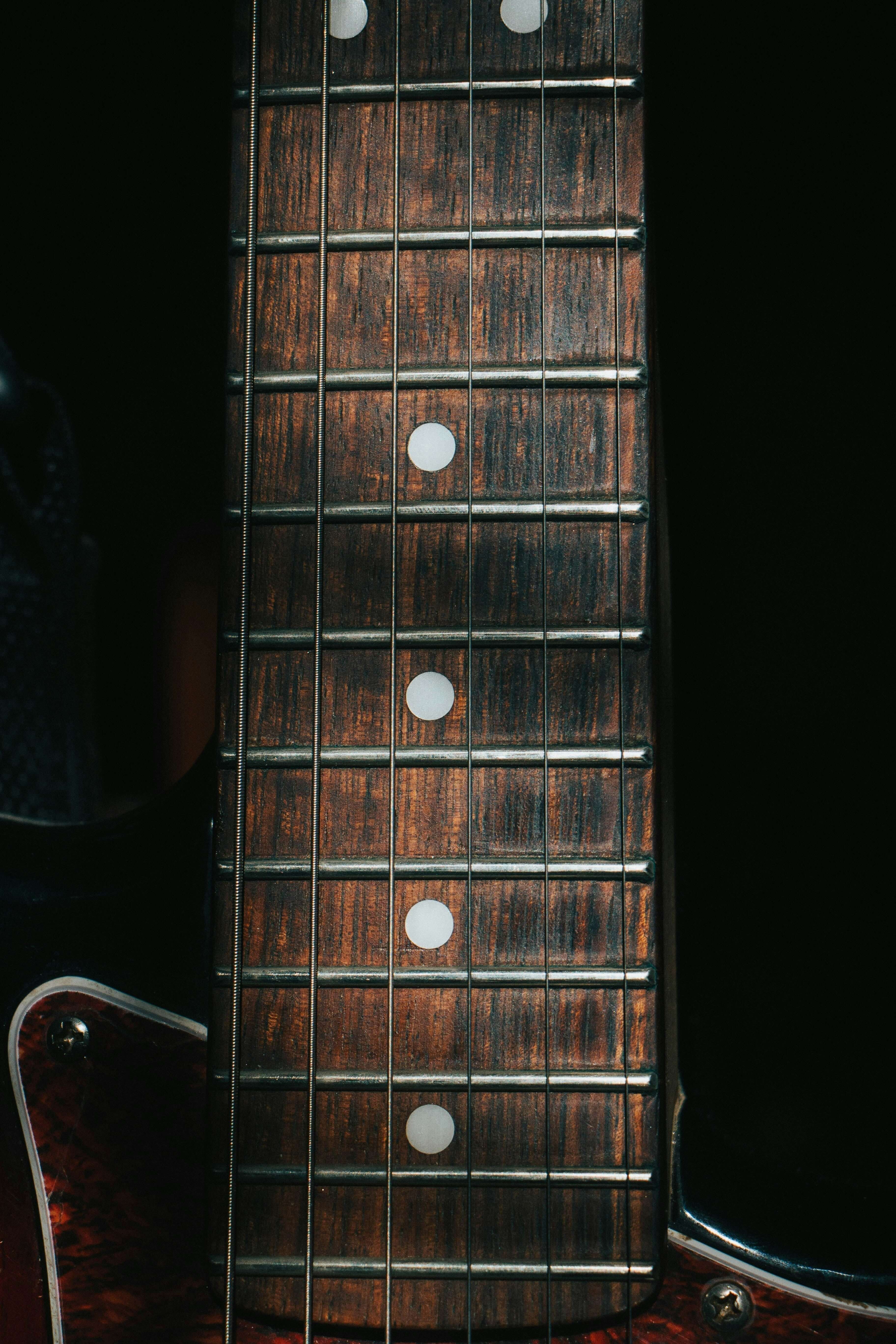
This is where matte earns its reputation. A matte neck gives consistent, predictable friction regardless of hand temperature or moisture. The microscopic texture lets your skin breathe against the surface — perspiration spreads instead of pooling, and the contact area is smaller than on gloss.
The result is a feel players describe as fast, dry, broken-in from day one. No adaptation period, no warm-up stickiness. Your hand moves the same way in the first minute as it does an hour later. For session players, touring musicians, or anyone who needs an instrument that behaves the same under changing conditions, that's a real advantage.
The body follows suit. No arm stick, no sweaty adhesion, no micro-friction when you shift position. It's the finish equivalent of a well-worn t-shirt versus a dress shirt: less polished, but you stop thinking about it. That's the point.
How Matte Ages — The Reverse Problem
Here's the irony: matte doesn't stay matte. The areas you touch most gain sheen instead of losing it. Oil and pressure from your skin burnish the textured surface, polishing the high points of those microscopic irregularities until they're smooth enough to reflect light. You get a semi-gloss patina in the high-contact zones — neck, forearm area, the body near the bridge.
This self-polishing is the mirror image of gloss wear, and it creates the same tension: the guitar becomes a patchwork of original matte and player-made sheen. Some players love it as a wear map of their habits. Others find the inconsistency distracting.
The repair challenge is real, too. Scratch or ding a matte finish and you hit a problem: most repair work involves sanding and buffing, which by nature leaves a smoother, glossier surface. Blending a repair back into matte means matting agents or re-scuffing the area — neither trivial. A skilled luthier can do it, but it takes more care than a gloss touch-up, and it's harder to make invisible.
Satin: The Compromise That Actually Works
The Visual Case
Satin is the diplomatic finish. It carries enough sheen to give wood visual depth — more than matte, less than gloss — without the reflective intensity that makes gloss high-maintenance. It reads as deliberate, like someone chose it rather than defaulting to an extreme.
Under stage lights, satin glows warm and diffused instead of throwing sharp reflections. Visible without being flashy. The grain shows with a soft dimensionality that splits the difference between matte's flatness and gloss's liquid depth. For figured woods, satin is often the sweet spot — enough reflectance to see the chatoyance and movement without the full mirror effect that can overwhelm the pattern.
The Feel
Functionally, satin behaves much closer to matte than gloss. The texture is subtler than full matte but still irregular enough to head off the moisture-adhesion that plagues gloss necks. Most players find satin necks fast and comfortable, with no real stickiness even over a long set.
In pure tactile terms the gap between satin and matte is small — freshly applied, most players would struggle to tell them apart blind. Where satin distinguishes itself is the feel of quality: a silkiness matte sometimes lacks, a smoothness that doesn't cost you playability.
How Satin Ages
Satin ages like matte — contact areas gradually polish to a higher sheen — but the shift is less jarring because satin already carries some reflectance. The gap between original and worn finish is smaller, so the patchwork effect stays subdued.
That makes satin the most graceful ager of the three. It evolves rather than degrades, gently enough that most players barely notice it happening. By the time a satin neck has a real patina, it feels perfectly broken in and looks like it was always meant to be that way.
The Neck Is Where It Really Matters
If there's one thing to take from all this: the body finish and the neck finish deserve separate decisions. More players — and more builders — are treating them that way.
A gloss body with a satin neck gives you the visual spectacle of gloss on the most visible part of the guitar while keeping the playing surface comfortable and consistent. A matte body with a satin neck is understated playability at its best. Nothing says a guitar has to wear one finish everywhere, and mixed configurations are some of the most player-friendly builds available.
So when you're choosing — or talking options through with your luthier — start with the neck. That's where finish interacts most directly with how you play. The body finish is mostly visual preference and maintenance tolerance. Get the neck right and the rest is taste.
So, Which One?
It's tempting to crown satin the winner and move on. In pure ergonomic terms, it probably is. But we don't just play guitars. We live with them, look at them, maintain them, get attached to them. A gloss guitar you pick up because it looks incredible beats a satin guitar you forget on the stand.
The best finish is the one you understand. Know what gloss demands and what it delivers. Know that matte will change under your hands. Know that satin threads the needle but isn't immune to wear. Choose with open eyes and you won't be disappointed, because you'll know exactly what to expect as the instrument evolves with your playing.
Still unsure? Play all three. Give each one thirty minutes.

공유:
IRYW : 아름다운 기타는 소리가 더 좋다
프렛 슬롯에 관한 진실