



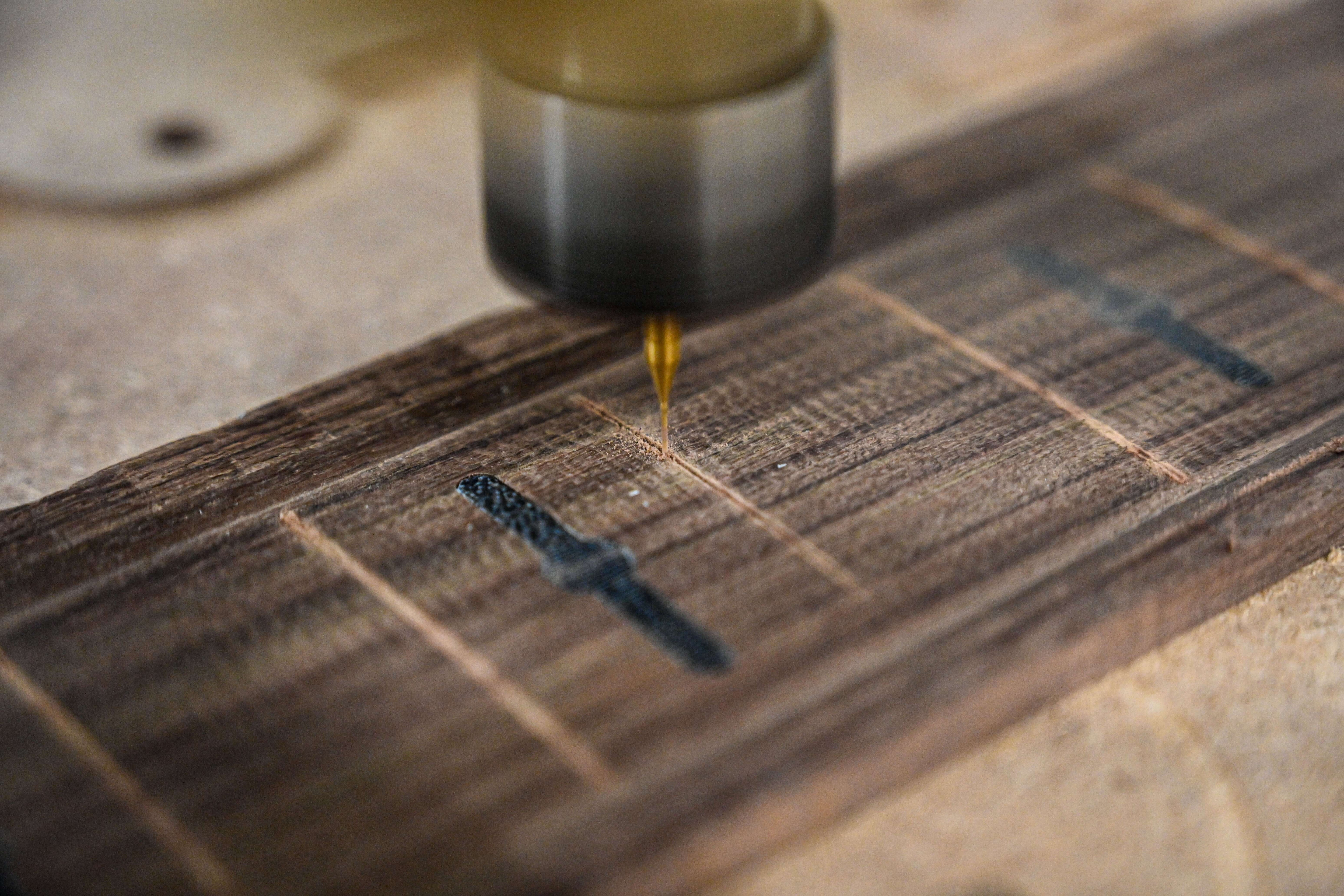
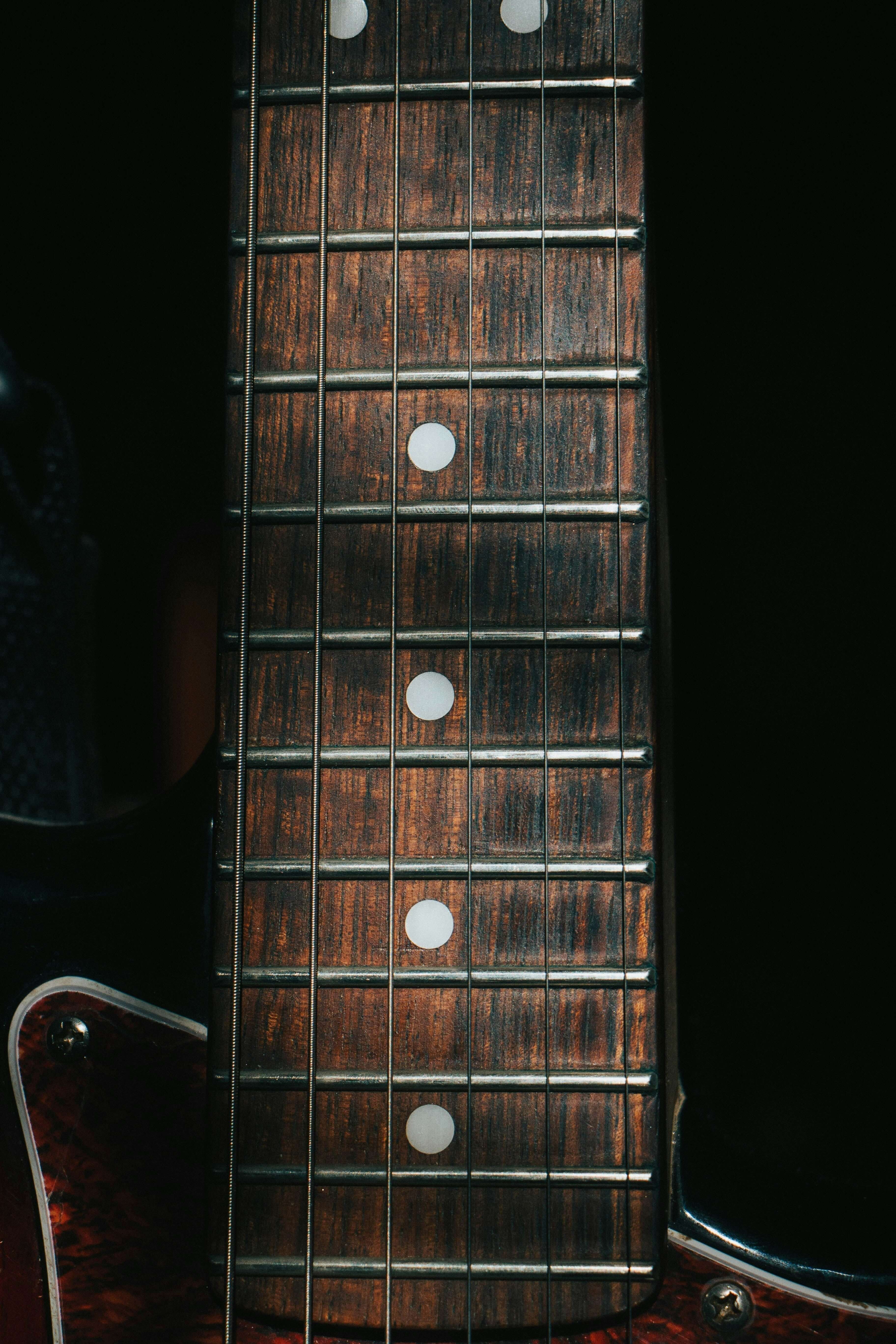
프렛 홈은 폭이 약 0.6mm 정도 되는 톱질 자국입니다. 그 안에는 아무것도 들어 있지 않습니다. 그리고 개방현 위에서 연주할 때 느껴지는 거의 모든 감각은 이 홈이 어떻게 깎였는지에 따라 결정됩니다.
슬롯이 겉보기에는 사소해 보이지만 실제로는 얼마나 큰 영향을 미치는지 사이의 그 간극이야말로 잘못된 정보가 번식하는 지점입니다. 프렛 슬롯에 대해 쓰여진 대부분의 글들, 이 기사가 대체하게 될 이전 버전을 포함해서, 세 가지 매우 다른 주장을 뒤섞어 마치 하나의 사실인 양 제시합니다. 따라서 이 글은 의도적으로 이 세 가지를 구분하여 다룹니다. 아래 내용 중 일부는 수학적으로 정해져 있어 단 하나의 정답만 존재합니다. 일부는 공구와 사용하는 와이어에 따라 결정되며, 해당 와이어에 대해서만 정답이 됩니다. 그리고 일부는 확립된 사실인 양 가장한 작업장의 선호도에 불과합니다. 어느 것이 어느 것인지 구분하는 것이 바로 이 글의 핵심입니다.
슬롯의 실제 용도
프렛 슬롯은 프렛의 둥근 윗면 아래에 있는 얇은 받침대인 ‘탱(tang)’을 고정하는 홈입니다. 탱의 측면에는 작은 돌기나 스터드가 있습니다. 이 돌기들이 슬롯 벽면에 단단히 물리며, 종종 접착제가 더해져 발생하는 이러한 마찰력이 프렛을 제자리에 고정시킵니다.
Worth stating plainly, because the next part trips people up: the fret does not rest on the bottom of the slot. It seats when the underside of the crown meets the surface of the fingerboard. The slot floor can sit a comfortable distance below the tang and nothing is wrong. Air under a tang does no harm.
A slot has three independent properties, and each controls a different thing. Where it sits along the neck sets intonation. How wide it is sets how the fret grips. How deep it is sets whether the fret seats at all. Treat these as one quality called "precision" and you'll repeat the usual mistakes. Treat them as three and the subject gets simple.
위치: 이 부분은 산술 연산입니다
프렛 위치는 슬롯팅 과정에서 유일하게 정답이 하나뿐인 부분이며, 이는 연주자의 기량이나 취향의 문제가 아닙니다. 이는 평균율에 따른 것이며, 평균율은 하나의 공식입니다.
The distance from the nut to the nth fret is the scale length L, minus L divided by the twelfth root of two raised to the nth power:
d(n) = L · (1 − 2^(n/12))
The old shop shorthand was the "rule of 18": divide the remaining scale length by 18 to find the next fret. It's close, but it leaves the upper register slightly flat, because the exact constant is 17.817, not 18. Modern templates and calculators use the real number. You can check any layout in one move: the twelfth fret must land at exactly half the scale length. On a 25.5-inch scale that's 12.75 inches, dead on. If it isn't, the math is wrong, and no amount of clean cutting will rescue the intonation.
This is why position error is the one slot error a player actually hears. A fret a couple of tenths of a millimetre off its calculated spot pushes that note sharp or flat for the life of the instrument. The same error in width or depth changes nothing about pitch. So when intonation gets blamed on "slot precision," the precision that matters is longitudinal placement — and that comes from the template or the CNC program, not from how the cut itself was made.
It's also where the geometry turns genuinely demanding on a multiscale instrument. On a fanned-fret neck — our Aeri HL, for instance, where the bass and treble sides run different scale lengths — every slot sits at its own angle, calculated per string. The standard Aeri keeps straight frets and a single scale; the HL does not. That kind of layout is where a machine or a dedicated template stops being a convenience and becomes the only sane way to hit the numbers.
폭: 핏의 문제일 뿐, 톤의 문제는 절대 아니다
Slot width is set by the wire, not by preference. Most fret wire is made with a tang about 0.020 inches wide — roughly half a millimetre — and the makers spec a 0.023-inch slot to receive it. That's Jescar's published recommendation for their standard profiles, and it's why StewMac's fret saws are ground to a 0.023-inch kerf: the saw is sized to the wire. The three-thousandths of an inch of clearance is the room the barbs need to dig in.
줄이 원하는 너비보다 넓게 만들면 프렛이 헐거워집니다. 그러면 프렛이 들뜨거나 삐걱거리거나, 슬롯이 해야 할 역할을 대신하기 위해 접착제에 의존하게 됩니다. 반대로 너무 좁게 만들면 탭이 눌리거나 지판이 갈라지며, 프렛이 제대로 내려앉지 못해 높게 솟아오르게 됩니다. 비대칭적인 점을 유의하세요. 약간 넓게 만든 것은 접착제로 보정할 수 있지만, 너무 좁게 만들면 지판을 망칠 수도 있습니다.
The number everyone quotes — 0.023 inches — is only "standard" relative to standard wire. Jescar say it themselves: other tang sizes need other slots. A vintage refret with thinner tangs, or a wide-tang specialty wire, throws the figure out, and measuring the actual tang beats trusting a default. There's also a deliberate use of the width-to-tang relationship: fret a neck with tangs slightly proud of the slot and the wedging action induces a touch of back-bow. Done on purpose that's compression fretting; done by accident it's a warped neck. Either way it has nothing to do with how the guitar sounds. Width is grip. Tone lives elsewhere.
Depth: clear the tang, miss the truss rod
깊이에는 두 가지 기준이 있으며, 그 사이에는 별다른 문제가 없는 여유가 충분히 있습니다. 홈은 가장 얕은 부분이라도 탕(tang)이 완전히 들어갈 수 있을 만큼 충분히 깊어야 하며, 그래야 크라운이 표면에 밀착될 수 있습니다. 홈을 너무 얕게 파면 탕이 먼저 바닥에 닿아 프렛이 돌출된 채 흔들리게 됩니다. 일반적인 관행은 탕보다 아주 약간 더 깊게 파는 것이며, 그 이상으로 복잡하게 만들 필요는 없습니다.
The catch is that tang depth isn't one number. It runs from around a millimetre on small wire to nearly two on tall bass wire, so "correct depth" is whatever clears the specific wire in hand, plus a little. The lower limit is structural: don't cut into the truss rod channel, and on a thin board don't break through the back. That's the real reason to respect depth — not seating, which a generous slot handles easily, but not turning a fingerboard into scrap. It's also why pre-slotted boards from suppliers come cut straight across and deliberately deep: deep is safe, and the builder can always stop a fret short of the floor.
반경 처리된 슬롯에 관한 질문
대부분의 프렛 슬롯 관련 글들, 이 글이 대체하는 글도 포함해서,에서 가장 자주 등장하는 주장은 다음과 같습니다. 즉, 바닥면이 지판의 곡선을 따라가는(평평하게 가로지르지 않는) 라디우스 처리된 프렛 슬롯이 더 우수한 선택이며, 프렛을 더 균일하게 고정하고 더 견고한 장착을 가능하게 한다는 것입니다. 이 주장은 신중하게 다뤄야 합니다. 왜냐하면 절반은 맞지만, 나머지 절반은 틀렸음에도 불구하고 많은 판매를 이끌어내고 있기 때문입니다.
Start with the geometry, which is real. Most builders cut slots into a flat blank at a constant depth, then sand the radius into the top. Sanding a radius removes wood from the edges of the board, not the centre. So once the radius is in, those constant-depth slots end up deepest in the middle and shallowest at the edges. Choose a tighter radius or a thinner board and that difference grows. A truly radiused slot — deepened at the edges, cut after radiusing with a follower, or done in one pass on a CNC — keeps the depth even across the width.
이제 “우수한” 프레임 설계가 간과하는 부분을 살펴보겠습니다. 프렛은 슬롯 바닥에 고정되는 것이 아니라, 표면에 닿는 윗면(크라운)을 통해 고정됩니다. 따라서 깊이의 차이가 영향을 미칠 수 있는 유일한 점은 얕은 부분, 즉 가장자리가 여전히 탱(tang)을 피할 수 있는지 여부뿐입니다. 만약 피할 수 있다면, 바닥이 평평한 슬롯도 라디우스 처리된 슬롯만큼이나 프렛을 완벽하게 고정합니다. 중앙부의 추가 깊이는 그저 공기가 차지하고 있을 뿐이며, 탱 아래의 공기는 그립력, 고정력, 안정성에 아무런 영향을 미치지 않습니다. 가장자리의 평평한 슬롯을 충분히 깊게 파기만 한다면, 일반적인 비율을 가진 보드에서 슬롯에 라디우스를 줄 필요성은 거의 사라집니다.
Where it stops being academic is at the margins: very thin boards where you can't spend the extra centre depth, tight radii where the variation is large, and any job where breaking through the back is a live risk. There, following the radius is sound engineering, not fuss. Everywhere else it's a refinement, and a builder who skips it is not cutting a worse slot.
So, the three labels, kept honest. The geometry — flat slots vary in depth on a radiused board — is measurable and true. That this makes them inferior in normal use is not established; the seating physics says otherwise. That radiused slots are universally "superior" is marketing. And my own position, offered as a bench opinion and not a fact: radius the slots when the board is thin or the radius is tight, and don't lose sleep over it otherwise. Plenty of fretwork I'd put my name to sits in flat-bottomed slots.
폐기해야 할 두 가지 주장
반경 처리된 슬롯 간격에 맞춰 두 줄이 더 이어지는데, 이 두 줄 모두 삭제해야 합니다.
The first is that radiused slots reduce fret sprout. They don't, and they can't. Sprout is the fingerboard losing moisture in dry conditions and shrinking across its width, while the steel frets — which don't shrink — stay put, so the ends sit proud and catch your hand. It's a humidity-and-wood-movement problem from start to finish. The geometry of the slot floor has no bearing on it. The actual remedies are controlling humidity and dressing the fret ends. That's the whole list.
The second is that slots, in general, determine intonation. Only their position does, and that's the arithmetic from earlier. Width and depth are seating and retention. Folding them into an intonation claim is how a fit specification gets quietly promoted to acoustic physics.
수작업 대 CNC, 공정하게
The usual framing says CNC slotting "dramatically reduces human error," which makes it sound as though a motor is inherently more honest than a person. That's not where the accuracy lives. Position accuracy comes from the template or the program. A builder cutting against a good template with a depth-stopped saw lands fret positions inside a tolerance no player will ever hear; a CNC running a bad file will cut a bad neck very repeatably.
CNC가 진정으로 제공하는 것은 수많은 판재에 걸쳐 일관된 품질, 속도, 그리고 복합 반경, 다중 스케일 팬, 가장 단단하고 부서지기 쉬운 목재와 같은 까다로운 형상의 깔끔한 가공 능력입니다. 수작업이 제공하는 것은 정밀도와 감각, 그리고 기계가 적합하지 않은 일회성 제작품, 바인딩이 부착된 보드, 마감 처리된 보드 작업 시의 편의성입니다. 연간 20~30개 정도의 제작량에서 우리가 한 방식을 다른 방식보다 선택하는 이유는 생산량이 아니라 눈앞에 놓인 작업 자체 때문입니다. 또한 어느 쪽도 귀에 들리는 소리의 관점에서 볼 때 '더 정밀하다'고 할 수는 없습니다.
나무에게도 생각이 있다
The board material changes how a slot behaves, though these are tendencies, not laws — every species varies plank to plank. Ebony is hard and brittle and likes to chip at the mouth of the slot, so it rewards sharp tooling and a scored or taped line. Rosewoods and pau ferro run oilier and are generally more forgiving. Maple is soft enough to compress and is almost always finished, which turns a slotting question into a finishing one. Dense modern composites cut consistently and wear tooling fast. Harder, denser boards dull blades and cutters sooner — a maintenance fact more than a design one, but it's the reason a tired blade leaves a ragged slot.
좋은 슬로팅과 나쁜 슬로팅을 실제로 구분 짓는 것은 무엇인가
Not the radius of the slot floor. Good slotting is position dead on the math, checked against the half-scale octave; width matched to the actual tang in your hand rather than a default; depth set to that wire with margin and never into the truss channel; and walls clean enough for the barbs to bite. On bound or finished boards there's one more: chamfer the top edges of each slot with a triangle file before the frets ever come out, so the day someone refrets the instrument the board doesn't chip on the way.
That last point is where slot quality is finally graded — not on the build bench but on the repair bench, years later. A guitar comes in for a refret and the old slots tell you everything: whether the width suited the wire, whether the depth was sane, whether anyone gave a thought to the person who'd open it up next. We see plenty of them as a Taylor repair centre. The clean ones were cut by someone who understood that the slot isn't the point. The fret is. The slot just has to be right enough to disappear.
공유:
광택, 무광, 아니면 새틴?
기타와 베이스 현에 관한 진실