



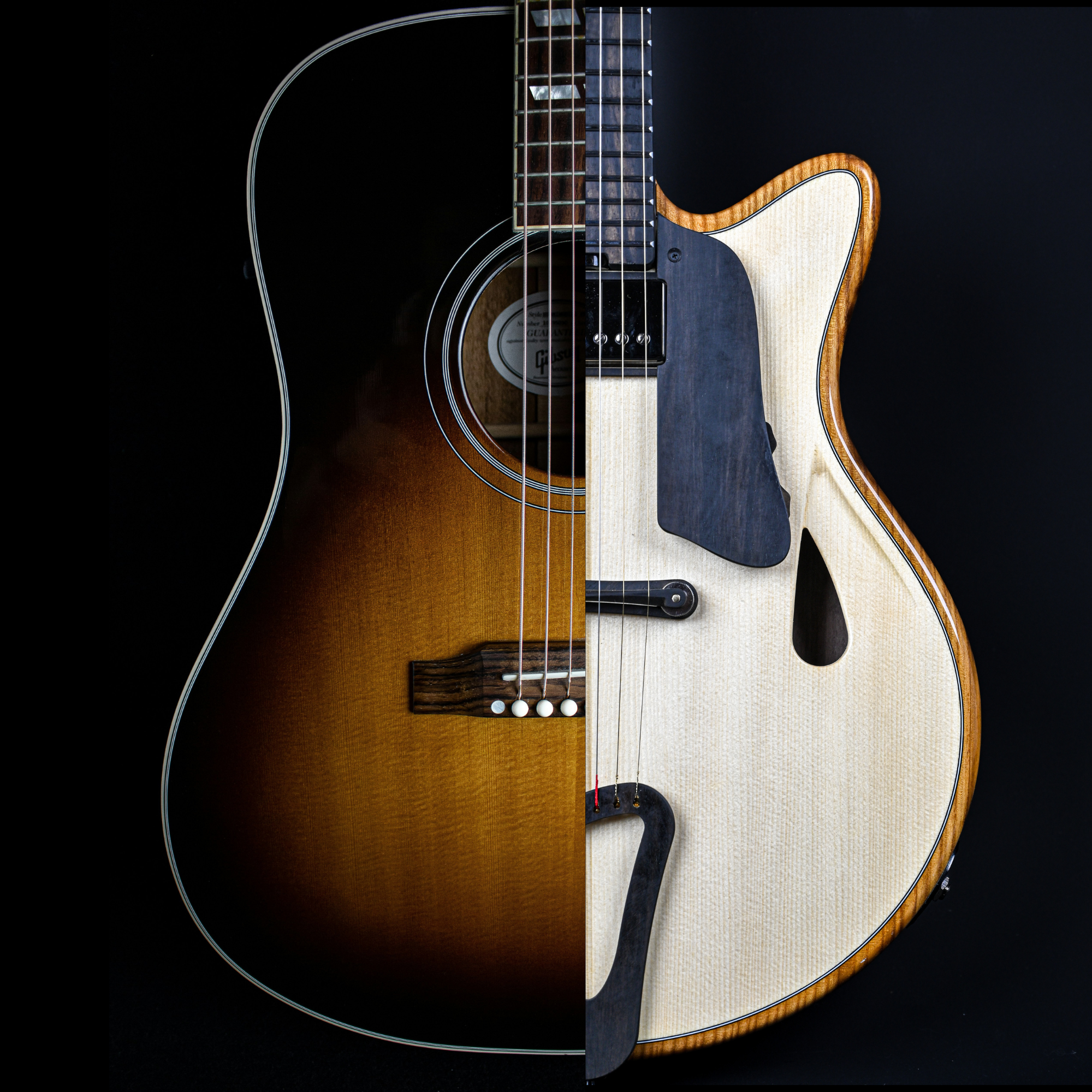
There is a sentence one hears in conservatories, in music magazines, and at family dinners. It is delivered with a small, knowing smile. The electric guitar is not a real instrument. It is less of an instrument than the others. Some of these comments carry a social class judgment, and that is the subject of another volume. Most of them come from plain scientific illiteracy.
We live in a world where every solid object has acoustic behavior. Bridges have it. Buildings have it. Wine glasses have it well enough to shatter on the right note.
The most produced and played stringed instrument in history is supposed to be the exception?
This is wrong, and it is wrong in a specific, measurable, demonstrable way. This volume is going to demonstrate it, once and for all. The point is to describe, as plainly as possible, what happens when a string vibrates above a magnetic pickup, and what role the rest of the instrument plays in shaping that vibration. The conclusion follows from the description.
The electric guitar is an acoustic instrument.
Therefore, electric guitars do not exist.
A note before the physics begins. The mechanism described in what follows tells us what an instrument does. It does not tell anyone what to like. High-damping instruments have places in music that high-sustain instruments do not. Resonant instruments are sometimes too much in a dense mix. The same physics that makes one guitar a precision tool makes another guitar a blunt instrument, and there are records that needed the blunt one. We are describing mechanism, not ranking taste.
At the end of this essay the physics will hit the wall of every reader's ears, and the ears will have the last word.
That is as it should be.
Just a microphone

Begin with the device that does the converting. A magnetic pickup is a transducer. It converts one form of energy into another — mechanical motion into electrical voltage — through electromagnetic induction.
The string is magnetized by the pickup's permanent magnet. When the string moves through the magnetic field, the flux through the coil changes. A changing flux induces a voltage across the coil. The voltage is a continuous, time-varying signal whose shape is a direct function of how the string is moving.
This is not a controversial description. It is in the physics textbooks. It is in the patent filings. It is on the Penn State physics department's educational pages, where the pickup is described as a transducer that measures string velocity according to Faraday's law.
The pickup does not generate tone. The pickup reports motion. Anything the string does, the pickup hears. Anything the string does not do, the pickup cannot invent.
The consequence is straightforward. The signal at the output jack is, within the bandwidth and impedance characteristics of the pickup itself, a graph of how the string is moving over time. If the string is moving with strong fundamental and weak overtones, the signal carries strong fundamental and weak overtones. If the string is decaying quickly on the third harmonic and slowly on the fifth, the signal carries that exact decay envelope.
The pickup imposes its own filter — high-frequency roll-off determined by coil inductance and capacitance, output level determined by magnet strength and coil turns — but the underlying signal it is filtering is determined entirely by string motion.
So the question of what an electric guitar sounds like becomes, almost entirely, the question of how its string moves. Which is the question everything else in this essay is about.
Nothing vibrates alone

An MIT researcher showing a graphic. In X : How I'm Right - in Y, How I'm Right, but vertically
A string under tension, anchored at two points, vibrates. In the simplest physical model — an ideal string fixed at perfectly rigid supports — it vibrates at a fundamental frequency determined by length, tension, and mass per unit length, plus integer multiples of that frequency as overtones.
Each overtone decays at its own rate. In the idealization, the supports are infinitely stiff. They do not move. They do not absorb energy. The string vibrates indefinitely.
No real string is in that situation.
The supports — the nut or fret at one end, the saddle at the other — are part of a larger mechanical system. The neck flexes. The body flexes. The bridge mounts move. Each support has a mechanical impedance: a measure of how much force is required to make it move at a given frequency.
When the string pulls on the bridge, the bridge moves a little. That motion drains energy from the string. The energy goes into the body, which now vibrates at its own frequencies, and some of that energy returns to the string, in phase or out of phase, fast or slow, depending on what the body wants to do at the frequencies the string is producing.
This is what coupling means. The string and the body are not separate systems. They are one system, exchanging energy. The string's motion at any moment is the result of its own physics plus the body's response plus the neck's response plus the supports' response. The decay envelope of every harmonic is shaped by how much energy each one is losing into the rest of the instrument.
The Materials journal study from 2021 — two identical electric guitar bodies, one in ash, one in walnut — measured this directly. Modal frequencies of the assembled instrument differed by tens of Hertz between the two woods. Damping coefficients differed. Harmonic decay rates on the open strings, measured at the pickup, differed measurably. Same strings, same pickups, same hardware, same player. Different body wood. Different signal at the output.
The pickup did not change. The string did, because the system the string was coupled to changed.
Older work by Gough, going back to the 1980s, derived the analytic relationship between structural resonances and string resonances on coupled systems. The result is general: where a structural mode lines up with a string mode, the string loses energy preferentially at that frequency. Where the modes are far apart, coupling is weak and the string rings out. The instrument's modal structure is not decoration. It is a filter applied to the string before the pickup ever sees it.
Rock Your Body

The body is the largest mechanical element coupled to the string, and the one the industry has spent the longest pretending is inert. It is not inert. It is a chunk of wood with mass, stiffness, internal damping, and a geometry that gives it a population of resonant modes — typically in the range of 80 Hz to 600 Hz for solid bodies, with the lowest modes contributing most of the audible coupling effect.
Four properties of the body matter.
First, density. Heavier bodies, all else equal, move less for a given force from the string. They have higher impedance at the bridge. They drain less energy per cycle. Strings sustain longer.
Second, stiffness. A stiffer body moves less in the elastic regime, returns energy faster, and has higher modal frequencies.
Third, internal damping. This is the measure of how much vibrational energy the wood itself converts to heat per cycle. High damping means energy that enters the body does not come back. Low damping means energy that enters the body resonates for a long time, potentially returning to the string.
Fourth, geometry. Where the wood is, how it is shaped, where the bridge is anchored relative to the body's nodal lines, all determine which modes get excited and how strongly.
The first three properties — density, stiffness, damping — are exactly the properties that vibrational tonewood characterization methods measure.
Non-destructive testing of wood for instrument use is not new and not particular to any one institution; CIRAD in France is one example among several research bodies that have developed these methods. The point is not the institution. The point is that the methods exist and have existed for decades, and that builders who use them on solid bodies are doing the same work acoustic builders do on tops.
They are characterizing the material before they cut it, because the material's mechanical properties determine what the finished instrument can do.
Variance between individual boards of the same species is enormous. Two pieces of swamp ash from different trees, or different parts of the same tree, can differ in density by twenty percent and in damping by more than that.
Grading by visual inspection or by species name alone produces a population of bodies whose acoustic properties are essentially random within wide bounds. Grading by measurement produces a population in which the builder knows, before assembly, roughly what the body will contribute.
This is why arguments about whether tonewood matters in solid bodies tend to be unresolvable in the public forums where they take place.
Both sides are right about different populations of instruments.
On a body cut from a randomly graded board, installed into a sloppy pocket, finished thickly, the contribution of wood choice is small relative to the noise floor of the rest of the construction. On a body cut from a measured board, fitted precisely, finished thinly, wood choice is a measurable and audible parameter.
The disagreement is not about physics. It is about which instruments the disputants have played.
Half Life

The neck is the other major resonant element, and on solid body electrics it is often the dominant one. The body is large and stiff. The neck is long, slender, and cantilevered. It has lower modal frequencies than the body for that reason — typically with its lowest bending mode somewhere between 100 Hz and 250 Hz, depending on length, mass, stiffness, and headstock geometry. Those low modes are firmly inside the range where the lower notes of the guitar produce strong harmonic energy. Coupling is unavoidable.
The clearest demonstration of this is the dead spot.
A dead spot is a note on which the string and the neck have a resonance at, or very close to, the same frequency. When that happens, coupling becomes strong. The neck moves substantially in response to the string. Energy drains rapidly from the string into the neck. The note's sustain collapses.
The pickup, faithfully reporting, sends a short note to the amplifier. This is not a setup issue. It is a structural one, and it has been characterized in the acoustics literature by Paté, Le Carrou, and Fabre, among others. Their conclusion is that dead spots occur where a structural mode of the neck-body system coincides with a fretted-string mode, and that the coupling at that frequency lowers decay time enough to be perceived as a loss of sustain.
The location of those resonances is governed by basic mechanics. Resonant frequency scales with the square root of stiffness divided by mass. A stiffer neck has higher resonant frequencies. A heavier headstock has lower resonant frequencies. Truss rod tension affects effective stiffness. The neck-body joint geometry affects effective stiffness too — a well-fitted bolt-on with full contact behaves differently from a sloppy bolt-on with air gaps, and a glued neck joint adds yet another condition.
None of this is mystery. It is the elementary mechanics of a coupled cantilever beam, applied to an object that happens to be a musical instrument.
This is also why headstock mass changes tone. Adding a heavy clamp to the headstock — the so-called Fat Finger — lowers the neck's resonant frequencies by adding mass at the most active end of the bending mode. The fix sometimes moves a dead spot away from a useful note. The mechanism is straightforward: the resonance moved, because the mass at the antinode changed. Locking tuners with different masses do the same thing, in smaller amounts. None of this requires belief. It is testable in an afternoon.
The fretboard is part of the neck and contributes to its stiffness and damping. Ebony, rosewood, maple, and the various dense substitutes are not interchangeable. They differ in density, in stiffness, and in damping at the frequencies the neck modes occupy. The frets themselves contribute mass.
Frets with a larger cross section, or made of harder alloy, change the neck's modal behavior measurably. None of these changes is large, in isolation. They are cumulative. The neck is the integrated result of every component in it.
Q is for Quiet

Two terms are useful here, and worth defining plainly. Q, or quality factor, is a dimensionless measure of how sharply a resonance is tuned. A high-Q resonance is narrow in frequency and rings for a long time after excitation. A low-Q resonance is broad in frequency and dies away quickly. Damping is the related property that describes how much energy is lost per cycle of vibration. High damping means low Q. Low damping means high Q. They are two ways of saying the same thing.
These terms apply to every resonant element in the instrument. The body has modes, each with a Q. The neck has modes, each with a Q. The strings have modes, each with a Q that is normally very high because steel strings under tension dissipate very little energy in themselves. The strings lose energy mostly into the supports.
What does this sound like, at the pickup?
A high-Q instrument — stiff, low-damping body and neck, well-fitted joints, thin finish — produces long sustain, strong harmonic content that persists over time, and a sense of clarity because individual frequencies are well separated. The same instrument is also more prone to dead spots, because when a strong narrow resonance does line up with a string frequency, coupling is severe.
A low-Q instrument — heavy damping in the wood, a thicker finish, looser joints — produces shorter sustain, a faster decay of upper harmonics, and a smoother distribution of energy across frequency. The same instrument is less prone to dead spots, because no single resonance is sharp enough to drain a string catastrophically. Neither set of properties is correct. They are different points in a design space.
Modal density matters too. An instrument with many closely spaced modes has a more even response across frequency. An instrument with few widely spaced modes has peaks and valleys. The body geometry, the wood selection, and the assembly choices all push this around. The builder who knows what they are doing has opinions about where they want it to land.
None of these properties is invisible to the pickup. Every one of them shows up in the signal at the output jack, because every one of them changes how the string is moving. The pickup, being a faithful transducer, sends all of it down the cable.
Built like furniture

Because, on most electric guitars, most of it does not. The body has been built so that its contribution is overwhelmed by the noise floor of its own construction. Boards are selected by yield and color rather than by vibrational properties. Pockets are routed wide for assembly tolerance.
Necks are fitted with gaps that get filled by finish or by shims. The finish itself is applied thickly enough to function as a damping layer on every external surface. Hardware is bolted into the body through thin sheet metal plates, transferring energy in ways the designer did not specify because no one specified anything about it.
This is not an accusation of bad faith. It is a description of manufacturing economics. The electric guitar was framed at its origin as an instrument in which the body did not matter, and the construction practices that followed from that framing made the framing true.
The evidence then confirmed the theory that had produced it. This is circular, and it is also stable. A factory that has built the same model for forty years does not need to revisit the assumption that its body wood is interchangeable. The instruments are, by construction, instruments on which body wood is largely interchangeable.
The assumption is locally correct.
Generalizing from that population to the question of what an electric guitar is capable of, when built differently, is the error. The instruments those factories produce are members of one design philosophy.
There are others. The boutique workshops, small in number and scattered internationally, work in a different design philosophy in which all the variables described in this essay are treated as parameters to be controlled. The instruments those workshops produce are not better or worse, in any universal sense. They are different.
They behave acoustically in ways the factory instruments do not, because they have been built to.
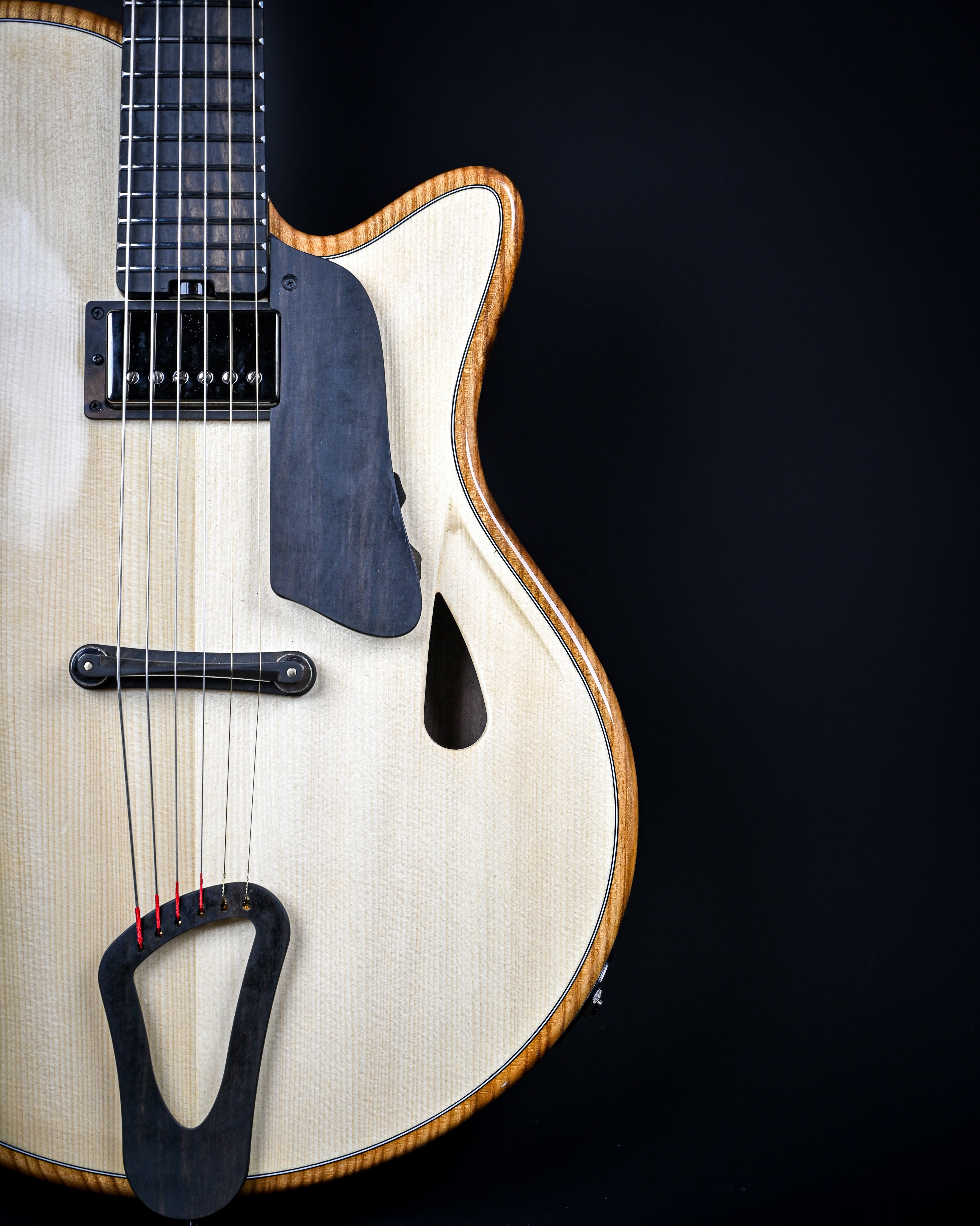
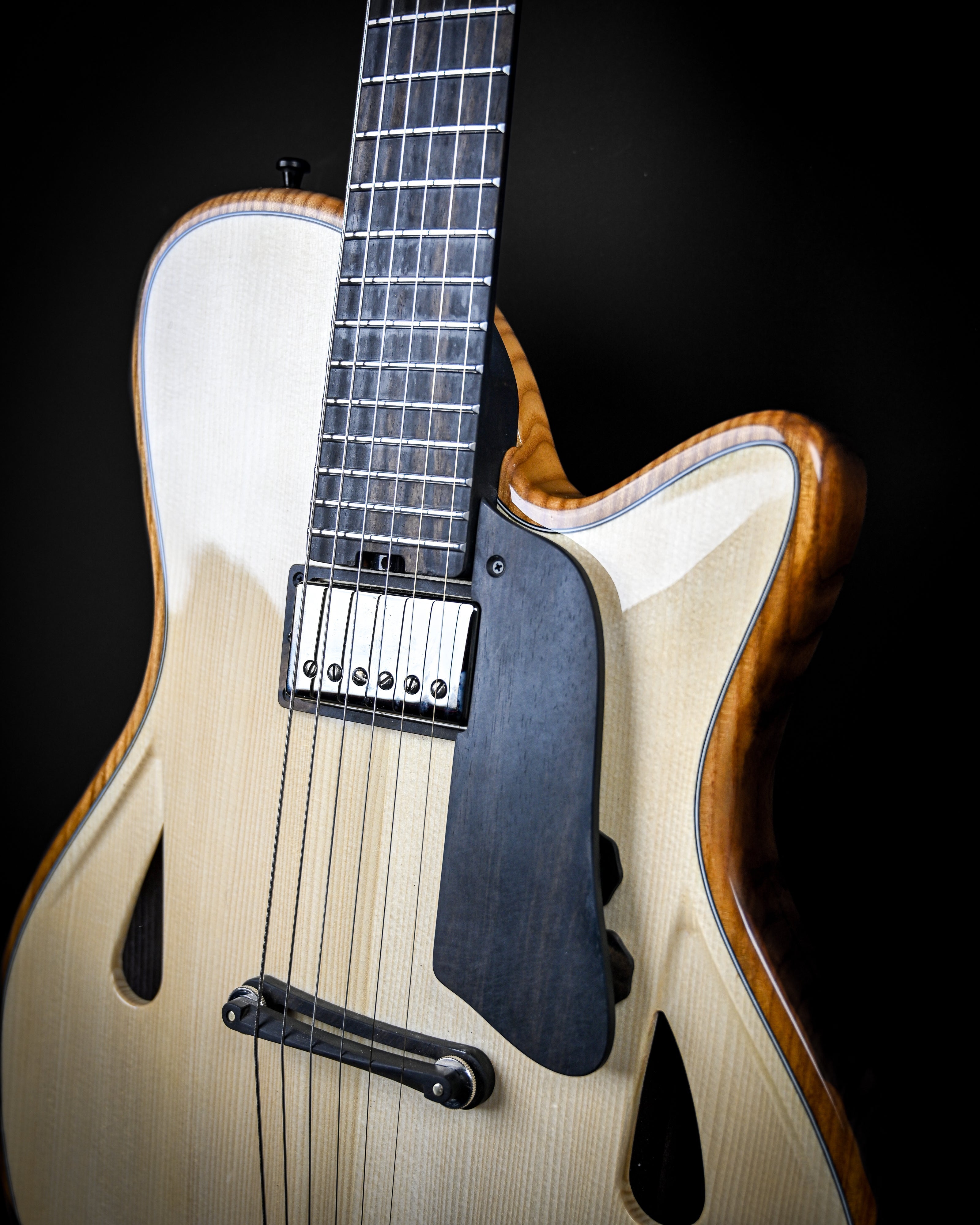
Hollow and semi-hollow electrics make the point easier to see. Nobody disputes that a 335 or an archtop electric has a body that contributes to the sound, because the body radiates audible sound even unplugged.
The solid body is the harder case because the radiated output is small. But the body is doing the same work — coupling, damping, shaping decay envelopes, defining modal structure.
The energy goes into the string's motion rather than into the air. The pickup hears the result either way.
Apples and other apples

The case against the electric as an acoustic instrument is almost always made with two specific examples.
A high-end concert acoustic, hand-voiced, with selected wood and conservatory-grade attention to every joint. And a factory solid body electric, with generic construction throughout.
The comparison is offered as if it settled the question. It does not. It compares two construction philosophies, not two categories of instrument.
Run the comparison the other way. Take the best solid body electric being built today — and the bar is high, but the makers exist — and compare it with the average acoustic guitar sold this year. Not the concert instrument. The average.
A factory acoustic with machine-cut bracing, robotically applied finish, kiln-rushed tops graded by yield, structural decisions made for assembly reliability rather than acoustic optimization. By any measure of acoustic attention — wood selection by vibrational properties, fitting of components for energy transfer, voicing of the structure, control of damping — the boutique electric will have had more acoustic care put into it than the factory acoustic. That is a fact about the labor, not about the category.
This is not an argument that the electric sounds better.
The two instruments sound nothing alike, because they are different instruments. It is an argument that the labels acoustic and electric describe construction categories rather than depths of acoustic intention, and that within each category, the variance between examples is far larger than the variance between the categories themselves. Some acoustics are built with less acoustic attention than some electrics.
The label does not protect the instrument from inattention, and the label does not condemn it to it.
Worthless Ears

Everything in this essay is mechanism. It describes what the instrument does, in measurable physical terms. It does not describe what anyone is going to like, and it does not describe what anyone should make.
This is the moment the physics hits psychoacoustics, and psychoacoustics wins. Listeners do not hear modal frequencies, damping coefficients, and decay envelopes as such. They hear notes that have a feel — fast, slow, woody, glassy, alive, dry, immediate, distant. The mapping between the physical properties of the instrument and those perceptual categories is not one-to-one, is not the same across players, and is heavily mediated by context.
A high-Q instrument in a dense rock mix can sound exhausting. The same instrument in a sparse arrangement can sound revelatory. A high-damping instrument can be the right tool for a specific record and the wrong one for the next. A guitar with a dead spot on a note the player never uses is, for that player, a guitar without a dead spot. There is no version of this essay that produces a ranking. There is only a description of mechanism, plus the player's ears.
The thing the description does is establish that mechanism exists, and that it can be controlled or ignored. The builder who controls it is not adding mystique. They are adjusting parameters.
The builder who ignores it is not making a humble instrument. They are accepting whatever the parameters happen to do. Either is a legitimate choice. Both produce instruments people play. But only one can honestly describe itself as having designed the result.
The electric guitar is an acoustic instrument. The string vibrates in air. The body and the neck respond. The string's motion is shaped by every parameter of the structure it is anchored to. The pickup converts that motion into voltage with the fidelity of a Faraday-law transducer, which is to say, faithfully.
At no point does the acoustic behavior of the instrument become irrelevant.
It can be ignored. It cannot be bypassed.
The choice the builder makes is whether to design it, or to accept it. Everything downstream of that choice — what the guitar sounds like, what it is good for, what someone is going to like — is a different conversation, and one this essay does not have a position on.
But the conversation cannot begin with the assumption that the body does not matter. That assumption is not modesty. It is wrong. It has been wrong since the first solid body was built. The instrument has been telling the truth the whole time, and anyone willing to listen to one unplugged, in a quiet room, before they form an opinion, can verify this for themselves in about ten seconds.
The string moves. The wood moves with it. The note has a shape that did not come from an amplifier. That shape is the instrument. The rest is wire.
And remember, it doesn't really matter, science, physics, it's all about me being right, and you being wrong.
See you on the next one
注:本站所有文章均先用法语撰写,再进行翻译。这种翻译属于主动翻译,并非简单地逐字对应,而是在必要时进行调整,以更好地适应目标语言。这可能会导致语气或内容的微妙变化,对此我们表示理解并予以认可。




分享:
是什么让现代拱面琴
关于音准”的真相
1 条评论
This is a fantastic breakdown of the science behind string tension and body resonance. It really puts into perspective how every choice in guitar hardware-right down to upgrading to high-quality guitar locking tuners-alters the instrument’s mechanical impedance and physical energy transfer rather than just being a cosmetic choice. The idea that pickups simply report this acoustic motion is a great reminder that the wood and hardware choices matter just as much as the electronics.