



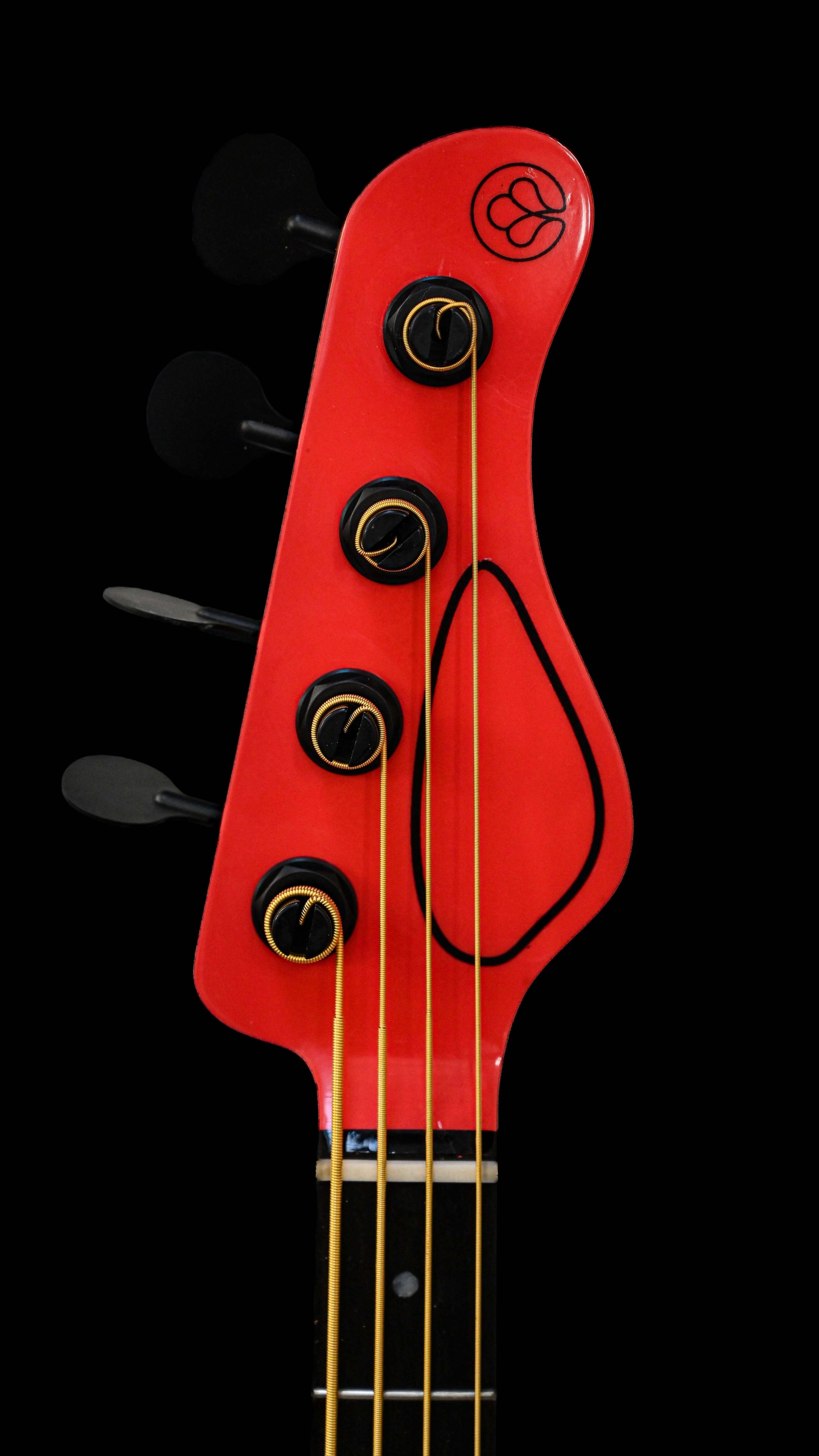
Strings are the most argued-about, most upgraded, and most misunderstood component on the instrument. They are also the cheapest, which is exactly why the marketing around them works so well: a string set costs less than a restaurant meal except for us bassists, so the temptation to believe that the right one will transform your tone is enormous, and the cost of testing that belief is low enough that almost everyone does it.
This article does what the rest of the series does. It separates what strings genuinely do — to tone, to feel, to tuning — from what the catalogue copy and the forums have decided they do.
Most of the construction details are real and worth understanding. The material differences are real, if smaller than people think. And the single biggest tonal variable in the entire conversation is one almost nobody is selling you, because you already own it: how old the strings are.
We’ll get to that. First, the parts.
What strings are actually made of
The material a string is made from is real, audible, and genuinely matters — but it sits a lot lower in the hierarchy than the way it’s marketed suggests, and it matters far more on an acoustic than on an electric. Here’s the honest version.
On an electric, the string has to be ferromagnetic so the pickup can sense it, which immediately rules out bronze and nylon. Within the magnetic materials, the differences are real but modest:
• Nickel-plated steel is the default for a reason: steel core for output and attack, nickel plating to take the edge off. Balanced, versatile, slightly scooped mids. This is what most players hear as “normal.”
• Pure nickel is warmer and softer in the top end, with a gentler attack. It’s the “vintage” choice, and the difference from nickel-plated is audible — but it’s a shift in flavour, not a different instrument.
• Stainless steel is brighter, louder, and more corrosion-resistant, at the cost of a slightly harsher feel and more fret wear. Funk and metal players reach for it for the snap and the cut.
• Cobalt and other exotic alloys claim stronger magnetic response and more output. Some of that is measurable. How much of it survives a blind test, played through a real amp in a real mix, is a much smaller number than the packaging implies.
On an acoustic, the material matters more, because there’s no pickup and amp to swamp the differences — the string’s own character is most of what you hear:
• 80/20 bronze is crisp and bright out of the packet, and oxidises fast, so that brightness has a short half-life.
• Phosphor bronze added a touch of phosphor for corrosion resistance and landed on a warmer, more balanced, longer-lasting tone. It became the acoustic standard because it solved a real problem, not because of marketing.
• Silk and steel lowers tension for a softer, mellower fingerstyle voice.
And on classical and flamenco, you’re in nylon and fluorocarbon territory entirely — clear nylon for the traditional soft tone, black nylon slightly darker for flamenco, fluorocarbon brighter and more focused with better tuning stability.
The honest summary: the alloy sets the flavour. It is a real ingredient. But on an electric especially, it is dwarfed by the pickups, the amp, and — the thing this whole article is building toward — whether the strings are fresh or dead.
Anatomy: the parts that change feel more than tone
A string is not just a wire. The construction details are where a lot of the genuine differences in feel live — and feel is what players most often misattribute to tone.
The core comes in two shapes. Hex core grips the wrap wire tightly, giving brighter tone, faster attack, and better tuning stability — it’s the modern standard. Round core is the vintage approach: more flexible, rounder, warmer, but fussier to install because it can slip if you’re not careful. The difference is real and mostly tactile.
The winding is the detail you feel under your fingers every second you play:
• Roundwound — the default. Bright, textured, lively, with more finger noise and faster fret wear.
• Flatwound — wrapped in flat ribbon for a glassy-smooth surface and a darker, subdued voice. The jazz and fretless-bass and vintage choice. The smoothness is the point.
• Halfwound / groundwound — roundwounds ground down to split the difference. A genuine middle ground, not a marketing one.
The core-to-wrap ratio lets makers tune stiffness and response: thicker core, more tension and tightness; thinner core, more flex and warmth.
Ball ends, taper cores, and exposed cores matter most on bass and extended-range instruments. A tapered or exposed core at the saddle reduces mass right at the contact point, which genuinely improves clarity and intonation on a low B — this is real engineering solving a real problem, not a tone-fairy story. It’s the same physics that justifies multiscale construction: get the low string to behave, and the clarity follows.
Notice the pattern. Almost everything in this section changes how the string feels and how cleanly it articulates — the actual tonal colour is a smaller part of the story than the catalogue makes it sound.
The physics, briefly, because it kills three myths at once
You don’t need the equation to play, but you need it to stop believing nonsense. A vibrating string’s pitch is governed by three things: its tension, its vibrating length (the scale length), and its mass per unit length (mostly its gauge). Pitch goes up with more tension, down with more length, down with more mass.
That’s it. And those three sitting in one relationship is what dismantles the most common string folklore:
It explains why gauge is mostly a tension-and-feel choice, not a tone choice. A heavier string at the same pitch and scale is under more tension — so it feels stiffer and pushes back harder. That’s the dominant thing you’re buying when you go up a gauge. The tonal change is real but secondary, and most of it follows from the tension, not from some inherent “fatter tone” in the wire. (This is the exact same point the scale-length article made from the other direction: tension is a product of gauge, scale, and pitch together, and players constantly credit the string for what is really a tension difference.)
It explains inharmonicity — why thick, short, stiff strings drift slightly sharp in their overtones and never sound perfectly in tune up the neck. It’s not a defect in the set; it’s physics. Heavier-gauge and very low strings carry more of it, which is part of why a sloppy low B sounds “off” even when it’s tuned correctly.
It explains why there’s no free lunch. You cannot get more tension, lower pitch, and less mass at once. Every string choice is a position in a three-way trade, and the marketing that implies a set escapes the trade is selling you geometry that doesn’t exist.
Gauge: the most overrated tone decision, the most underrated feel decision
Here is one of the cleaner myth-kills in the whole subject.
The myth: heavier strings sound better. Stevie Ray Vaughan played telephone cables, the logic goes, therefore thicker equals tone.
The reality: gauge is overwhelmingly a feel and tension decision, and only secondarily a tone one. What you actually get going heavier is more tension — stiffer feel, more resistance under bends, a tighter response, more headroom before the string flubs out in a low tuning. Those are real and they’re the reason to do it. The tonal “improvement” people describe is mostly the consequence of that higher tension (and, very often, the fresh set they installed at the same time), not a property of the diameter itself.
So choose gauge for the job:
• Lighter (.008–.038, .009–.042): easy to fret and bend, slinky, quick attack, brighter and a touch thinner. Lead playing, lighter touch, beginners.
• Medium (.010–.046, .011–.049): the sensible default. Balanced tension, stable tuning, fuller body. Most styles live here.
• Heavy (.012–.054+): more tension, more finger strength required, tighter low end. The reason to use them is drop tunings and aggressive picking, not a magic tone upgrade.
For bass, light sets start around .040 and heavy five- and six-string sets run to .130 and beyond, where balanced tension across the set becomes a real design problem — which is why extended-range and multiscale instruments often need custom or tapered sets rather than an off-the-shelf pack.
And the practical trap worth naming: changing gauge changes your setup. A jump in gauge changes neck relief and string height, so the truss rod and action need adjusting and the intonation needs resetting. Swap from 9s to 11s and skip the setup, and you’ll blame the strings for buzz and tuning problems that are actually a neck that hasn’t been re-balanced for the new tension.
Matching strings to the instrument and the style
Most of “what strings for what” is just the sections above applied with common sense, so here’s the short, honest version rather than an exhaustive table.
Electric needs magnetic material, so it’s nickel-plated (the all-rounder), pure nickel (warmer, vintage), or stainless (brighter, tougher, more cut). Roundwound by default; flatwound if you specifically want the smooth, dark, jazz-or-vintage voice and the reduced squeak.
Acoustic is where material choice earns its keep: 80/20 bronze for bright-and-cutting (with a short bright life), phosphor bronze for warm-and-durable (the safe default), silk-and-steel for low-tension mellowness.
Bass runs roundwound for bright and punchy, flatwound for smooth and mellow (the reggae/soul/jazz staple), tapewound for an even darker upright-like thump, with tapered/exposed cores earning their place on low strings.
Classical is nylon or fluorocarbon, and not interchangeable with steel — putting steel strings on a classical built for nylon tension is a way to damage the instrument, not a tone experiment.
The genre lists write themselves from there: jazz leans flat and warm, metal leans heavy and bright and stable, funk leans bright and responsive, folk and fingerstyle lean phosphor bronze or silk-and-steel. These are starting points and defaults, not rules — the value is in knowing why each pairing is conventional, so you know what you’re trading when you break it.
The spine: it’s freshness, not brand
Now the part everything else has been pointing at.
If you blind-tested a player on two identical guitars — same model, same pickups, same amp, same gauge — and put a fresh set of mid-priced nickel-plated strings on one and a fresh set of boutique strings on the other, most players, most of the time, could not reliably tell you which was which. The differences are there, but they’re small, and they’re swamped by everything downstream.
Now run a different test. Put a fresh set on one and a three-week-old set of the same strings on the other. Almost anyone can hear it instantly. The fresh set is brighter, more harmonically alive, with a clearer attack and better intonation. The old set is dull, thuddy, and slightly out of tune with itself, because grime, corrosion, and microscopic dents at the fret contact points have added uneven mass along the string and killed its high harmonics.
That is the whole game. The single largest tonal variable in the string conversation is not the alloy, the brand, the coating, or the price — it’s age. A fresh set of cheap strings beats a dead set of expensive ones, every time, by a margin that dwarfs any difference between two fresh sets. The string industry’s most expensive products are, in large part, sophisticated answers to a problem you can also solve by changing your strings more often.
This reframes everything:
• The player chasing “more brightness” through pricier strings is very often just a player who’d been playing dead strings, and would have got the same result from a fresh five-dollar set.
• The endless nickel-versus-stainless debate is real, but it’s a debate about flavour conducted by people who often can’t agree because they’re comparing strings at different ages.
• The honest reason to spend more on strings is almost never tone. It’s longevity, consistency, and tuning stability — paying so that the fresh-string sound lasts longer before it dies.
Which is exactly where coatings come in.
Coated strings: the most unfairly maligned product in the category
The myth: coated strings sound worse — duller, deader, less alive.
The reality: modern coated strings give up a small amount of initial brightness and feel slightly different under the fingers, in exchange for lasting several times longer before they die. And given that age is the dominant tonal variable, that trade is far better than the snobbery suggests. A coated set spends most of its long life sounding decent, while an uncoated set spends a short life sounding great and then a long time sounding bad — because people rarely change strings as often as they should.
The polymer coating (PTFE or similar) protects the winding from the sweat, oils, and grime that kill tone. The brightness penalty on early coatings was real and earned the reputation; on current ones it’s small enough that for most players, in most contexts, the longevity wins. If you have acidic sweat or live somewhere humid, coated strings aren’t a compromise — they’re the correct answer.
Maintenance: how to make the variable that matters work for you
Once you accept that freshness is the whole ballgame, maintenance stops being a chore and becomes the cheapest tone upgrade available.
Strings die from corrosion (sweat, humidity, skin oils — acidic sweat is brutal), from fretting wear (flat spots and dents where string meets fret), and from debris packing into the winding and adding dead mass. The signs are familiar: lost brightness, won’t stay in tune, uneven intonation, discoloration, eventually breakage.
The maintenance that actually works is unglamorous and cheap:
• Wipe the strings down after every session with a dry cloth. This single habit does more for string life than any product.
• Wash your hands before playing — you’re removing the oils and salt before they get on the string, which is more effective than cleaning them off after.
• Keep the instrument in a stable, not-too-humid environment.
• Use coated strings if your chemistry or climate is hard on them.
Rough lifespans: uncoated sets give one to four weeks of regular play before they noticeably fade; coated sets two to six times that, often months. But “lifespan” is personal — a heavy-handed player with acidic sweat in a humid room will kill a set in days, while a light player who wipes down religiously can stretch the same set for weeks.
For builders and setup, this is non-negotiable: an instrument must be voiced, set up, and demoed on fresh strings. Dead strings misrepresent everything — the intonation, the response, the tonal character the instrument was built to have. A customer trying an instrument on tired strings is hearing the strings, not the guitar. Every instrument should leave the bench on a fresh, appropriate set, because anything else is testing the wrong variable.
Entonces, ¿qué conclusión deberías sacar de todo esto?
Strings matter — but they matter in a specific order that the marketing consistently scrambles.
Freshness is first, and it isn’t close. The difference between fresh and dead strings dwarfs every other variable in this article combined. If you want better tone tomorrow and you’ve been playing the same set for two months, you don’t need a better brand — you need a new set, and a habit of changing them more often.
Construction is mostly about feel. Winding type, core shape, and gauge change how the instrument feels under your hands and how cleanly it articulates far more than they change its fundamental voice. Choose them for the playing experience and the job — flatwound for smoothness, heavier gauge for drop tunings — not for an imagined tonal transformation.
Material is a real but secondary flavour — and more of one on acoustic than electric, where the pickups and amp dominate. Nickel versus stainless is a genuine choice. It is not the choice that’s holding your tone back.
And the honest reason to spend more is longevity, not magic. Coatings and premium alloys mostly buy you a longer life for the fresh-string sound — which, given everything above, is actually the most sensible thing to pay for. Just don’t pay for it expecting a different instrument.
Strings are the first point of contact between the player and the instrument, the membrane where motion becomes tone. That makes them genuinely important. It does not make them magic. Change them often, match them to the job, and let the instrument be heard.
No fluff, no dogma — just what the wire is doing.



Compartir:
La Verdad Sobre las Ranuras de Traste
Ajuste de guitarra: ¿Qué es? (y qué no es)