



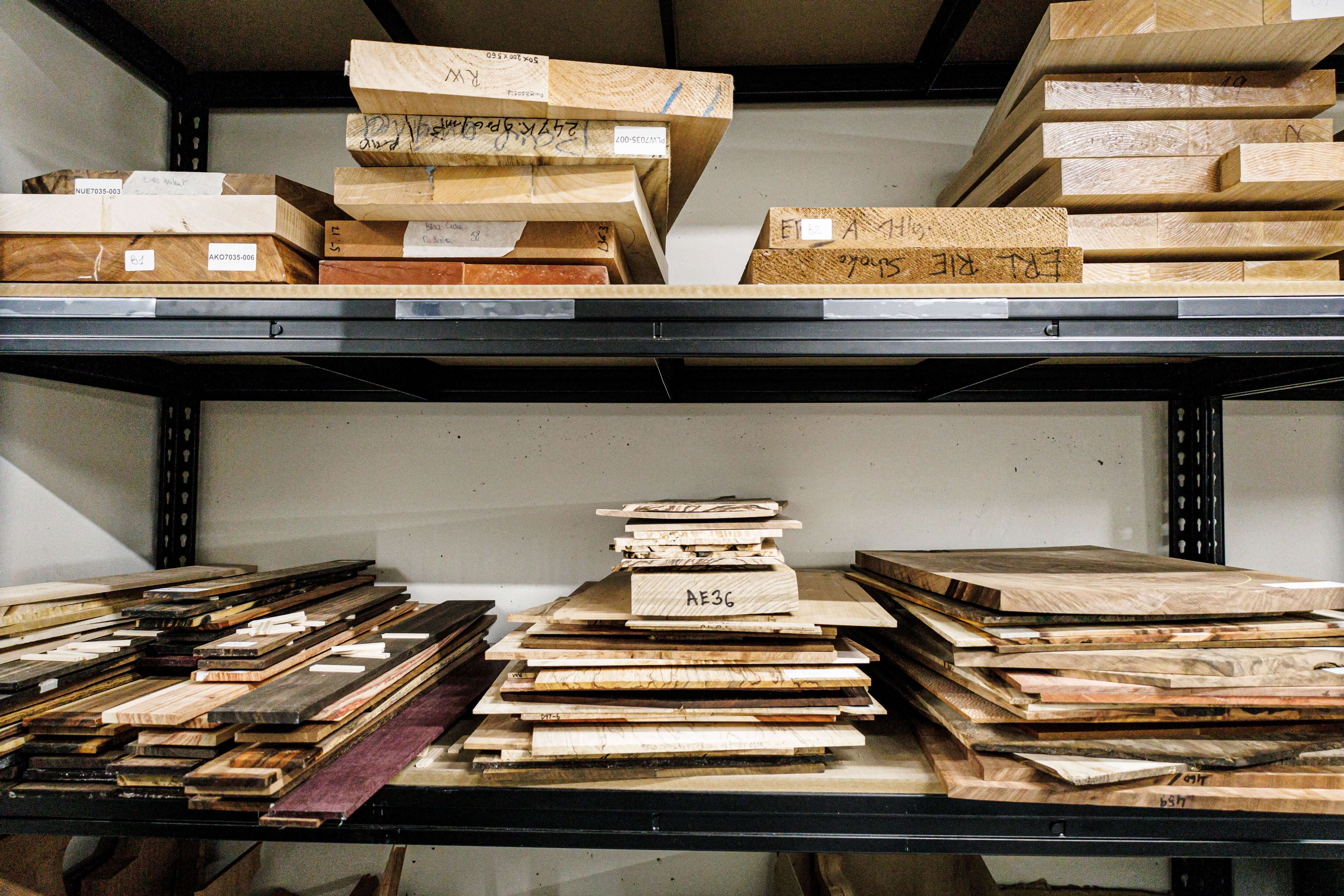
Buy a soundboard set and you buy a letter. AAA. Master Grade. Premium. Somewhere behind that letter is a person who looked at the wood, counted the grain lines, checked for runout and colour, and assigned a tier. Nobody weighed it. Nobody measured how stiff it was along the grain, across the grain, or in torsion.
That's the whole industry, and it has been for a century. The grading language is inherited from a visual tradition and it survives because it is fast, cheap, and legible to buyers looking at a listing photo. It is not a measurement. It is a description of an appearance, sold as a description of behaviour.
The interesting part is that the appearance and the behaviour are only loosely related. That isn't a hunch. It has been tested.
Look at me
Iris Brémaud's review of wood acoustical properties across 452 species, published in the Journal of the Acoustical Society of America in 2012, summarises the grading literature bluntly. Quality classes assigned by makers correlate more closely with visual and physical criteria than with acoustical ones, and the measured properties of wood classified as "good," "medium," and "poor" overlap substantially. Grading works, in the sense that top-grade material sits in a tighter distribution — but the distributions are not separate populations.
A 2021 study by Dinulică, Stanciu and Savin in Forests pushed on the same question with Carpathian resonance spruce, sorted into four commercial quality classes by a violin manufacturer and then measured ultrasonically in all three anatomical directions. Only a handful of variables had real power to separate the classes: radial sound velocity, the longitudinal-radial Poisson ratio, longitudinal velocity, and longitudinal modulus.
Density was not one of them. In their sample, classes A and C came out around 60 kg/m³ heavier than classes B and D — the letter grade and the density didn't move in the same direction at all. If you are paying a premium for a grade because you believe it tells you what the board weighs relative to its stiffness, that is the study that should bother you.
Nine identical guitars walk into a listening room
Here is the part that matters, and it points the other way.
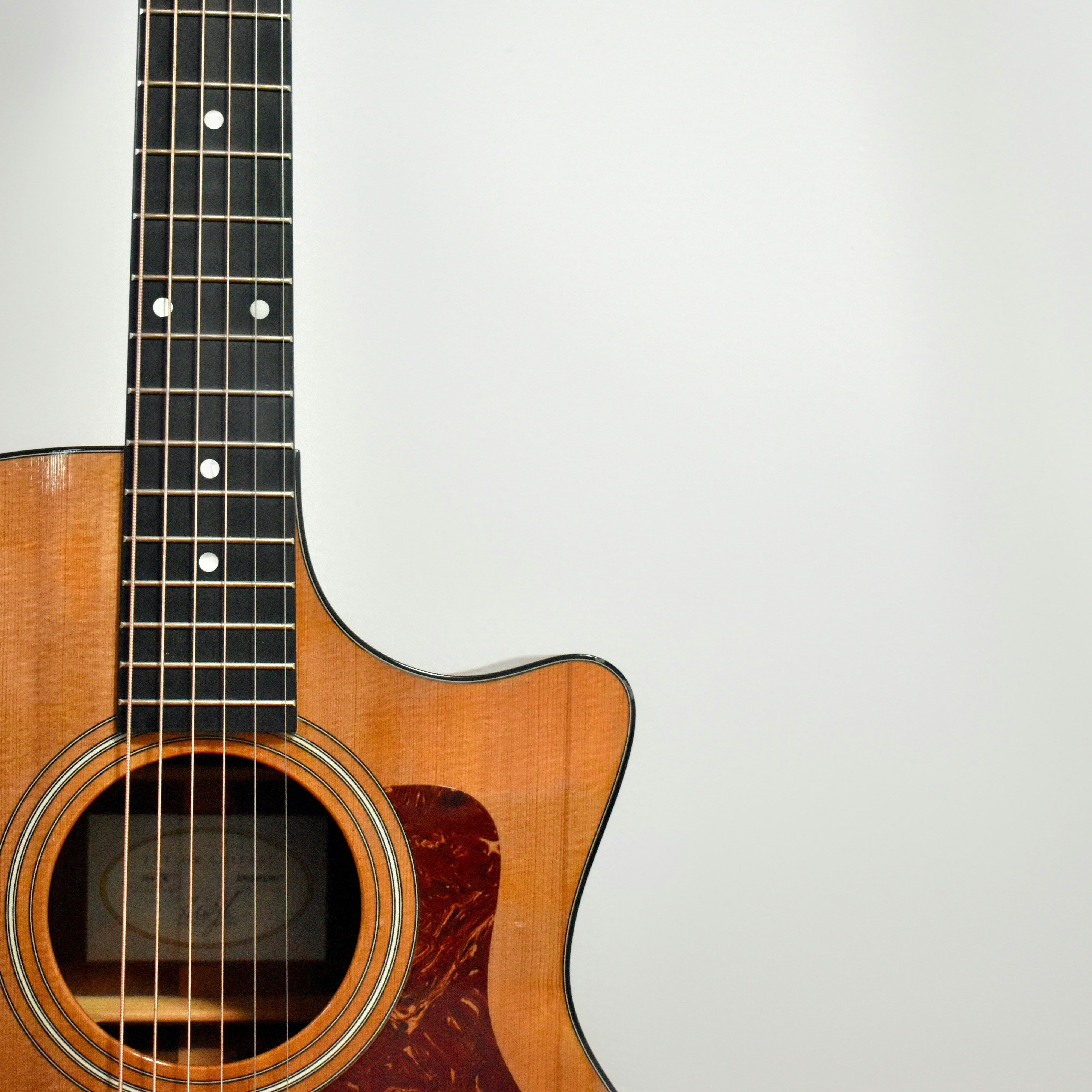
Sebastian Merchel and M. Ercan Altinsoy at TU Dresden, working with David Olson of Pacific Rim Tonewoods, published a study in JASA in 2019 in which nine steel-string guitars of the same model — Taylor 814ce Grand Auditorium — were built varying only two parameters: the density and Young's modulus of the soundboard and bracewood. Same design, same maker, same everything else. The material spread was representative of what PRT actually produces.
Twenty-three listeners then ran a pairwise preference test on recorded music sequences. Across the five instruments in the soundboard-and-brace comparison, the differences in preference were statistically significant. The guitar built from low-modulus, low-density wood was preferred over the high-modulus, high-density one with a p-value below 0.001; the low-modulus, median-density instrument beat it too.
So the variation within a species, invisible in a listing photo, was audible in a blind test. The thing the grading system doesn't measure is the thing people could hear.
Note the direction, because it isn't the one tradition predicts. "Light and stiff" is the standard demand, and here the stiffest material lost. That result belongs to that design — the authors say so explicitly, and the study was supported by Pacific Rim Tonewoods and Taylor Guitars, with one author employed by PRT. A number is only meaningful relative to the instrument you're going to build with it.
Where I have to argue against myself
If measurement always beat appearance, the argument would be tidy. It doesn't.
In 2018, Carcagno, Bucknall, Woodhouse, Fritz and Plack published a study in JASA in which six steel-string guitars were built to identical design and specification, differing only in the back and sides: Brazilian rosewood, Indian rosewood, mahogany, maple, sapele, walnut. Fifty-two guitarists rated them in a dimly lit room wearing welder's goggles. Thirty-one more ran a blinded ABX discrimination test.
The ratings came out very similar across all six. Discrimination performance was barely above chance. Bridge-admittance measurements showed small modal differences that the authors attributed mostly to residual manufacturing variability rather than to the back plates themselves.
Measurement is worth doing where the material does work. On the back and sides of a steel-string, the evidence says it does much less work than the market prices it for. A rating system applied indiscriminately to every board in the shop will generate precise numbers about things that don't matter. Precision is not relevance.
The hammer, unglamorously
Which brings me to the tools. Acousonix, built inside the Galloup School, is the most developed commercial attempt I know of to replace visual grading with measurement.
Two pieces. The Frequency Hammer is a handmade tapper with an OLED readout that returns the dominant frequency of whatever it strikes — plates, billets, assembled instruments — at $450. The Sonic Calculator is the software: you enter the board's length, width, thickness and weight, which gives density, then the resonant frequencies of the long-grain bending, cross-grain bending and twisting modes captured on any well-configured FFT analyser. Out comes a rating and a stiffness value across a range of thicknesses.
None of that is exotic physics. Free-plate vibration analysis is standard practice in wood science for deriving elastic moduli non-destructively, and luthiers have been tapping plates and listening since long before anyone put a number on it. What Acousonix adds is standardisation and a database. Their reference sample geometry for a soundboard is 22 × 8.5 × 0.150 inches, and the point of that is comparability: two boards measured the same way can be ranked against each other and against everything already in the library.
The underlying method is covered by US Patent 11,668,678, "Material selection system and method for constructing a musical instrument," issued to Bryan John Galloup and claiming priority from a provisional filed in September 2018. The patent describes running FFT analysis on material samples, storing the results in a database, and recommending a sample for a given build. Galloup's own materials date the software lineage to a 2014 launch, with the current version extended to archtop billets, necks, brace stock and electric bodies.
The stiffness-at-thickness function is the part I'd actually pay for. It turns "sand until it feels right" into "this board reaches target stiffness at 2.7 mm," which is a different kind of decision.
I use the Hammer as a field tool. It goes to the rack, to the supplier, to a stack of billets I have twenty minutes to look at — situations where I am not going to set up a proper free-free rig and run a full characterisation on forty boards. It returns one number fast, on anything, without preparation. That is exactly what triage requires and exactly what a bench method can't give you.
What it doesn't do is produce a rating. A dominant frequency on its own is meaningless: the same reading comes off a dense stiff board and a light floppy one at different dimensions. Frequency only becomes information once it is paired with mass and geometry. The Hammer tells me which boards are worth carrying back to the bench. The bench does the rest.
Same three words
Here is the awkward part, and I'd rather say it than have it said to me.
The Belforti wood library is sorted into Premium Grade, Master Grade and Private Stock. Those are the same words the industry uses for the thing I have just spent two thousand words describing as a photograph. Nobody owns grading vocabulary, which is precisely the problem — the words are free, so they get used by anyone, attached to anything.
The difference is what sits underneath them. Every board in the library carries a Belforti Rating on a hundred-point scale, and the tier is derived from the number rather than the other way round. Premium is 70 to 79. Master is 80 to 89. Private Stock is 90 and up. Nothing is promoted into a tier because it looked good on the bench that morning.
The inputs are measured, not judged. BING — Beam Identification by Non-destructive Grading, developed by CIRAD — runs vibration analysis to derive mechanical properties. Alongside it: density, Janka hardness, modulus of elasticity, modulus of rupture, FFT analysis, first mode frequency. The Quantified Sustain Potential relates density to Q-factor, which is the damping side of the picture rather than the stiffness side.
That last one matters more than it sounds. Most rating work in this trade concentrates on stiffness and mass because those are the easy measurements. Damping is what determines how fast the energy leaves, and it is where a lot of the audible difference between two boards of identical specific stiffness actually lives.
Seventy is the threshold for a critical component — bodies, necks, fretboards. Below seventy the board isn't rejected; it's reassigned to secondary work. Wood that fails a structural spec is still wood.
So: the Hammer for triage in the field, the full parameter set on the bench, a number at the end of it. The label on the shelf is a consequence of the measurement, not a substitute for it. That's the only defensible way to use a word like Master Grade, and I'm aware that plenty of people using it can't say the same.
Three piles
The trade mixes these together constantly, so I'll separate them.
Measurable. Density, longitudinal and cross-grain modulus, shear modulus, mode frequencies, damping. These are real, repeatable numbers with established methods behind them. Two people measuring the same board carefully will agree.
Craft tradition. Tap it, listen, feel the flex, choose. This works, in the hands of someone with thousands of boards of experience, and it is not mysticism — the tap tone is genuinely carrying stiffness and density information. It just doesn't transfer, doesn't scale, and can't be written into a spec sheet.
Marketing. AAA. Bearclaw as a premium. Tight grain as a proxy for quality. Grade letters with no published criteria behind them. These describe a photograph. They are not lies, exactly — they're honest descriptions of appearance being used as claims about behaviour, which the literature above says is a weak substitution.
Acousonix's own pitch makes a version of this argument: that conventional grading leans on appearance and species names, without standardisation. On that specific point, the peer-reviewed work backs them.
The study nobody has run
Here's what's missing, and it's the same gap every proprietary rating system has.
I could not find a published blind test correlating Acousonix ratings specifically with player or listener preference in finished instruments. Merchel and colleagues are the closest thing, and they used raw density and Young's modulus, not a proprietary composite index. So the honest position is: the inputs to these ratings are measurable and the input-level evidence is good, but the index itself — the single number — has not been validated against ears in public.
The study that should exist is not complicated. Build twelve instruments to one design. Select tops in three rating bands, four per band, with everything else held constant. Run blinded playing and listening tests with enough participants for the statistics to mean something, then correlate rating band against preference. Merchel's group did essentially this with two raw parameters and 23 listeners. Somebody should do it with a rating system.
Until that exists, a wood rating is a materials specification, not a tone prediction. That is still enormously more than a letter grade gives you.
At the bench
The workflow is two-stage and there's nothing clever about it. In the field, tap and read: the Hammer narrows a stack down to the boards worth the trip. On the bench, the full set — mass, dimensions, BING, damping — produces a number, and the number decides where the board goes.
Nobody in this shop selects wood by looking at it. Weigh it. Measure it. Get the modal frequencies. Know what you have before you start removing material, because everything after that is subtractive and permanent.
The grade on the invoice tells you what the wood looks like. It was never asked to tell you anything else.

Partager :
IRYW : Les acoustiques sont plus faciles à construire que les électriques